
Portfolio Kanban: How Enterprise Kanban Works Above the Team
Updated at
The Answer
Portfolio kanban is a board whose cards are whole initiatives rather than tasks. Each card is an epic, months of work with a budget attached, and the board exists to make an organisation admit how many of those it has running at once. SAFe supplies the version most enterprises copy: six states running Funnel, Reviewing, Analyzing, Portfolio Backlog, Implementing and Done, with work in progress limits on the middle three and Lean Portfolio Management owning the system. None of it requires SAFe. Flight Levels and the Kanban Maturity Model describe the same climb above a team board with no framework attached, and whatever the label on the thing, the mechanic is the one from a two-person board. Cap what is in flight, pull the next item when something finishes, count how long it took.
What Is Portfolio Kanban?
Portfolio kanban is a kanban system whose cards are epics rather than tasks, so the board shows what an organisation has committed to instead of what somebody is doing this afternoon. One card might be a payments rewrite. Another might be entering a new market. Both run for months, both consume several teams, and both stay invisible on a team board, because a team board only ever shows the slice currently in someone’s hands.
That invisibility is why the pattern exists. Six teams can each keep a disciplined board of four items while the company as a whole is spread across nineteen initiatives, none of them finishing. Nobody chose nineteen. It accumulated one urgent request at a time, and the only place the number would ever have shown up is a board nobody had drawn.
Enterprise kanban is the wider label, covering every board above the team including the coordination boards in between. Scaling kanban does not mean adding ceremonies. It means running the same three practices at a bigger item size: make the work visible, limit how much is in flight, measure how long it takes to get through. The grain changes and the clock changes with it. A team board gets walked every morning, while a portfolio board gets a serious look once a quarter, which is about as often as a decision at that altitude can honestly be revisited.
The most copied version of that board comes from SAFe, and it has six named states.
What Are the States of the SAFe Portfolio Kanban?
The SAFe portfolio kanban has six states, running Funnel, Reviewing, Analyzing, Portfolio Backlog, Implementing and Done. Ideas land in the Funnel with no filter on them at all, which is deliberate, since a funnel that rejects things stops receiving them. Reviewing asks the cheap question of whether an idea deserves a business case. Analyzing writes that case. The portfolio backlog holds approved epics ranked by Weighted Shortest Job First while they wait on capacity, Implementing is where the trains build the thing as features, and Done means delivered and, if the organisation is being honest with itself, checked against whatever the business case promised.
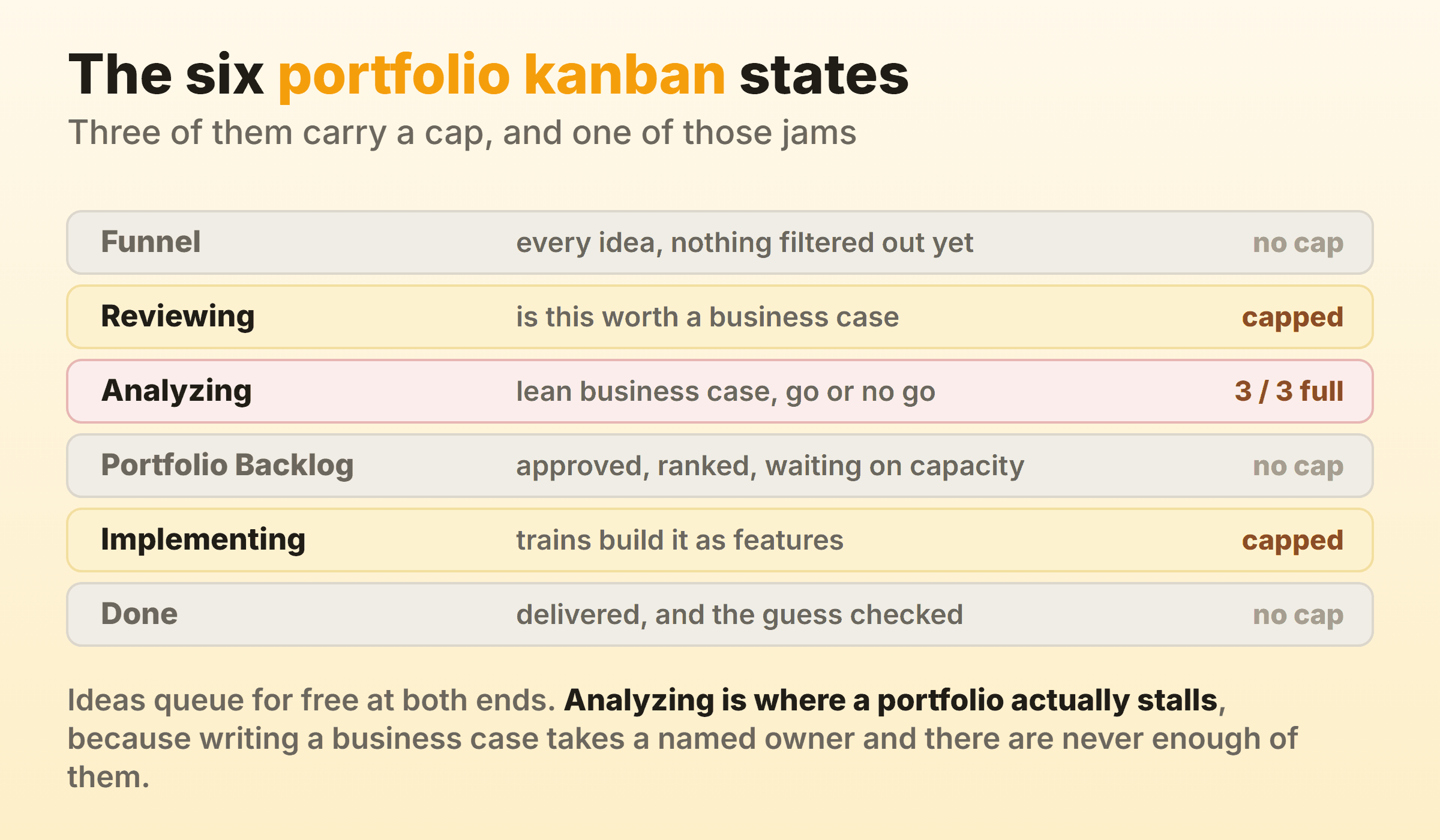
Three of those states carry a work in progress limit and three do not. Funnel and the portfolio backlog stay uncapped on purpose, because queuing an idea costs nothing until somebody starts work on it. Done is never capped anywhere. The caps live on Reviewing, Analyzing and Implementing, the three states where people are actually spending their time.
The Analyzing Step of the Portfolio Kanban
The analyzing step of the portfolio kanban is where an epic gets a lean business case and a go or no go decision. It is also the state that jams. Writing a business case takes a named Epic Owner, several conversations with people who never asked for the epic, and usually a number somebody has to go away and find. Portfolios routinely split the state into Analyzing (doing) and Analyzing (done) sub-columns for that reason, since a finished case waiting on a decision is otherwise indistinguishable from one still being written.
If your board has one obvious queue in it, my money is on this state.
Classes of Service on the Portfolio Kanban
Classes of service on the portfolio kanban are the classic four, expedite, fixed date, standard and intangible, and they describe the cost of delay on an epic rather than the kind of work it is. SAFe’s own guidance is that adding them lets high priority items move through the system quickly while total work in progress stays capped. An expedite epic jumps the queue and takes a slot somebody else was using, and that trade is the entire reason for naming the class out loud, because a portfolio that expedites everything has simply raised its WIP limit without admitting it.
Do not confuse a class of service with an epic type. SAFe has two epic types, business and enabler. Business epics deliver something a customer notices. Enabler epics build architectural runway, the platform and infrastructure work that later business epics quietly depend on. Both flow through the same six states and either can carry any class of service. Portfolios that want to protect the second kind give it a lane of its own or a fixed share of the WIP limit, so it cannot be starved by whatever is loudest this quarter.
Who Is Responsible for Managing the Portfolio Kanban?
Portfolio Leadership is responsible for managing the portfolio kanban, working alongside the Value Management Office, while an Epic Owner coordinates one epic’s progress through the states. That is SAFe’s own answer on its portfolio backlog page, and the phrase people are usually hunting for is Lean Portfolio Management, the function those roles sit inside.
Split it in two and it makes more sense. The system belongs to a group, being the people who can move money, the enterprise architects who can say whether a thing is buildable, and the business owners sponsoring it. A single card belongs to one person. The Epic Owner carries an idea through Reviewing and Analyzing, writes the business case, and stays with it while the trains implement it.
The failure mode here is a board owned by a committee and therefore by nobody. Every state has a group name against it, no card has a person’s name against it, and epics sit in Analyzing for two quarters while everybody assumes somebody else is drafting the case. Whoever chairs the review meeting owns the board in practice. Saying that out loud beats letting the org chart imply it.
How Do the Kanban Systems in SAFe Fit Together?
SAFe runs a kanban system at every level of the framework, and the boards connect by splitting cards rather than copying them. The portfolio kanban carries epics. Under it, the solution kanban carries capabilities, which only portfolios big enough to run several trains against one solution ever need. The ART kanban carries features. The team kanban carries stories.
Naming trips people up here, because it changed. SAFe 6.0 replaced program terminology with ART terminology across the framework, partly to stop people reading it as waterfall programme management, so what a generation learned as the program kanban is now the ART kanban, running at the Agile Release Train level. Search behaviour has not caught up. People still type program kanban, safe program kanban and kanban program management, and every one of those means the board sitting between the portfolio and the teams.
An epic reaching Implementing does not turn up on a team board as an epic. It gets broken into features that live on the ART board, and those get broken into stories on the team boards. One piece of work, three sizes, three boards. The rule that keeps this honest is that the same work never appears twice at the same size. Copy an epic onto a team board as a card called “payments rewrite” and within a fortnight the two boards will disagree about whether it is finished.
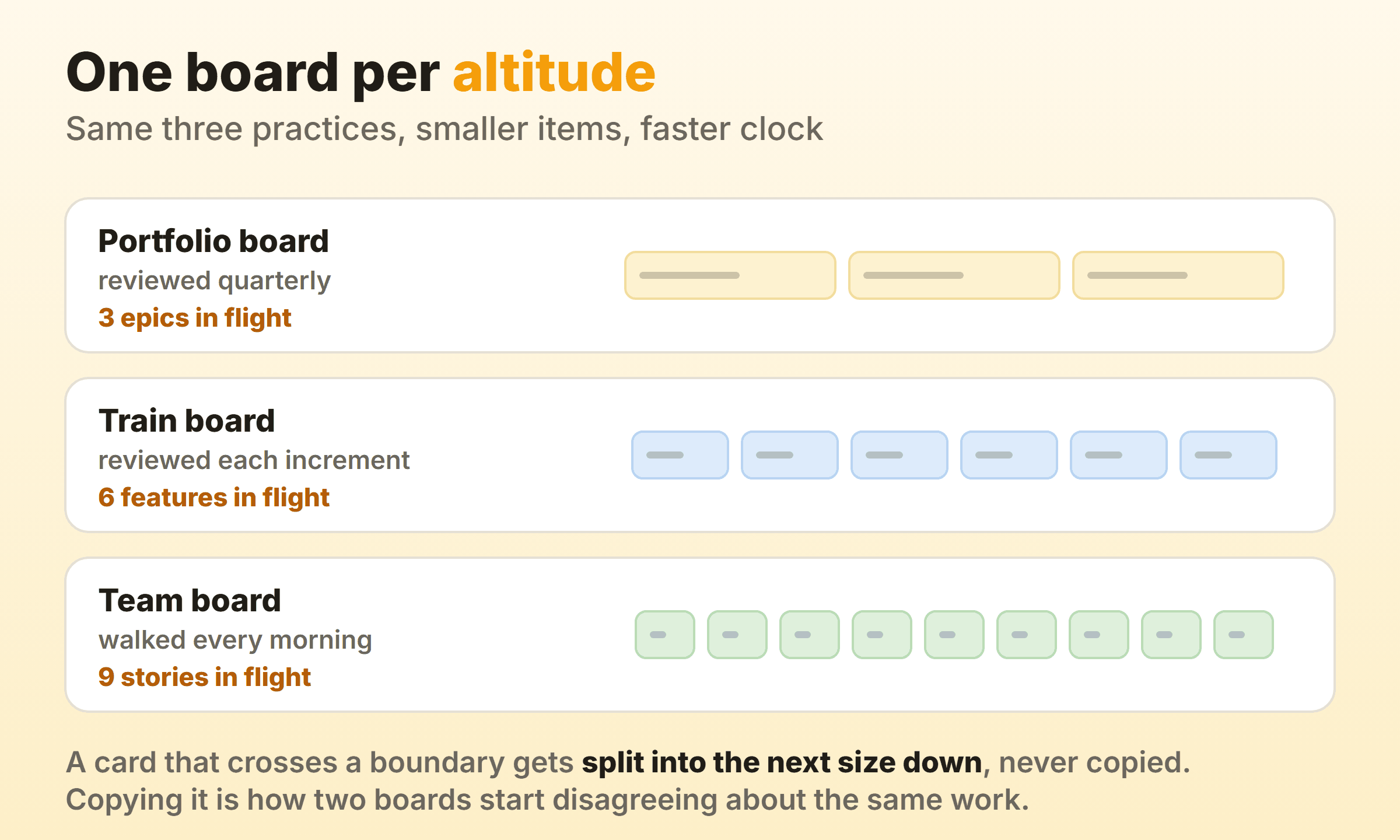
Each board also answers a different question. The team board answers what we are doing today. The ART board answers what ships this increment, and the portfolio board is answering something with a much longer half-life, which is what the company has said yes to and can therefore no longer say yes to something else instead. Running a daily standup at portfolio level wastes everybody’s morning.
How Do You Scale Kanban Without SAFe?
You scale kanban without SAFe by adding boards above the team and connecting them, and that is genuinely most of it. The framework supplies vocabulary, a role set, a certification market and a shared language for people who have never met. The mechanic underneath is a queue with a cap on it. The official Kanban Guide does not tell you how to scale at all, defining three practices and stopping there, which leaves everything above one team to your judgement.
Flight Levels
Flight Levels is the best known alternative, a thinking model from Klaus Leopold that asks where in an organisation you need to intervene rather than what process to install. There are three of them. Flight Level 1 covers the operational work of individual teams or departments. Flight Level 2 covers coordination, the cross-functional workflows where several teams have to agree on an order. Flight Level 3 is strategic, bridging the gap between what leadership decided and what is actually being built.
Flight Levels ranks nothing, which is the thing people most often get wrong about it. Level 3 does not beat level 1 and there is no graduating upward. It is a map for working out where the problem lives, and the answer comes back as level 2 more often than anyone expects, because a great deal of delivery pain is coordination pain wearing a team-shaped costume. A kanban flight level diagnosis quite often ends with nobody touching their team board at all.
Which is the opposite of the other well known model above the team board. That one does rank.
What Is the Kanban Maturity Model?
The Kanban Maturity Model is a seven level map of organisational maturity from David J. Anderson and Teodora Bozheva, published through Kanban University and the David J. Anderson School of Management. Its second edition sorts 150 practices across those seven levels, which makes it less a scorecard for where you are and more a shortlist of what to try next. Three pillars run through the whole thing: culture, kanban practices, and outcomes.
The levels run ML0 Oblivious, ML1 Team-Focused, ML2 Customer-Driven, ML3 Fit-for-Purpose, ML4 Risk-Hedged, ML5 Market Leader and ML6 Built for Survival.
An enterprise kanban conversation should care about the ordering rather than the labels. Practices belong at a level, and dropping an upper-level practice onto an organisation that has not done the lower ones is how transformations end up producing binders. A portfolio board is an upper-half practice. Where the teams underneath it have no caps, no written policies and no cycle time data, the portfolio board becomes a status report with rounded corners, and the quarterly review turns into eleven people explaining why their epic is still amber.
I have sat in that meeting. The board was accurate. Nothing on it moved.
The order that works is the boring one, which is getting a team board genuinely working first, then a coordination board across the teams that trip over each other, then the portfolio.
How Do You Set WIP Limits on a Portfolio Kanban?
Set the WIP limit on each portfolio kanban state from the resource that state actually consumes. Analyzing consumes Epic Owners, so cap it at the number of people who can genuinely write a lean business case this quarter, which in most portfolios is three or four rather than the twelve names on the org chart. Implementing consumes trains, so cap it at the number of epics your ARTs can carry in parallel without every train touching all of them at ten percent each.
Reviewing earns a cap for a different reason. Nothing expensive happens in Reviewing, but leave it uncapped and it quietly becomes a second funnel, at which point the review meeting turns into a two hour reading exercise.
The honest starting number is whatever you already have. Count the epics in flight today, write that number on the column, then take one off each time something finishes, until the number starts to hurt. Setting a cap below current WIP on day one means breaking it on day one, and a limit everybody is already violating gets ignored inside a month. WIP limits behave the same way at every altitude. The portfolio is simply where breaking them is most tempting, because the person asking for the exception usually outranks the person defending the number.
That last point deserves saying plainly. A portfolio WIP limit is a political object before it is an operational one, and it holds only when a named executive has agreed to be the one who says no.
What Does a Portfolio Kanban Board Need From a Tool?
A portfolio kanban board needs a card roomy enough to hold an epic’s worth of context, a per-column limit that shows visibly when it has been broken, and cycle time measured at the epic grain. The fourth requirement is where tools separate, and it is a link between an epic and the smaller items underneath it. Jira Align, Planview and the enterprise tiers of the older portfolio tools exist largely because parent-child hierarchy across separate boards is hard to build. Generic board tools do not have it. The workaround is the split discipline described above plus a link in the epic card.
Measurement matters more than hierarchy, in my experience. An epic’s cycle time from Analyzing to Done is the one number that changes portfolio conversations, because it converts a vague feeling that the company should start fewer things into a median in months that nobody in the room can argue with. A cumulative flow diagram at the epic grain tells the same story as a picture, and the widening band is usually the portfolio backlog.
Where our own tool sits in this is worth being straight about. Kanbanee caps columns individually, with a badge showing the count against the limit that turns red once a column goes over, and the Pro plan at $6 a month adds weekly throughput, a cumulative flow diagram and cycle time. It has no epic hierarchy, no API and no realtime sync. That makes it the wrong choice for a twelve-train portfolio running Jira Align, and a reasonable one for the coordination board three or four teams share, which is the level most companies actually need and skip.
FAQ
What is one way kanban boards are used in SAFe?
Kanban boards are used in SAFe to manage the backlog and the flow of work at every level of the framework, so the answer most exams are looking for is that a kanban board visualises a backlog and limits the work in progress moving through it. Portfolio epics, solution capabilities, ART features and team stories each get their own board. Each board is what turns its backlog from a ranked list in a document into something with a visible flow rate.
What does SAFe Team Kanban promote?
SAFe Team Kanban promotes flow. It is the method a SAFe team uses to visualise its work, set WIP limits and improve how work moves through the team, as documented in the SAFe Team Kanban guidance. In exam wording that comes out as promoting flow and continuous improvement instead of time-boxed commitment, which is the practical difference from a scrum team on the same train.
Is the portfolio kanban the same thing as the portfolio backlog?
No. The portfolio backlog is one state inside the portfolio kanban, the queue holding approved epics that are waiting on capacity. SAFe’s own page for the portfolio backlog describes it as a kanban system, which is where most of the confusion starts. Treat the kanban as the whole six state pipeline and the backlog as the holding pen sitting in the middle of it.
How is the flow of portfolio epics managed?
The flow of portfolio epics is managed by limiting how many sit in each state and pulling the next one only when a slot opens up. Importance decides the order of the queue. The free slot decides the timing, and that division is what separates a portfolio kanban from a prioritised spreadsheet, since a spreadsheet will happily let you rank ninety things and start forty of them.
How many epics should be in flight at once?
Fewer than you have. No published right number exists, and anybody offering you one is guessing, because it depends entirely on how many teams an epic consumes and how long it holds them. The usable version of the question is what your current number is, which most portfolios cannot answer on the day they first draw the board. Count, cut, then watch whether epic cycle time drops.