
What Is Kanban? Meaning, Boards and How It Works
Updated at
The Answer
Kanban is a method for managing work by making it visible and capping how much of it runs at once. The word is Japanese for signboard, and the first kanban was a paper card telling a Toyota production line to make more of something. Knowledge-work kanban kept the mechanic and swapped the props. Work items become cards on a board, columns stand for the stages those cards pass through, and busy columns carry a limit on how many cards they may hold. Nothing new starts until something finishes and frees a slot. That one rule is the whole difference between a kanban system and an ordinary task board, and it is why capping a column speeds a team up without anyone working longer hours.
What Does Kanban Mean in Japanese?
Kanban in Japanese means signboard, written 看板. The two characters are 看 (kan, to watch or look at) and 板 (ban, a board or plank), so the literal reading lands near “a board you look at”. Jisho’s dictionary entry gives signboard, sign, billboard and hoarding. Walk down a street in Osaka and the kanban are the shop signs hanging overhead, none of them anything to do with software.
The business meaning arrived from Toyota’s factory floor, where a kanban was a physical card clipped to a bin of parts. Empty the bin and the card travelled back up the line, carrying the permission to build more.
So the meaning of kanban splits in two. The kanban meaning in Japanese is still a shop sign and always was. The kanban definition used in delivery work is narrower and borrowed, and it comes down to a visual signal that authorises work, with boards and columns and limits built on top. Ask three practitioners to define kanban and you will get that second version three times.
In the manufacturing literature a kanban is a countable object, and a plant might have four hundred of them circulating. Software uses the word as a mass noun for the method. That is why “what is a kanban” and “what is kanban” get you the same answer everywhere.
How Does Kanban Work as a Pull System?
Kanban works by pulling work instead of pushing it. In a push system somebody else decides what you start next, usually a schedule or a manager or your own free half hour. In a pull system the trigger is capacity. A slot opens in a column, and only then does the next item move in. Same people, different rule about what begins next.
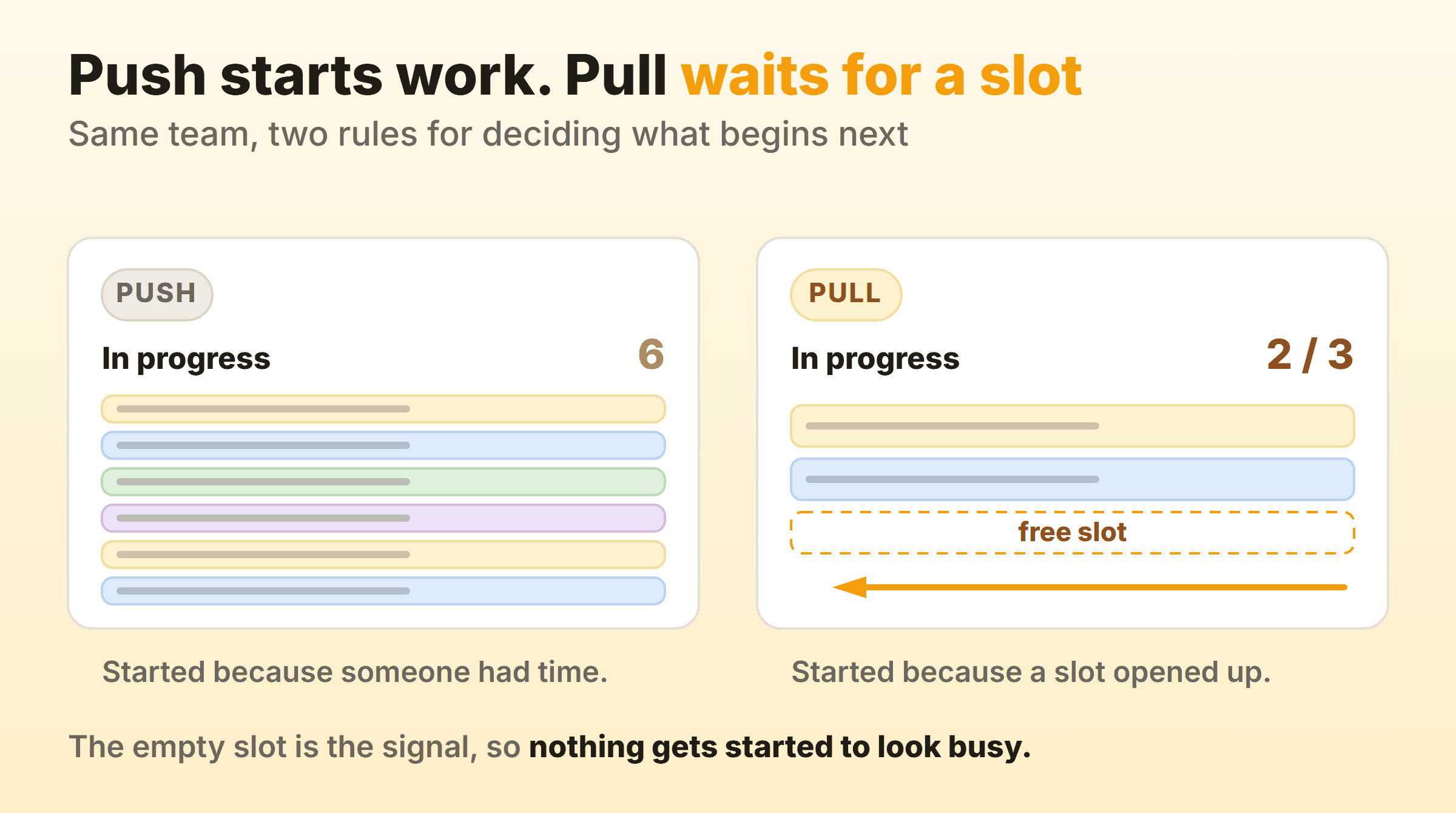
Strip the kanban system definition back and it is that one sentence. The arithmetic underneath is unglamorous. A team running twelve items at once and finishing three a week takes four weeks per item. Cut the twelve to four and the same three-a-week output delivers each item in a bit over a week. Output never changed. The wait collapsed, because the queue in front of each item got shorter.
Behaviour shifts before the numbers do. When a column is full, the honest answer to “can you also look at this” becomes “yes, once this finishes”, and the conversation happens against a visible board instead of somebody’s memory.
What Is a Kanban Card?
A kanban card is one unit of work made visible: a bug, an article, a customer request, a bin of parts. On a physical board it is a sticky note. In software it carries a title, an owner, a due date and whatever else the team needs to decide without opening a second system.
People read a card as a task description. It behaves like a parking permit. Every card in a column occupies one of that column’s slots, and the occupancy is what gives a WIP limit teeth.
One-Card and Two-Card Kanban Systems
A one-card kanban system uses a single card per container, and that card does both jobs, authorising production and releasing the move. When a bin empties, its card goes back to the supplying stage as an order to refill. Simple, and it holds up when the two stages sit close enough that transport is trivial.
A two-card kanban system splits the signal. A withdrawal kanban authorises moving parts from a store to the next stage, and a production kanban authorises making replacements. Toyota ran the two-card version because its stages sat far apart. Software boards rarely need the distinction, though the capped ready queue between a backlog and the board does something similar.
What Is a Kanban Board?
A kanban board is the display surface for a kanban system, with columns for stages, cards for work items, and limits on the columns where work collects. Three columns get most teams started. To do, Doing, Done. Add a fourth only when work genuinely waits somewhere the current board hides, which in my experience is almost always a review or approval step nobody had drawn.
Plenty of task boards look identical and are not kanban. Columns get named for what is happening to the work, so a column called “In review” tells anyone the state of the card sitting in it. A column called “With Sam” dies the week Sam changes team. At least one column also carries a number. There is more on both in the guides to kanban board columns and WIP limits, including how to pick your first cap.
Tools muddy this with the phrase kanban view. Switch a Notion database or a Jira project to kanban view and the rows turn into cards in columns, which is a display setting and nothing more. A kanban view with no limits on it is a task board wearing kanban clothes. Easier to read than a list, and it will not change how much you start.
What Are the Six Practices of the Kanban Method?
The kanban method rests on six practices, and they are what turn a board into a system:
- Visualise the workflow. Draw the real kanban workflow, waiting stages included.
- Limit work in progress. Cap the columns where cards pile up.
- Manage flow. Watch how work moves and where it stops.
- Make process policies explicit. Write down what done means per column and who may pull.
- Implement feedback loops. Review the board and the numbers on a regular beat.
- Improve collaboratively, evolve experimentally. Change one thing, measure, keep or revert.
Kanban University’s guide calls this a method and refuses the word framework, and the distinction has a practical consequence. A framework replaces your process, so adopting scrum means new roles and a new cadence before anything improves. A method sits on top of the process you already run, which is why a rollout needs no reorganisation and nobody’s job title changes on day one. Kanban framework, kanban model and kanban process all get used for the same thing in conversation. The longer treatment lives in the kanban methodology.
The practice count is not settled either. The separate Kanban Guide by Daniel Vacanti and John Coleman compresses the same ground into three: define and visualise the workflow, actively manage the items in it, and improve the workflow. Same ideas, fewer bullet points. If two sources hand you different numbers, that is why.
What Do Kanban Metrics Measure?
Kanban metrics count the movement of work, and a board that has run honestly for a month produces every one of them without anyone filling in a form.
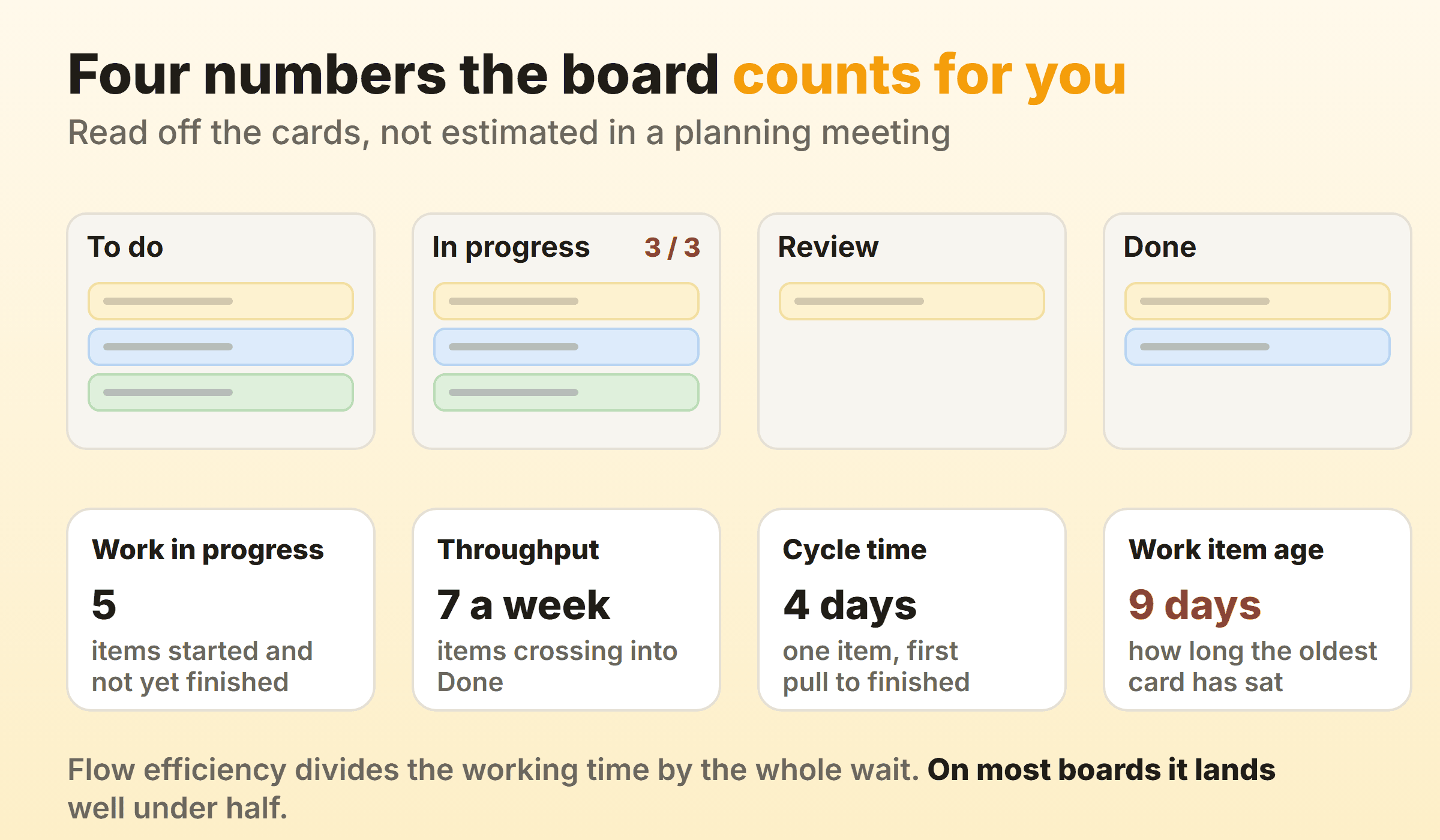
| Term | What it means |
|---|---|
| Work in progress (WIP) | How many items have been started and not finished. Count them right now. |
| WIP limit | The maximum number of cards a column may hold. The cap, not the count. |
| Throughput | How many items cross into Done per week. |
| Cycle time | How long one item takes from the moment work starts to the moment it finishes. |
| Lead time | The customer’s wait, clocked from the moment they asked. |
| Work item age | How long the card sitting in a column right now has been in progress. |
| Flow efficiency | Working time divided by total elapsed time, as a percentage. |
| Service level expectation | A forecast of how long an item should take, quoted with a probability. |
| Cumulative flow diagram | A stacked area chart of how many items sat in each stage on each day. |
Work item age is the one to check in a standup, because it points at the card quietly rotting while everybody discusses the one raised yesterday. Nobody enjoys measuring flow efficiency. Every board I have measured came in under fifty percent, which means most of an item’s life is spent waiting. And the service level expectation, defined in the Kanban Guide as a forecast with a confidence level attached, is what you say to a stakeholder instead of guessing. “Eighty-five percent of items like this finish within nine days” beats “probably next week” in every conversation I have had.
None of it requires estimation, because the board already knows when each card moved. Kanban metrics covers reading a cumulative flow diagram and what to do when the bands widen.
Where Did Kanban Come From?
Kanban came from Toyota in the late 1940s, developed by Taiichi Ohno as part of what became the Toyota Production System. The inspiration was a supermarket. Ohno noticed shelves were restocked only as customers emptied them, with no schedule and no forecast involved, and he built the same signal into the factory. Cards told upstream stages to produce. No card meant no production.
Ohno wrote the system up in Toyota Production System: Beyond Large-Scale Production, published in Japanese in 1978 and in English a decade later. The card is one piece of a larger just-in-time argument about inventory, and inventory is the part that translates, because a half-finished feature is stock on a shelf, costing money and going stale while it waits.
David J. Anderson brought the ideas to knowledge work in the mid 2000s, first at Microsoft and later at Corbis, publishing Kanban: Successful Evolutionary Change for Your Technology Business in 2010. That book is where the six practices come from. Physical cards became columns on a screen and parts became work items, but the claim survived the move intact. Limit what is in the system and the system moves faster. Pull, flow and queue all come out of lean manufacturing, which is why kanban vocabulary still sounds unlike the rest of the agile world.
What Is Kanban Used For?
Kanban is used for any process where discrete pieces of work flow through repeatable stages, which is a wider net than most people expect. Most English speakers meet kanban for software development first, usually on a team doing continuous delivery whose priorities shift mid-week. Support desks run boards because tickets arrive unpredictably and a sprint boundary means nothing to them. Marketing teams, recruiters, legal departments and university admissions offices use the same shape.
Kanban in project management handles the delivery layer and stays quiet about everything else. It tells you what is in flight, what is stuck and how long things take. Budgets, procurement and stakeholder negotiation all sit outside its scope, so kanban project management works alongside a project manager and replaces none of the job. The benefits of kanban land as shorter waits. Output usually holds steady, which is worth saying before anyone promises a productivity gain.
Where it struggles is work with a hard external date and a scope agreed months ahead. A construction schedule or a regulatory submission needs a plan with dependencies, and continuous flow is the wrong shape for that.
How Is Kanban Different From Scrum?
Kanban differs from scrum over the fixed time box. Scrum commits to one and kanban does not. Scrum runs sprints of a month or less, defines three accountabilities, and holds sprint scope steady once planning ends. A kanban team has no iterations, caps work in progress instead of scope, and reprioritises on a Tuesday afternoon if it needs to.
No sprint means no sprint planning, no velocity, no burndown chart and no commitment ceremony. A short replenishment meeting takes over the planning job. Throughput does what velocity did, and the burndown has no equivalent at all, so kanban teams read a cumulative flow diagram to see where work is piling up.
Kanban vs scrum covers cadence, roles and metrics side by side if you are choosing. The narrower questions have their own pages: whether kanban has sprints, what scrumban keeps from each, and whether kanban counts as agile given that it predates the manifesto by fifty years.
How Do You Start Using Kanban?
- Draw the process you actually run. One column per real stage, waiting states included. Do not tidy it up, because the mess is the information you came for.
- Put every in-flight item on the board. All of it, including the thing someone started in March. Every team I have done this with had two or three times the count the standup implied.
- Cap the column where cards pile up. A workable first number is the count of people who pull from that column, plus one. Adjust after a fortnight of evidence.
- Write the policies on the board. What done means per column, who pulls next, and the rule for a genuine emergency.
- Wait two weeks before changing anything else. You need flow data before you have opinions worth acting on.
Most kanban software handles steps one and two, and any of them gives you a visual kanban system by the end of an afternoon. Step three is where tools differ, and it is the one that matters. In Kanbanee, WIP limits are off by default and switched on per column from the column menu, and once set the column counter becomes a count / limit badge that turns red the moment you go over. The limit is soft, so a drag is never blocked. You get the red badge and the decision stays yours.
Give it a month before judging any of it. The board is accurate from day one, and the numbers showing where delay actually sits need a few weeks of finished cards behind them. Nine times out of ten they point at a queue in front of review.
FAQ
Is kanban capitalized?
Both forms are in use and neither is wrong. Kanban University and much of the formal literature capitalise Kanban when naming the method, keeping lowercase for the Japanese word and the physical card. Plenty of practitioners, this guide included, write it lowercase throughout on the grounds that nobody capitalises scrum either.
What is the primary goal of kanban?
A smooth, predictable flow of finished work. Utilisation is the trap here. A team can be one hundred percent busy and deliver almost nothing, and kanban exists to make that gap visible before closing it.
What is WIP in kanban?
WIP stands for work in progress, meaning every item started and not yet finished. The WIP limit is the cap on that number for one column. People use the two terms interchangeably, so check which is meant when somebody says “our WIP is three”.
Is kanban the same as a kanban board?
No. The board is the tool and kanban is the method that gives the board its rules. You can buy a whiteboard and stick cards on it in an afternoon without adopting any of the practices, and thousands of teams have. A board becomes kanban when the columns are capped and the policies are explicit.
Explore the Kanban Guide
Board anatomy
- Kanban board columns - how many, what to name them, and the queue column that exposes bottlenecks.
- WIP limits - picking your first number and what to do when you breach it.
Comparisons
- Kanban vs scrum - cadence, roles, planning and metrics side by side.
- Kanban vs sprints - what replaces sprint planning when there is no time box.
- Scrum vs kanban vs scrumban - the hybrid, and the three versions teams run.
- Kanban vs agile - whether a method from 1948 counts as agile.
- Kanban vs gantt - two different axes doing two different jobs.
- All the comparisons - every versus question in one place.
Running the method
- Kanban methodology - the six practices, and method versus framework.
- Kanban principles - change principles, delivery principles, classes of service.
- Kanban metrics - cycle time, throughput and the cumulative flow diagram.
- Kanban planning - replenishment meetings and forecasting without estimates.
- Kanban backlog - how a backlog works with no sprint, and why the queue is capped.
- Kanban meetings - the seven cadences and the three most teams need.
Start here
- How to use kanban - the first board, the first cap, and the habits that keep it honest.
- Implementing kanban - a rollout that survives contact with the process you already run.
- Benefits of kanban - what improves, and what stays exactly the same.
- Kanban meaning - the Japanese word, and how it ended up on a software board.
- Kanban glossary - the vocabulary, defined once.
- History of kanban - Toyota, Ohno and the route into software.
The system underneath
- Kanban system - what makes a board a system rather than a wall of cards.
- Kanban process - mapping the process you already run before changing it.
- Kanban workflow - naming states after what happens to the work.
- Pull system - why nobody gets handed work.
- Kanban roles - the roles the method asks for, which is none.
- Types of kanban - production, withdrawal and signal kanban, and the two-bin loop.
More board anatomy
- What is a kanban board - the parts, and what the board demonstrates.
- How to create a kanban board - columns first, caps second.
- Kanban cards - what belongs on the front of a card.
- Swimlanes - when a lane earns its row.
- Kanban view - the board as one view over records you already keep.
- Board examples - column sets that hold up in real use.
- Physical boards - walls and sticky notes, and where they stop.
Inside the tools you already pay for
- Kanban in other tools - the board view hiding in the apps your team already has.
- Kanban tools - the roundup, the free tiers and the self-hosted options.
Where teams run it
- Kanban use cases - the teams and the shapes of work that fit.
- Then by team: software teams, sales, enterprise and students.
On the factory floor
- Kanban in manufacturing - where the cards came from.
- E-kanban - the electronic signal that replaced the card.
- Kanban inventory - bins, racks and the reorder point.
- Lean and kanban - how the two fit together.
Learn it properly
- Kanban books - the short shelf worth the money.
- Kanban certification - the bodies, the classes and what they cost.
- Kanban games - simulations that teach flow faster than reading does.