
Kanban Pizza Game and the Other Kanban Games Worth Running
Updated at
The Answer
The Kanban Pizza Game is a facilitated workshop simulation from agile42 where small teams build paper pizzas against a shared oven constraint, published free under a Creative Commons Attribution-NonCommercial-ShareAlike 4.0 licence, and it wants one to two hours and at least four people per team. Four rounds. The first runs with no process at all, the second introduces a board and WIP limits, the third adds a second recipe with customer order cards, and the fourth hands the policies back to the players. Featureban and getKanban reach the same lesson using cards and dice instead of scissors. Kanban EV is a different animal, a tabletop board game by Vital Lacerda about running an electric vehicle factory, and it will not change how your team works. A Monte Carlo simulation gets called a kanban simulation too, though it runs on your team’s recorded throughput rather than paper, resampling the last few months several thousand times to say when a backlog is likely to finish.
What Do People Mean by a Kanban Game?
People mean three different things by a kanban game, and search results serve all three on one page. The first is a facilitated simulation you run in a room, of which the Kanban Pizza Game is the best known. The second is Kanban EV, a commercial board game that borrowed the word for its factory theme. The third is a Monte Carlo simulation, which coaches shorten to kanban simulation and which needs no props at all.
Sorting that out first saves money. Somebody who buys a $550 getKanban kit when what they wanted was a forecasting spreadsheet has made an expensive category error. Start with the pizza game, since that is what most people mean by default.
What Is the Kanban Pizza Game?
The Kanban Pizza Game is a hands-on simulation created by agile42 in which competing teams assemble paper pizzas, watch their own improvised process fall over, and then rebuild it with a visible board and WIP limits. agile42 gives away the whole kit under a Creative Commons Attribution-NonCommercial-ShareAlike 4.0 licence, which covers internal use at no cost. The Agile Alliance also hosts an older all-included PDF of the game, which carries the earlier Attribution-ShareAlike 3.0 Germany licence, so check which copy you are working from before you build a paid workshop on it.
Pizza is arbitrary, and that is deliberate. Nobody in the room holds a professional opinion about the correct way to assemble a paper Hawaiian, so the argument stays about flow instead of migrating into your codebase.
What You Need to Run It
You need coloured Post-its in yellow, pink and green, plain printer paper, red markers, two kinds of tape, scissors, and a stopwatch everyone can see. The printed pieces come from the download: order cards, the oven plate diagram, the rule sheets and the slides. agile42 puts the floor at four people per team, and it only really works with two or more teams racing the same clock.
Budget two hours. One hour is the stated bare minimum and it buys you the mechanics with the debrief cut off at the knees, which is the part that actually transfers.
How the Four Rounds Work
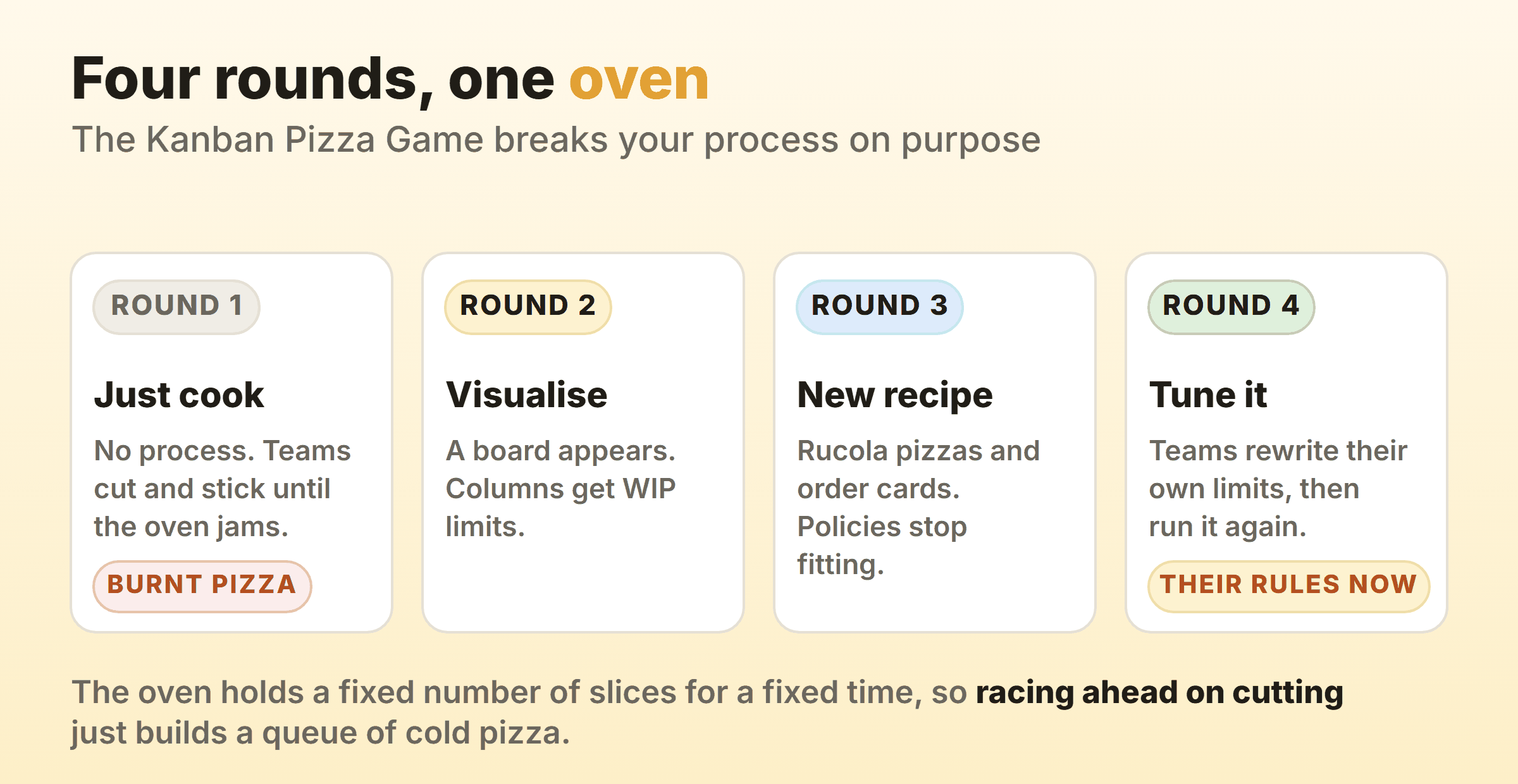
Each round breaks the process the previous round settled on. Round one gives teams five to seven minutes, the Hawaiian recipe and nothing else, so they build by instinct. Then everything stops for round two, which introduces the kanban vocabulary and asks each team to draw a board and put WIP limits on it. A Rucola recipe and customer order cards arrive in round three, promptly invalidating whatever policy the team wrote twenty minutes earlier. Round four belongs to the teams, who change the limits, the hand-offs and the batch sizes, then run it once more.
The oven does the teaching. It holds a fixed number of slices and it takes a fixed time, so a team that races ahead on cutting and topping is manufacturing a queue of cold pizza in front of a machine that does not care how fast they are. Most rooms work that out inside the first minute of round one. On a live board the same realisation takes a quarter, if it lands at all.
What the Pizza Game Actually Teaches
A busy station and a productive station have nothing to do with each other. Round one always produces somebody cutting bases at speed while the oven sits half empty, and watching that happen to paper is cheap.
The second lesson lands in round two, when output drops. Teams put limits on and immediately deliver fewer pizzas in the same window, which feels like proof the limits are wrong. It is proof they are working, because what vanished was the half-finished inventory piled between stations. Feeling that dip in a room and then watching it recover is what makes somebody defend a WIP limit three weeks later when the pressure is real.
How Do You Facilitate a Kanban Pizza Game Without Losing the Room?
You facilitate the Kanban Pizza Game by keeping quiet through round one. The design depends on people failing at something that has no rules, so a facilitator who explains WIP limits before the first stopwatch starts has given away the one advantage the game has. After that, most of the job is spotting the same failures early.
Engineers find the cutting station, decide it is the interesting part, and pour attention into it while the oven idles. Leave them alone. The score sheet corrects this better than you will, and the question that lands in the debrief is where the pizzas were sitting while everybody looked busy.
Bring double the paper the kit suggests. Round one is a massacre, round three doubles the recipes, and somebody always sits on the scissors.
Score visibly on a flipchart, two columns, delivered and wasted, both read out loud. A team that delivers fourteen slices and burns nine has not won anything.
Round four dissolves into rules lawyering if you let it. Hard time box, stopwatch in view, start the round whether anyone is ready.
Debrief Questions Worth Asking
Give the debrief about a third of your total time. Ask about the system. Names of people do not belong in the answers.
- Where did the work pile up, and how long was it sitting there before somebody said so?
- Which station was idle in round three, and did being idle feel wrong?
- What limit did you set in round two, and what did you quietly change it to?
- Which of these piles has a twin on our actual board?
Spend the longest on the last one, while people are still holding scissors. Sent as a follow-up email on Thursday it gets one reply.
Running It Remotely
Remotely the Kanban Pizza Game loses the thing that makes it work. Cutting paper is a real constraint with a real cost, and on a shared whiteboard nothing is scarce. Miro’s template library carries a Kanban Pizza Game board built by the coaching outfit Flowana, and facilitators do run it, usually by adding artificial per-station timers to replace the physical friction. If your team is distributed, Featureban was built for this and needs nothing scarcer than sticky notes and a deck of cards.
What Other Kanban Simulation Games Are Worth Running?
A handful of other kanban games earn a slot in a training day, and they trade cost against how close they land to software work.
| Game | Cost | Kit | Runs in | Best for |
|---|---|---|---|---|
| Kanban Pizza Game | Free, CC BY-NC-SA 4.0 | Post-its, paper, tape, scissors, printed cards | 1-2 hours | Mixed rooms meeting flow for the first time |
| Featureban | Free, CC BY-SA 4.0 | A whiteboard, sticky notes, a deck of cards per team | 75-120 minutes | Remote teams, WIP limits, blockers |
| getKanban | $550 per kit | Boxed board, dice, tickets, printed flow charts | A workshop slot | Software teams that need flow metrics |
Featureban is Mike Burrows’s simulation, released in 2014 under a Creative Commons Attribution-ShareAlike 4.0 licence and still the easiest of the three to run. Players work a shared board through simulated days, and a card drawn each turn decides whether they get to advance a ticket or have to block one. That single mechanic manufactures blockers, queues and the argument about whether to start something new. Version 3.0 swapped the coin toss of the older releases for a deck of cards, and Agendashift still keeps the classic version 2.2 available for anyone who preferred coins. Either way it travels to video calls intact, because the randomiser was already abstract.
getKanban is the expensive one and the closest to software delivery. Version 5.0 costs $550 for a kit, and getKanban states that one kit plays with one team of about five people, so a room of twenty needs four kits. The money buys a simulated development project run day by day with dice, real flow metrics, and a cumulative flow diagram the team plots itself. The older version 2 is no longer sold, but getKanban publishes its print files free, so you can build a kit yourself before spending anything. For a team already arguing about cycle time, version 5 is the sharpest of the three.
The penny game is a fifteen-minute warm-up rather than a session of its own. Twenty coins, four people, and the same batch flipped first as one lot of twenty and then one coin at a time. Everyone sees the first finished coin arrive far sooner in the second version even though nobody worked harder, and nobody needs the diagram explained afterwards.
Is Kanban EV a Kanban Board Game or a Training Tool?
Kanban EV is a tabletop board game, and it teaches you nothing about your board. Vital Lacerda designed it, Eagle-Gryphon Games publishes it, Ian O’Toole drew it, and the publisher puts it at one to four players and ninety to a hundred and twenty minutes. It reworks Lacerda’s earlier 2014 design. Players are rookie employees inside an electric vehicle factory, chasing promotions and factory goals while the factory manager reviews their performance.
Most people searching for a kanban ev board game or a kanban ev game want a heavy euro to play on a Saturday, and they are in the right place. A smaller group read the title and hoped for a training aid. Kanban sits in the title because the automotive theme borrowed the word, and the machinery underneath is worker placement and resource management.
Buying it on a training budget is a stretch. Two hours of heavy euro plus the rules explanation gets you a good evening and no transferable insight about your queue.
What Is a Monte Carlo Simulation in Kanban?
A Monte Carlo simulation in kanban takes the throughput your team actually recorded, samples from it at random several thousand times, and reports the range of dates a backlog could realistically finish in. No estimates go in anywhere. The only input is your own history.
That is why it outlives the workshop. Whatever the pizza game shifted in the room fades inside a week, while a forecast built from throughput gets used every time somebody asks when something will be done. Troy Magennis wrote the book for delivery teams, Forecasting and Simulating Software Development Projects, and publishes free spreadsheet models, though a plain sheet gets you to the same place.
How to Run One From Your Own Throughput
Start with two columns in a spreadsheet, week number and items finished that week, and get eight to twelve weeks of real history into them. Do not clean it up. The fortnight when two people were on holiday belongs in there.
Then pick a random week from that column, subtract its throughput from the backlog, repeat until the backlog hits zero, and record how many weeks it took. That is one simulated run. Copy the formula down ten thousand rows. Sort the results ascending. Row 8,500 out of 10,000 is your 85th percentile and row 5,000 is your median.
Your next few months have to look roughly like your last few, or the whole thing falls apart. Lose two people out of five, or take on a category of work nobody has done before, and the history is now lying to you.
Reading the Monte Carlo Simulation Chart
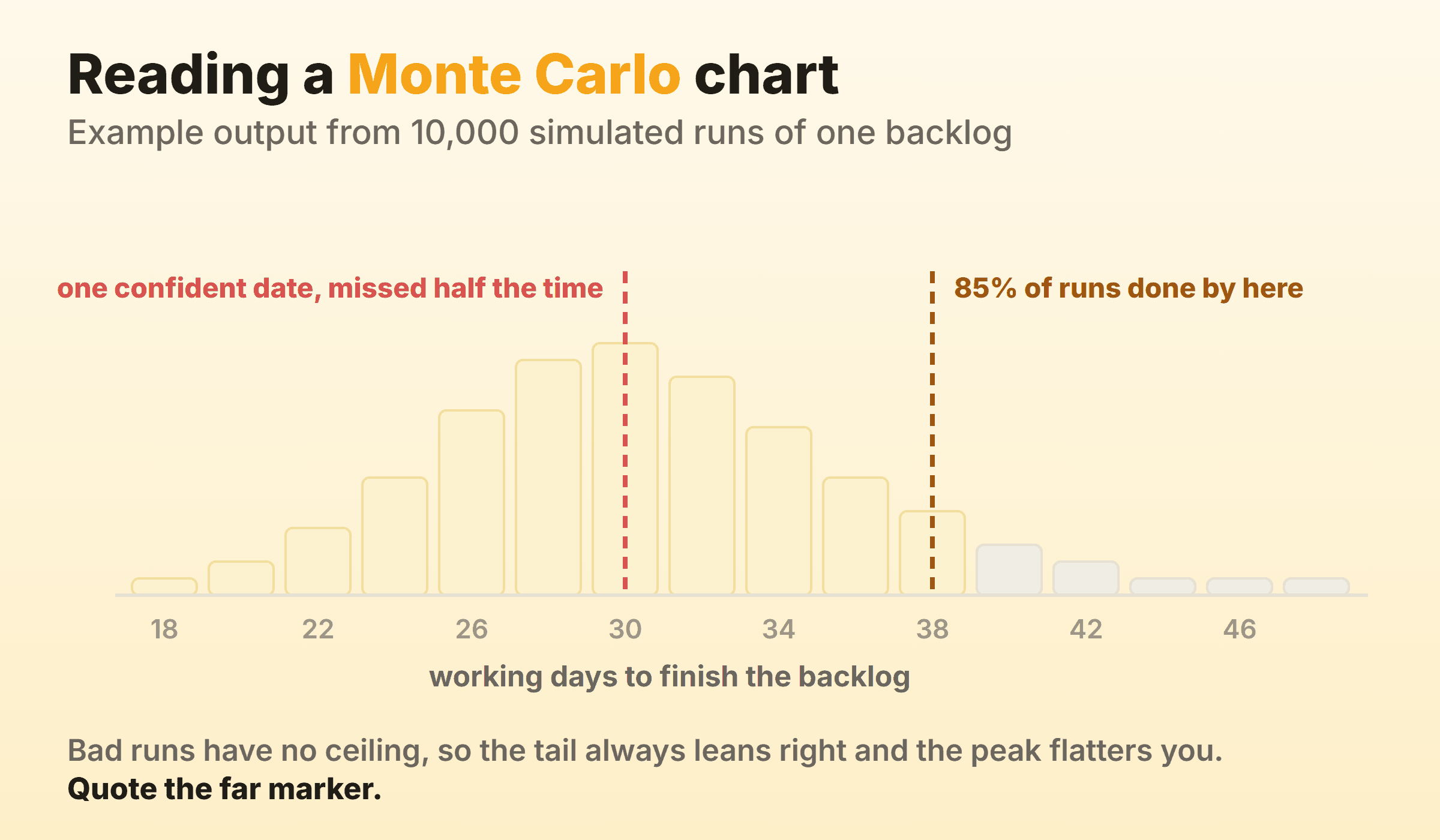
A Monte Carlo simulation chart plots days along the bottom and the number of simulated runs that finished on each day up the side. It comes out as a histogram with a long right tail, because a run can go badly for an unbounded stretch and can only go well down to zero delay.
Read two markers and ignore the rest of the shape. The median is the date you will miss half the time, which is exactly why quoting it as a commitment goes wrong so reliably. The 85th percentile is the number to say out loud, phrased as “eighty-five per cent of simulated runs finished by day 38” instead of a flat promise about day 38.
Stakeholders push back on that phrasing at first and then come to prefer it, because a percentage hands them a lever. They can ask what 95 per cent costs in days.
How Do You Take a Kanban Game Back to a Real Board?
Everybody leaves the pizza game agreeing that WIP limits work. By Thursday the Doing column holds nine cards and nobody recalls agreeing to anything, which is about four days of half-life on a very good workshop.
So cap one column before anyone leaves the room. One column, one number, written down. The oven from the game becomes the constrained column on your board, and the burnt pizza becomes the card nobody has touched in nine days. I run our own product board in Kanbanee with Doing capped at three and the count badge turning red on the fourth card, which is what turns a WIP limit from something we agreed in a meeting into something the board brings up itself.
Then decide who owns the change. Enthusiasm does not schedule itself, so name the person who reviews that limit in a fortnight and put the review in a calendar before the room empties. Most kanban certification classes run a simulation for the same reason, and that is about where a real kanban implementation starts.
FAQ
Is the Kanban Pizza Game free?
Yes. agile42 publishes the slides, order cards, oven plate and rule sheets under a Creative Commons Attribution-NonCommercial-ShareAlike 4.0 licence, so running it inside your own company costs you paper and Post-its. Read the non-commercial clause carefully if you plan to charge for a workshop built on it.
How many people do you need for a Kanban Pizza Game?
At least four per team, which agile42 gives as the floor, and at least two teams so there is something to compare. Eight is a workable minimum. Twenty to twenty-four people across four or five teams is where it gets loud, and at that size you want a second pair of hands on the stopwatch.
Can you run kanban games with students?
Yes, and the pizza game travels to a classroom well. It needs no software and no prior exposure to delivery work, which is why it turns up in university courses. Featureban works too and needs less floor space.
What is the difference between the Kanban Pizza Game and Featureban?
Physical constraint. The pizza game gives you a real oven with a real capacity, so queues become objects sitting on a table. Featureban abstracts that into a card draw and a sticky-note board, which makes it quicker to set up and easier over video, at the cost of everything visceral.
Do you need a tool to run a Monte Carlo simulation for kanban?
No. A spreadsheet holding your weekly throughput and a random sample formula copied down ten thousand rows produces the same answer a paid tool does. Flow analytics products save you the setup and read the board automatically, running the same arithmetic underneath.
Does playing a kanban game count towards a certification?
No credential is awarded for the game itself. Simulations are how most accredited classes fill their practical hours, so you will probably play one on the way to a credential. The certificate comes from the class or the assessment behind it.