
Kanban Manufacturing: How the Card System Runs a Production Line
Updated at
The Answer
Kanban manufacturing is production control by signal card. Nothing is made and nothing is moved until a card, a bin or an empty slot says the process downstream has already consumed something, so a plant builds to real consumption instead of to a schedule written weeks earlier. Toyota invented it. Two card types carry the work: a production kanban authorises an upstream process to make one standard container of parts, and a withdrawal kanban authorises moving a full container to the process that needs it. The cards in circulation set the stock ceiling for that part, which is why a kanban plant can state its maximum inventory before a single piece gets cut.
What Is Kanban in Manufacturing?
Kanban in manufacturing is a signalling method that authorises the production and movement of parts, one standard container at a time. The Lean Enterprise Institute’s kanban entry calls it a signalling device giving authorisation and instructions for producing or withdrawing items in a pull system. Read that twice and notice the absences. No date. No forecast. Nobody in a supervisory role. The card carries the whole instruction, and the person holding it needs nothing else to act.
The word is Japanese and translates as sign or signboard, which explains why kanban meaning in manufacturing keeps drifting since the software world borrowed the term. Two things share the name. A kanban is a card, a bin or an electronic message attached to a known quantity of parts. A kanban board is a wall of columns showing the state of work. Toyota ran on the first for two decades before anyone in a factory drew the second, and plenty of plants today have thousands of the former and none of the latter.
What a Production Kanban Card Signals
A production kanban card is used to signal that a downstream process has taken a container of parts out of stock, and it authorises a worker to make one replacement container of that part in that quantity. Nothing else. Sequence comes off the card too, in the order the cards arrived. An operator who fancies a bigger batch because the machine is already set up has no card for the extra, so the extra does not exist.
A withdrawal kanban does the other job, authorising somebody to move a full container from where it sits to where it is wanted. Two cards, two permissions, one loop. Where the same people both make and move, plants collapse this to a single card, and a two-bin rack is the plainest version of that arrangement. Signal kanban handle parts made in batches on shared equipment, where the trigger is a stock level rather than one container coming back. Supplier kanban run the identical loop outside the fence.
Where Did Kanban Manufacturing Start at Toyota?
Kanban manufacturing started at Toyota in the 1950s, when Taiichi Ohno went looking for a way to stop every department building to its own plan. American supermarkets handed him the mechanism. A shopper takes what they want off a shelf, the shelf gets refilled to a set level, and no one in the back room forecasts what any individual will buy. Ohno put that arrangement between two production processes and called the stock in the middle a supermarket, a name that stuck and still hangs on racks in lean plants.
Toyota’s own 75-year corporate history is the primary record of what followed, and it is specific where retellings are vague. Kanban were first tested in the Honsha Plant Machining Division. Use expanded steadily from there, the system was adopted at all plants in 1963, and through 1965 kanban were also adopted for retrieving parts from suppliers. Toyota describes the card as the tool that made just-in-time production possible, which is a careful way of saying the cards were never the whole system. The history of kanban ran about a decade of shop-floor argument, so any Toyota kanban story that gives you a single invention date is guessing.
The Six Rules of Kanban
Ohno published six rules for kanban in Toyota Production System, his 1978 book (English edition 1988), and the Lean Enterprise Institute still prints them under that heading today. They read like housekeeping until you look at what each one is holding back.
| The rule | What it prevents |
|---|---|
| The later process withdraws only what its kanban specifies | Downstream hoarding |
| The earlier process makes only what the kanban specifies, in that order | Convenient batching |
| Nothing gets made or moved without a kanban | Inventory nobody planned |
| A kanban always travels attached to the goods | Cards drifting away from parts |
| Defective parts never pass to the next process | Rework discovered late |
| Fewer kanban in the loop make problems visible sooner | Comfortable stock levels |
Rule five is the one plants quietly break. Passing a suspect container on is faster than stopping the line, and the loop keeps turning, so nothing looks wrong until assembly finds the defect two hours later with four more containers already in the rack. Rule six is the improvement engine, and it is the reason lean people will not shut up about card counts. Pull a card out of the loop and stock drops. The buffer that used to hide a slow changeover goes with it, and the problem surfaces on a shift where somebody can still fix it.
How Does a Kanban System Work on a Production Line?
A kanban system works on a production line by placing a small sized store of parts between each pair of processes, then letting withdrawal from that store be the only event that authorises making more. The Lean Enterprise Institute defines that store, the supermarket, as “the location where a predetermined standard inventory is kept to supply downstream processes”. Predetermined is the load-bearing word there. Somebody set the number in advance, and no shift raises it by working harder.
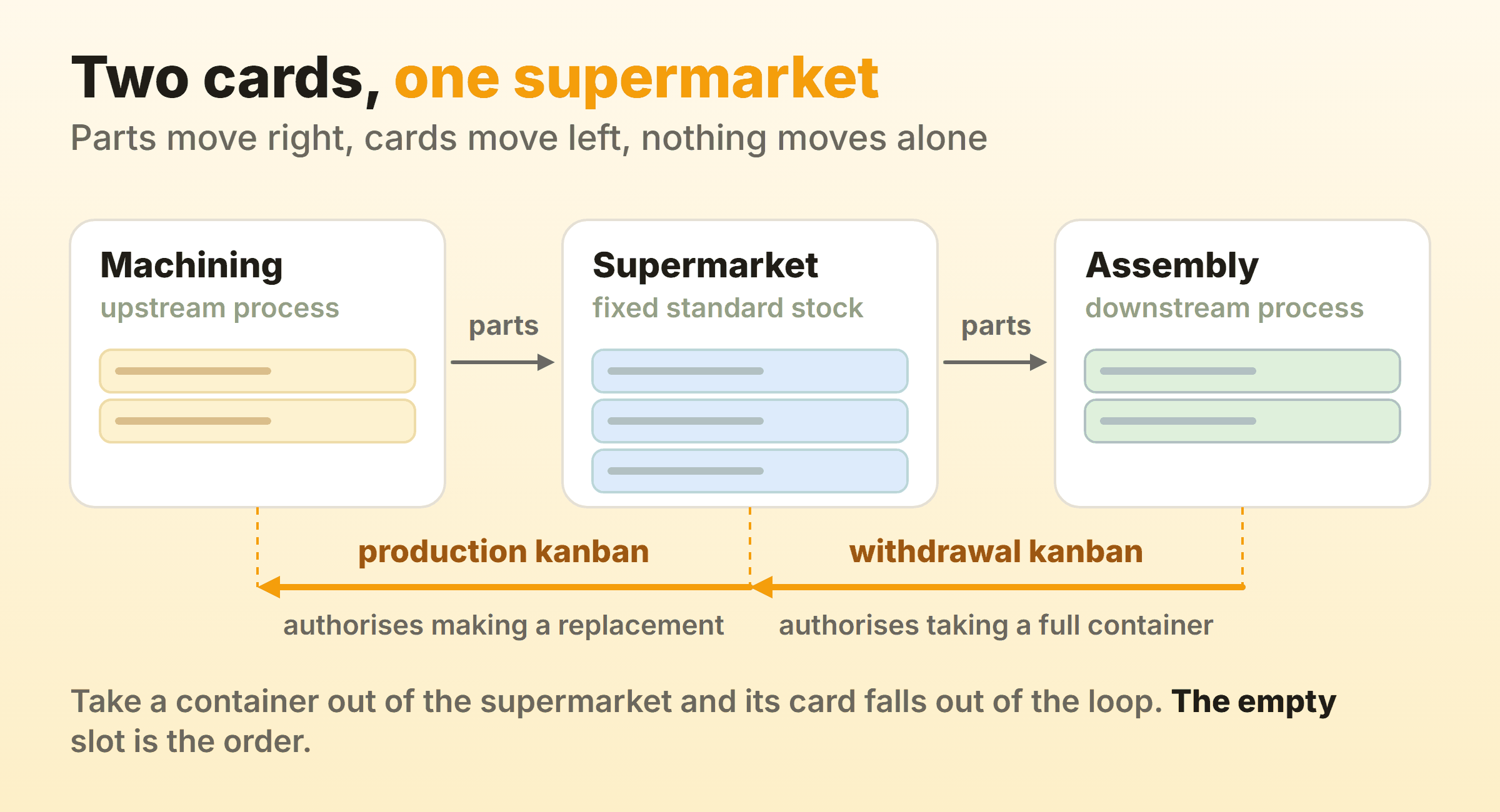
Walk one cycle. Assembly needs part A-1180, so it takes a full container from the supermarket under its withdrawal kanban and brings it to the line. The production kanban riding on that container comes off and goes to the card post at machining. Machining sees the card, runs one container of A-1180, attaches the card to the full container and returns it to the supermarket. No planner, no meeting, no system login anywhere in that sequence.
All of it hangs on how many cards are circulating, because cards in the loop are the stock ceiling for that part. Four cards against a 60-piece container means 240 pieces on the floor at most, ever. Card counts get worked out from demand across the replenishment lead time plus a safety factor, divided by container quantity, and the number deserves a review whenever either input moves. Most plants calculate it once at implementation and never look at it again.
What Does a Manufacturing Kanban Board Look Like?
A manufacturing kanban board looks like a wall of columns holding cards, where each column is a state a piece of work can be in and each card is one container or one job. A factory kanban board for a machining cell might run Queued, Setup, Running, QC hold and Staged. Nothing more exotic than that. The fewer columns you can survive with, the better the board reads from a distance.
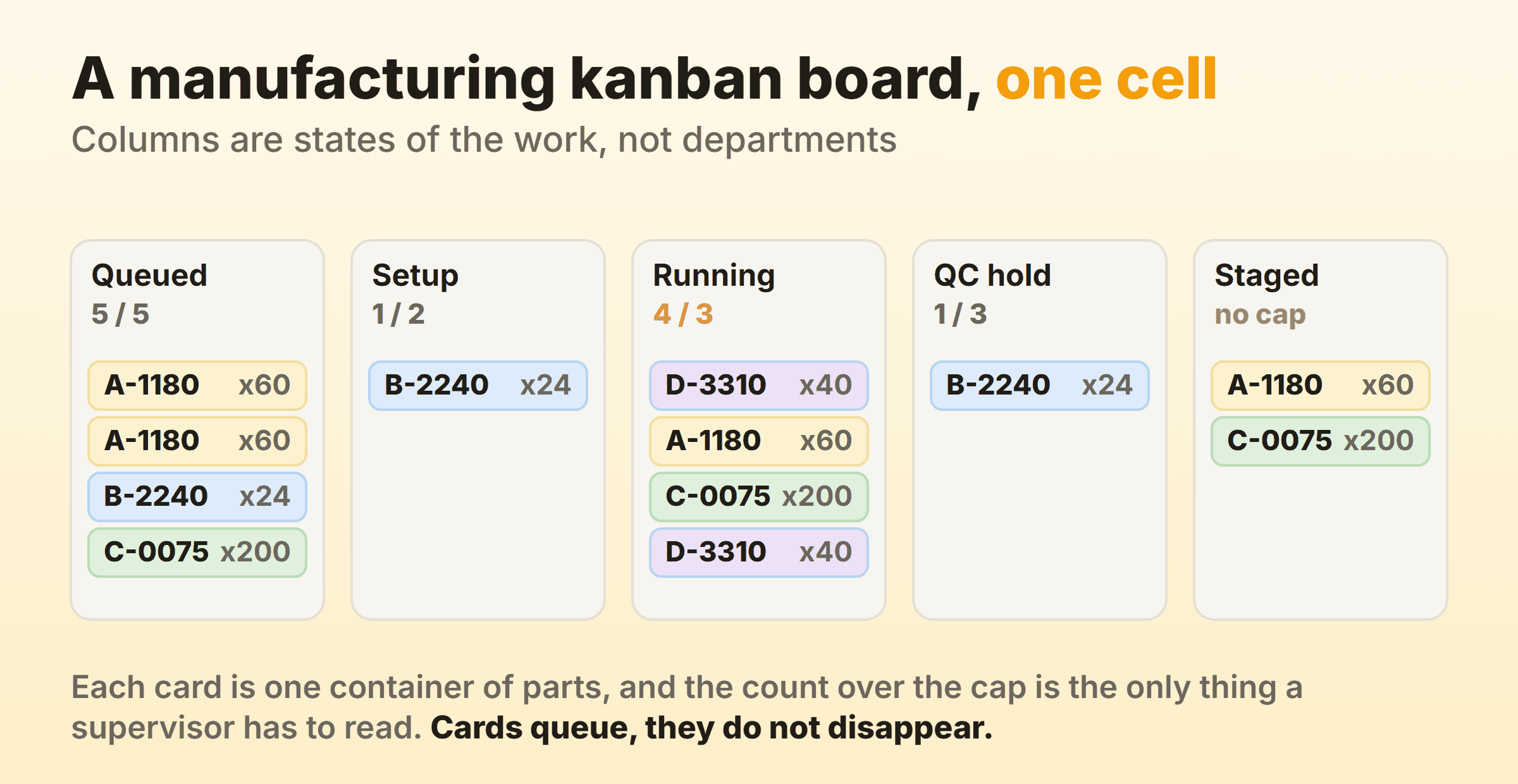
Two habits keep a lean manufacturing kanban board honest. Columns get named after the state of the work rather than the department that owns it, so Waiting for inspection beats QA. And every active column carries a cap on the cards it may hold, which is the visible twin of the card limit already running in the material loop. Running is over its cap by one in that picture, and that single red count is the entire message from twenty feet away. It works as a lean manufacturing visual kanban system precisely because nobody has to ask anyone anything to read it.
Manufacturing kanban board examples split fairly cleanly by what they track. A material board follows containers of parts and mirrors the physical loop. A production status board follows work orders through a cell. A maintenance board follows machines. All three look identical from the corridor and behave nothing alike, so give each board one job.
Where Kamishibai Boards Fit
Kamishibai boards hang next to kanban boards in a lot of plants and do a different job entirely. The name comes from Japanese paper theatre. The board holds two-sided cards, green on one face and red on the other, each describing a check somebody has to perform. A team leader pulls a card at random during the shift, runs the check and flips it to show whether the standard held. No flow, no queue, no work in progress. People search for kamishibai kanban boards, but what they are describing is a layered audit board, and mixing audit cards into a material board is how both stop being read.
Where Does Kanban Fit Against MRP and Scheduling?
Kanban sits underneath MRP rather than replacing it. MRP explodes a forecast into planned orders and dates, which is how a plant buys long-lead material and books capacity months out. Kanban decides what runs in the next hour. A kanban production control system pulls the parts with steady repeating demand off the schedule entirely and leaves the planner with the awkward ones, and that is the right division of labour rather than a compromise.
The pull system definition in lean manufacturing comes down to one sentence. Nothing upstream produces until something downstream consumes. Push works the other way, releasing work against a plan and trusting the plan to hold, and its visible symptom is a stack of finished subassemblies nobody ordered.
Kanban stops earning its keep when a part moves too rarely. A loop that turns three times a year never self-corrects, and its card count will still reflect demand from two years ago when somebody finally opens the spreadsheet. Long changeovers create the same failure from another direction, since a press needing four hours to change over cannot economically run one container of anything. Shorten the changeover or leave that part number on the schedule where it belongs.
Which Manufacturing Work Belongs on a Digital Kanban Board?
The manufacturing work that belongs on a digital kanban board is the work that has no container. Engineering change requests, tooling builds, maintenance jobs, new product introduction, supplier quality escapes. All of it flows, all of it queues, and none of it can be represented by a bin on a rack. Kanban for production support is the cleanest case of the lot, because a support queue is arrival, triage and a cycle time somebody is already being measured on.
Material replenishment is where digital boards earn their reputation for disappointing people. A card taped to a bin needs no login, survives a power cut and stays readable to an operator wearing oily gloves. Software wins when signals have to cross a fence to a supplier, when demand shifts often enough that card counts need recalculating, or when nobody can tell you what last month’s replenishment cycle time was. That is electronic kanban territory, and it is a narrower use case than most software vendors admit.
On our own product board in Kanbanee I cap Doing at three and let the badge turn red rather than block the drag, which is the same WIP limit logic a shop floor gets from a fixed number of cards. The board can only tell you the cap is broken. Somebody still has to walk over and decide what to do about it.
Why Do Kanban Systems Fail on a Shop Floor?
Kanban systems fail on a shop floor for reasons that have little to do with kanban. The most common is a card count nobody has reviewed since the day the loop was set up. Demand moved, the supplier’s lead time moved, the cards did not.
Lost cards come second, and they are quiet. A card that slips behind a rack removes stock from the loop permanently, and the shortage arrives weeks later as an unexplained expedite. Numbering every card 2 of 4 makes the gap visible, which is why Toyota production system kanban cards carry that field at all.
Then there is the override. A supervisor authorises a run with no card because a customer is shouting, nothing bad happens, and the next override costs less thought than the first. Three months of that and the cards are wallpaper. Plants that hold the line treat a missing card as a stop-and-ask event, which sounds heavy-handed until you price a week of overproduction nobody noticed.
The last failure is a board nobody stands at. A manufacturing kanban board in a corridor showing cards two shifts out of date is worse than no board, because people keep making decisions from it anyway.
FAQ
What does kanban mean in manufacturing?
Kanban is Japanese for sign or signboard, and in manufacturing it means the physical or electronic signal that authorises making or moving a set quantity of parts. No card, no production. Strictly the word covers the signal rather than the whole system, though almost everyone uses it for both.
What is an example of kanban in manufacturing?
A two-bin rack of fasteners at an assembly station is the example most people have already seen. The operator empties the front bin, that bin travels to a collection point with its card attached, and the reserve bin covers the days it takes to refill. The same loop at scale: a stamping press runs one container of brackets because one production kanban came back from the weld cell.
Is kanban the same as just-in-time?
No. Just-in-time is the goal of making only what is needed when it is needed, and kanban is the mechanism that enforces it on the floor. Toyota’s own history calls the card the tool that made just-in-time production possible. A plant can pursue just-in-time by other means, including sequenced delivery windows and a paced conveyor, so the two words are not interchangeable.
Who developed the Toyota kanban system?
Taiichi Ohno developed the Toyota kanban system as an engineer inside Toyota, backed by Eiji Toyoda. He borrowed the replenishment idea from American supermarkets and spent most of the 1950s and early 1960s proving it out plant by plant, and Toyota adopted the system across all its plants in 1963.
Can you run manufacturing kanban on a software board?
The office half of manufacturing kanban runs on a software board without argument, meaning engineering changes, maintenance, tooling and production support. Material replenishment is a harder sell, since the operator at the rack needs the signal in their hand rather than on a screen in an office. Plants that do go digital for material generally scan at the point of use into an e-kanban loop rather than using a general purpose board app.
More on Kanban in Manufacturing
Three spokes carry the detail this page skipped.
The two-bin system, the card count formula and the honest reasons loops still run dry are in kanban inventory.
Lean kanban takes apart the just-in-time loop, the kaizen link, and where kanban sits inside Lean Six Sigma and value stream mapping.
If the cards are going digital, electronic kanban covers the signal loop, the ERP wiring and what gets lost the moment paper leaves the rack.