
Lean Kanban: What It Is and How It Drives Continuous Improvement
Updated at
The Answer
Lean kanban is the signalling system lean production uses to authorise work, and the card itself is the authorisation. The Lean Enterprise Institute kanban definition describes a device that tells an upstream process what to make or move and how much, inside a pull system. No card, no work. Holding to that rule caps inventory at whatever the next stage has already used up, which is the just-in-time half of lean kanban. The continuous improvement half comes from the card count. It is a dial. Turn it down by one, the process runs closer to its edge, and the first thing that breaks is your next improvement project.
What Is Kanban in Lean?
Kanban in lean is a physical signal that authorises production or movement of a specific quantity, and nothing beyond that. The word is Japanese for signboard. Toyota picked it because the original ones were literal boards and slips of paper travelling with parts around the plant, and the name stuck long after the paper became a barcode or a light on a rack.
The Lean Enterprise Institute lexicon keeps its kanban definition tight. A kanban gives authorisation and instruction for making or withdrawing items in a pull system. Notice the absences. No schedule appears in that definition and no forecast either, and nobody in a supervisory role turns up in it at all. The card carries the entire instruction.
Lean vs kanban is worth clearing up early, because the two names get used interchangeably and they are nowhere near the same size. Lean is the whole production philosophy that came out of Toyota, covering standard work, levelled scheduling, quick changeover, mistake-proofing and a dozen practices beyond those. Kanban is one control inside lean management. The most copied one, probably. Bolt kanban cards onto a plant that still schedules to a monthly forecast and you get cards with nothing behind them.
Production Kanban, Withdrawal Kanban and Signal Kanban
Lean manufacturing names three kanban types, and they authorise different things.
A production kanban tells a process to make something. It arrives at the making stage and says build this part, this many, now. Movement gets its own card. The withdrawal kanban, sometimes called a conveyance kanban, travels with a material handler who takes a full container out of the store and leaves the card behind as proof of what went. Then there is the signal kanban, for processes that cannot economically run one piece at a time because the changeover costs too much. It sits at a reorder point inside a stack of containers, and uncovering it triggers a whole batch instead of a single replacement.
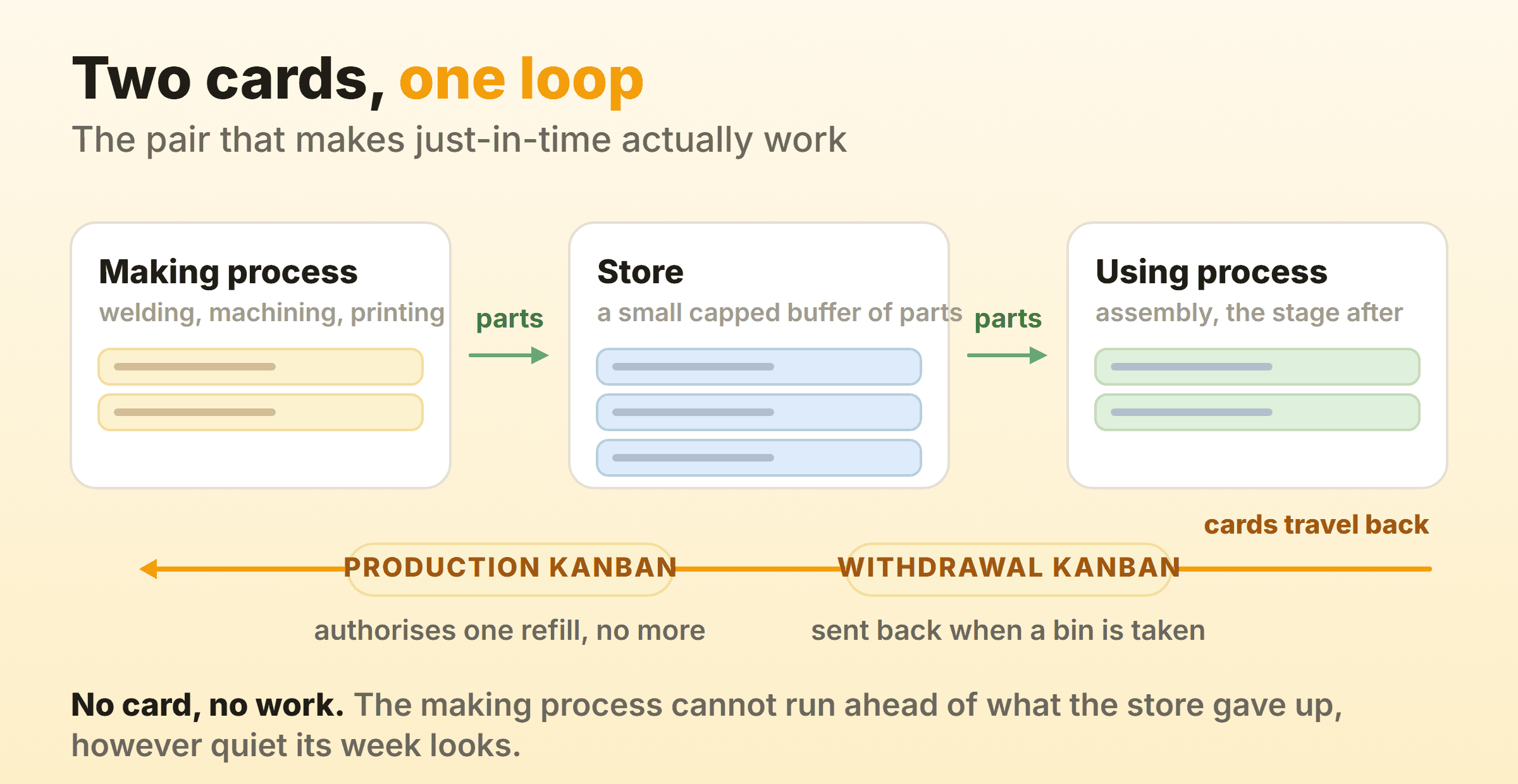
Most plants running the classic two-card system use production and withdrawal kanbans together, which is where the name comes from.
How Does Kanban Deliver Just-in-Time Production?
Kanban delivers just-in-time production by refusing to let any stage make more than the stage after it has already used. Toyota describes just-in-time on its own production system page as making only what is needed, when it is needed, and in the amount needed. Kanban enforces that sentence on the shop floor instead of leaving it as a poster in the canteen.
JIT and kanban depend on each other in a way the two names hide. Just-in-time is the goal. The just-in-time kanban cards are the physical carrier of the instruction, and capping how many of them circulate is what stops the whole arrangement sliding back into scheduling. Strip the cards out of a just-in-time kanban system and the intention survives fine. The enforcement goes, and enforcement is the part that gets you through a bad week.
Taiichi Ohno set out six rules for kanban in his 1988 book Toyota Production System: Beyond Large-Scale Production. Five of them protect the loop.
| Rule | What it means on the floor |
|---|---|
| 1 | The later process withdraws only the quantity the kanban says |
| 2 | The earlier process produces in the quantity and sequence the kanban says |
| 3 | Nothing is made or moved without a kanban |
| 4 | A kanban is always attached to the goods |
| 5 | Defects never move to the next process |
| 6 | Reducing the number of kanban raises the system’s sensitivity |
Rule 5 is the one people skip when they are behind. Passing a suspect part downstream inside a JIT kanban loop does more damage than stopping, because there is no buffer of good parts sitting there to absorb the mistake. Every pull system makes that trade. If you want the pull half away from a factory, the kanban pull system guide walks the same loop on a software board.
How Many Kanban Cards Should Be in Circulation?
The number of kanban cards in circulation comes from demand, replenishment lead time and container size, with a safety factor bolted on for variability.
number of kanban = (average demand during lead time x (1 + safety factor)) / container quantityA fast supplier drives the number down. Give it a slow one and the count climbs, which is the maths telling you the truth about your supply chain. The safety factor is where the honesty lives. Set it at 0.2 and you are carrying a fifth more stock than a perfectly reliable loop would need, and that fifth is buying cover for late deliveries, scrap and breakdowns. A safety factor set once during the rollout and never revisited is exactly the habit rule 6 exists to break.
How Does Kanban Drive Continuous Improvement?
Kanban drives continuous improvement by making the amount of inventory in the system adjustable, then daring you to adjust it. Ohno’s sixth rule is the whole engine. Fewer cards in circulation means less material sitting between stages, and thin material between stages means every hiccup upstream reaches the next station fast enough for somebody to still remember what caused it.
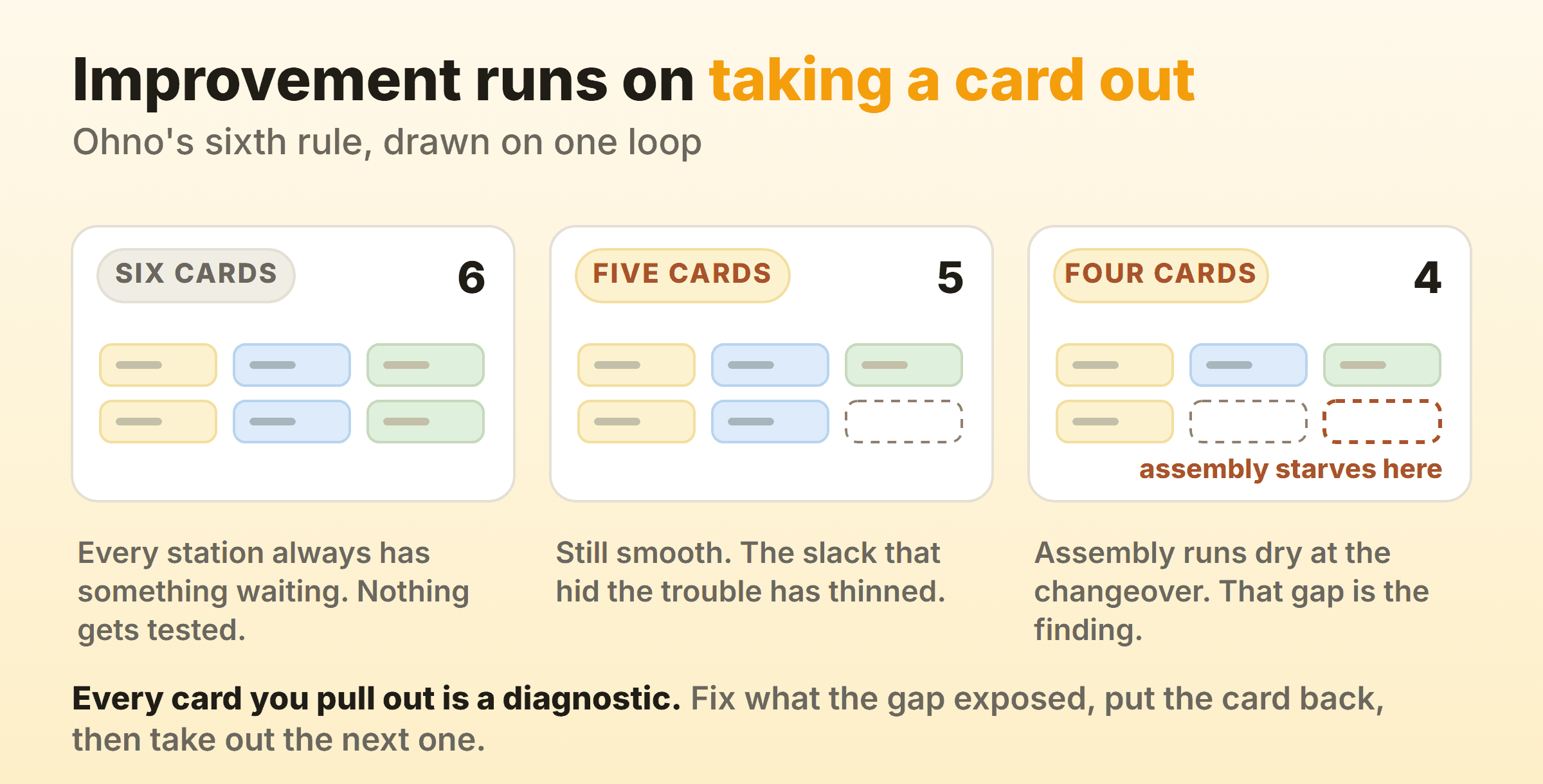
Lean teaching explains this with water and rocks. Inventory is the water, problems are the rocks on the riverbed, and lowering the water shows you which rock you hit first. Decent image. It undersells the discomfort though. Lowering the water means somebody stands idle in front of the whole shift while a changeover runs long, and the instinct in almost every plant is to hand that person something to do. Kanban gives you the exposure. Whether the continuous improvement system does anything with it depends on a supervisor holding their nerve for ten minutes, and then on somebody walking over to fix what the gap revealed.
Once the fix holds, the card goes back in and the loop settles. Then you take out another one. Continuous improvement with kanban is that cycle repeated for years, and the card count never settles on a final number.
Kaizen and Kanban
Kanban and kaizen pair up for a plain reason. Kaizen is the lean practice of small, frequent, incremental change driven by the people doing the work, and it supplies the improvement method. Card removal supplies the trigger. The Lean Enterprise Institute is just as plain in its kaizen entry, defining the word as continuous improvement built from small incremental gains that add up to something significant over the long run.
Without a trigger, kaizen drifts into a suggestion box. Teams schedule an improvement event, brainstorm for a day, fill a wall with sticky notes and act on a handful. Card removal gives kaizen something concrete to point at. The line stopped at the changeover on Tuesday, everybody saw it, and the improvement question writes itself. I use the same trick on software boards by dropping a WIP limit by one and waiting to see which handoff complains first.
What Does a Lean Kanban Board Look Like?
A lean kanban board is a visual control showing the state of a value stream and the caps that govern it, which is a different artefact from the card. Boards vary wildly by setting. A factory version might be a rack of card slots by the machine, colour coded by part number, with the slot positions themselves acting as the limit. A knowledge work version is columns and cards on a screen.
The number is what translates between them. A factory loop is constrained by how many kanban cards exist, and a board by the WIP limit written on the column. Same job, same reason. Each one caps what can be in play at once. That produces a queue whenever demand runs ahead of capacity, and the queue then sits somewhere visible instead of hiding in an inbox.
In Kanbanee the limit lives on the column menu and shows as a count against the cap in the column header, turning red once the column goes over. The limit stays soft, so a drag is never blocked. That was a deliberate call. A hard block teaches people to route around the tool, while a red badge sitting there through a whole standup tends to get discussed.
Construction runs its own version of this. A lean construction kanban board pulls materials, drawings and inspections to the trade that needs them, and the Lean Construction Institute treats kanban exactly that way in its topic guide. The payoff is bigger on a site than in a plant, because storage is scarce and anything that turns up early gets moved twice.
What Is a Kanban Continuous Flow Diagram?
People search for a kanban continuous flow diagram, and the chart they nearly always want is the cumulative flow diagram. Continuous flow is the lean goal of work moving one piece at a time with no batching and no waiting. The cumulative flow diagram, or CFD, is the stacked area chart that shows how close you are to it, with one band per column and the band heights showing how much work sits in each state on a given day.
Read it by watching the bands. A band that thickens over several weeks is a stage taking in work faster than it clears it, and the horizontal distance across the chart at any point is your approximate cycle time. Most board tools will draw one for you, though a spreadsheet and a daily column count produce the same picture for a small team. Kanban WIP limits and continuous flow meet right here. Cap the columns, the bands stay thin, and the chart flattens into something you can forecast from.
Where Does Kanban Sit in Lean Six Sigma and Value Stream Mapping?
Kanban sits in the lean half of Lean Six Sigma, as a control tool for flow rather than a statistical one for variation. Six Sigma proper is a defect reduction method built on the DMAIC cycle, and ASQ frames it around measurement and statistical analysis of process variation. Lean contributes the waste and flow side. Kanban lean six sigma programmes usually deploy kanban during the improve and control phases, once the analysis has shown where inventory piles up and why.
The two disciplines answer different questions. Variation is the Six Sigma question, and how much work belongs in a process at once is the six sigma kanban blind spot that lean fills. Which is why a team can run a beautiful DMAIC project on a machine that was never the constraint. Picking projects without a flow view first produces exactly that outcome.
That flow view usually comes from value stream mapping. Kanban value stream mapping is a sequence, and the order matters. You map the current state, with its process times, waiting times and inventory piles between stages, and the map tells you where the queues are. Then you design a future state, and kanban loops are one of the standard mechanisms for connecting stages inside it. Mapping first stops you capping a stage that was never the problem.
Is Lean Kanban the Same as the Kanban Method?
Lean kanban and the Kanban Method are related but separate, and mixing them up causes most of the arguments about what the word means. The older one is Toyota’s, dating to the 1940s and 1950s, where a physical card authorises production or movement of parts. David J. Anderson formulated the other at Microsoft and Corbis in the mid 2000s and published it in 2010 as Kanban: Successful Evolutionary Change for Your Technology Business.
The organisation certifying the second one was called Lean Kanban University for years, which is why the phrase still turns up in so many searches. It now trades as Kanban University, and it runs the certification track for the method, from Team Kanban Practitioner up to Kanban Coaching Professional. Separately, The Kanban Guide by Daniel S. Vacanti and Orderly Disruption gives a shorter, method-neutral description of the same practices.
The mechanism carried across intact. Cap the work in progress. Let a free slot pull the next item in, keep the flow visible, then tighten the cap once things start looking comfortable. The physical card and the container stayed behind in the factory, because a design task has no container quantity and no reorder point to speak of. The history of kanban traces the route from Ohno’s supermarket observation to the boards teams run today.
FAQ
Is kanban lean or agile?
Kanban started as lean. Agile teams adopted it later, so both labels hold, and arguing about which one owns the word is a decent way to waste a meeting. The mechanism came from the Toyota Production System decades before anyone wrote the Agile Manifesto. The Kanban Method sits outside that manifesto and requires none of its ceremonies.
What is a two-bin kanban system?
A two-bin kanban system holds every part in two containers, one in use and one in reserve. When the first bin empties, it goes back to the supply point as the reorder signal and the reserve slides forward. The empty bin is the kanban, so no cards or scanners are needed anywhere in the loop. Hospitals and maintenance stores lean on it heavily for consumables, because the signal is impossible to misread.
What is an electronic kanban?
An electronic kanban, usually written e-kanban, replaces the paper card with a record in a system. A barcode scan at the point of use fires the replenishment signal, which lands with the supplier directly. The mechanism is unchanged and the failure mode is new, because a lost card is obvious on the floor while a lost message is invisible until the part fails to arrive.
What is the difference between a kanban and a kanban board?
A kanban is the signal itself, which might be a card, a bin, a slot or a light. A kanban board is the visual display of the workflow those signals move through. In lean manufacturing the kanban carries the authorisation while the board shows the state of the line. Knowledge work blurred the distinction, because a card on a screen is both the signal and the item of work.
Does kanban work in a forecast-driven plant?
Partly, and most plants end up running both. Kanban sizes itself from what was actually consumed, so it needs demand that repeats. Parts that move steadily go on kanban loops. New product introductions, seasonal builds and one-off orders stay on conventional scheduling, and pretending otherwise is how people end up maintaining kanban cards for items that ship four times a year.