
Kanban Meaning: What the Word Means and How to Say It
Updated at
The Answer
The kanban meaning is signboard. It is an ordinary Japanese word, written 看板 and read かんばん, built from 看 (kan, to see or look at) and 板 (ban, a board). You say it kahn-bahn, four beats of even length, no stress punched onto either half. In everyday Japanese it is the sign hanging outside a restaurant and carries no management flavour whatsoever. Toyota took the word in the 1950s for a card that told an upstream stage what to make next. Software teams inherited it fifty years later for the board on your screen, and underneath both of those sits the same plain object, a board that somebody looks at.
What Is the Literal Meaning of Kanban?
The literal meaning of kanban is a board you look at. Wiktionary’s entry for 看板 splits the compound into 看, a grade six kanji glossed as to see, to look at, or to look after, and 板, a grade three kanji glossed as board, plank, plate or slab. Stick those together and you have a viewing board, which in practice means a shop sign.
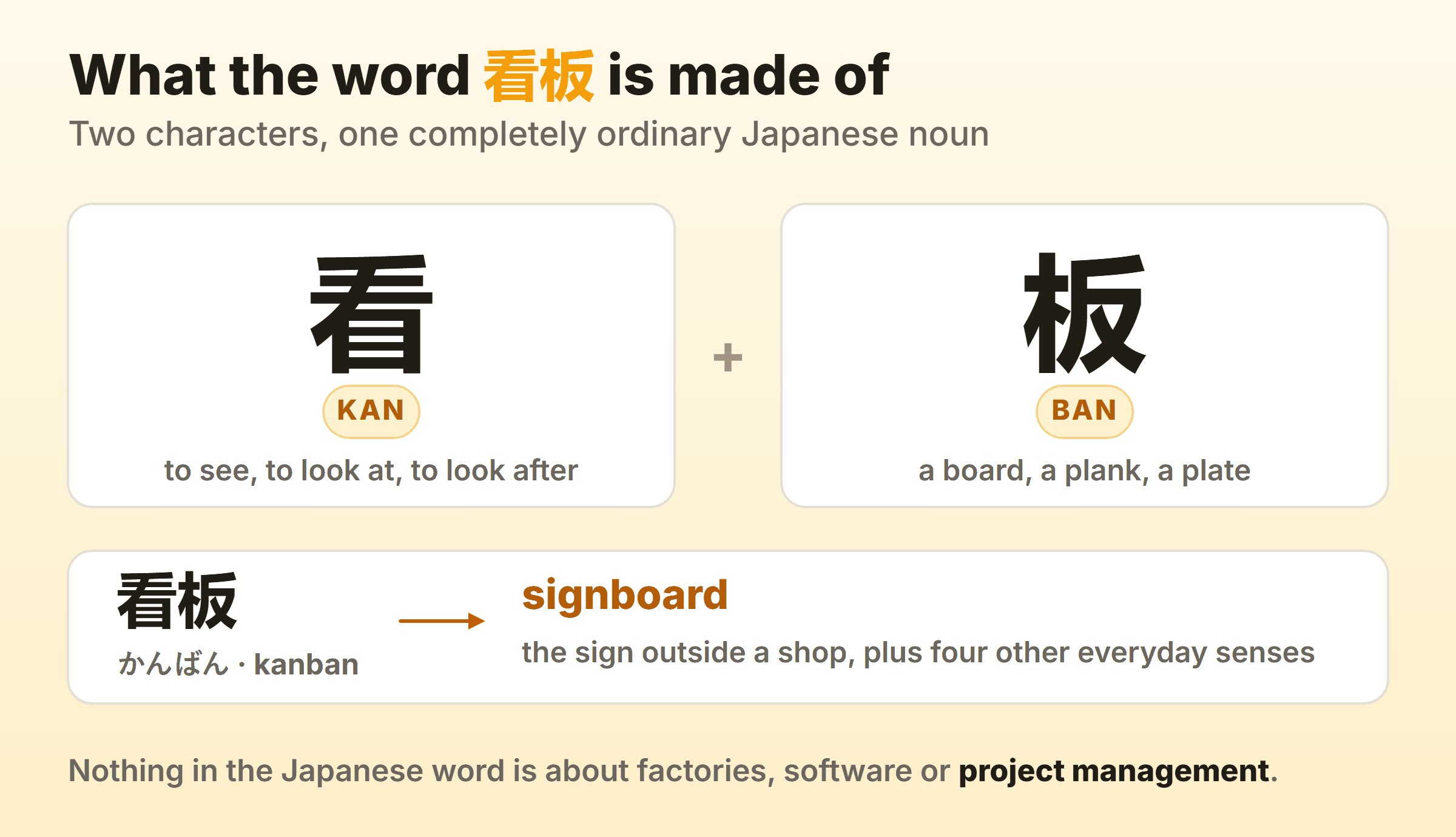
The grade numbers are worth a second. Japanese schoolchildren pick up 板 around age eight and 看 around eleven or twelve, so this sits at roughly the level of the English word signpost. Nobody at Toyota reached for anything technical when they named the cards, they used a word every person in the building already had.
What Does a Japanese Dictionary Actually List?
A Japanese dictionary lists five senses for kanban, and only the first is the one English borrowed. Wiktionary gives them as signboard, then feature or highlight, then the reputation and public trust of a shop, then a name or public appearance, and last the closing time of a shop.
That last one is my favourite. Take the sign down and the shop is shut, so the word for the sign ends up doing duty as the word for the end of the working day. Sense three lands close to the English phrase the face of the company. A Japanese speaker can call a chef the kanban of a restaurant and mean he is the draw, the reason anyone books a table at all. Card appears nowhere in the five, and neither does anything resembling workflow.
How Do You Pronounce Kanban?
You pronounce kanban as kahn-bahn. Two long a sounds, equal weight across both halves, and the vowel you want is the a in father rather than the a in can. Four beats, ka-n-ba-n, each getting the same amount of time.
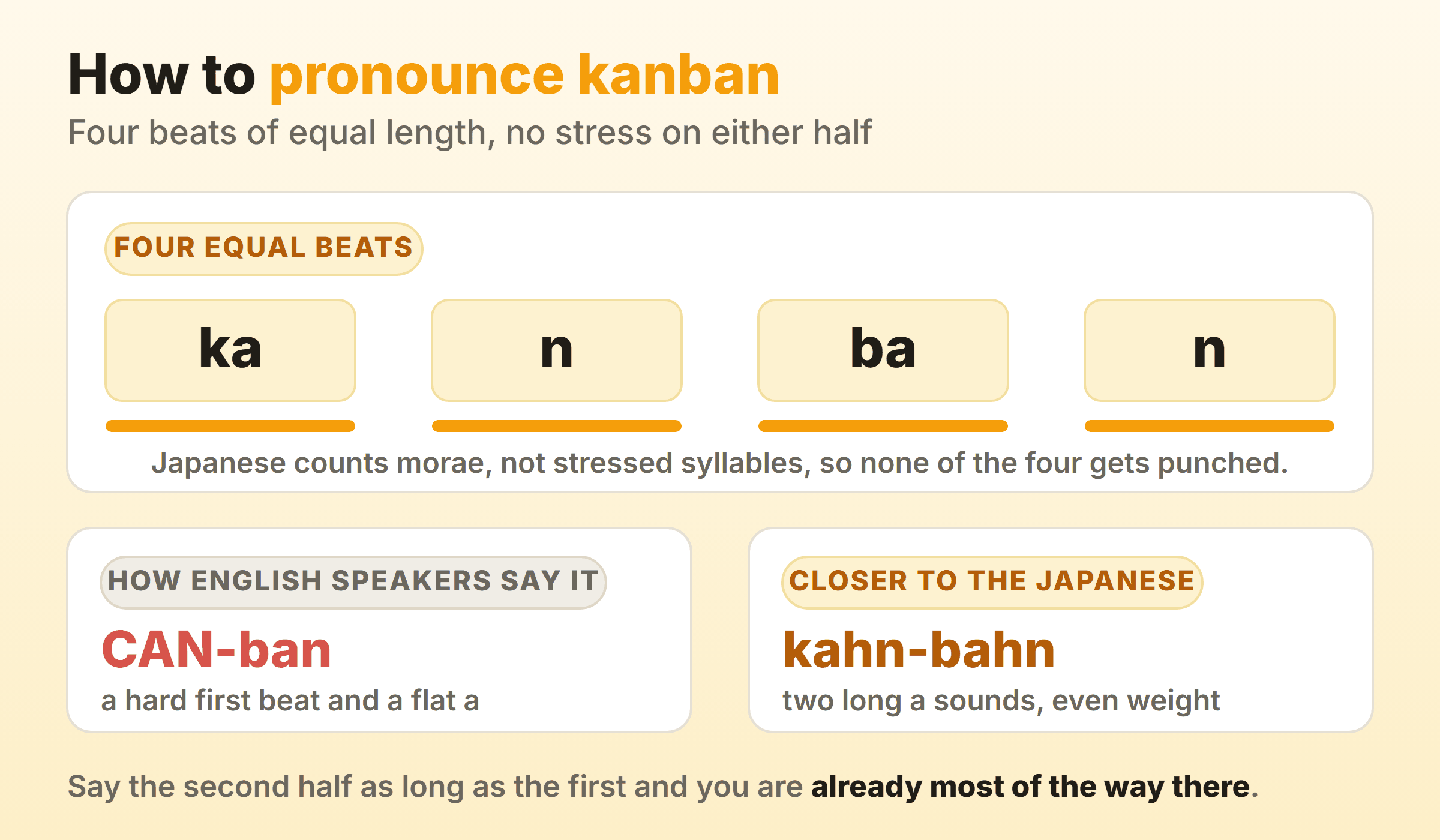
Japanese counts morae, which are timing units, and one syllable can hold two of them, which is why that middle n gets a beat entirely to itself. English has no equivalent unit. So the instinct is to squash the n and land hard on the front of the word.
Most people looking up how to pronounce kanban are about to say it out loud in front of a room, which raises the stakes higher than the word deserves, given that nobody else in the room knows either.
How Is Kanban Pronounced Wrong Most Often?
Kanban is pronounced wrong most often as CAN-ban, with a heavy stressed first half and the flat a of the English word can. I hear it in nearly every meeting where somebody says the word out loud for the first time, and I have never once seen anybody corrected for it.
Two other versions turn up regularly. Some people say kan-BAN, stressing the back half, which is the opposite error and lands no closer to the Japanese. The other one stretches the first vowel and swallows the second, kaaan-bn, which drops the fourth beat entirely. All three get fixed the same way, by giving the second half as much room as the first.
Does the Stress Fall on Kan or Ban?
Neither. Standard Japanese gives kanban a flat pitch pattern, what linguists call heiban, so there is no accented mora to hunt for. Wiktionary marks it as pattern 0 for Tokyo speech, which is the notation for no accent at all.
English speakers hearing a flat word add stress somewhere out of sheer habit, because English words want a strong syllable. If you have to add one, put a very light touch on the first beat and keep both halves the same length, which comes across as an accent rather than a mistake.
How Do You Say Kanban in a Sentence?
The word does not shift shape for grammar. Kanban names the method, a board and one piece of card without changing a letter, and the plural is kanban too. Japanese nouns take no plural s, so a shop floor holds fifty kanban, and manufacturing writing in English has kept that convention.
Plenty of English speakers say kanbans anyway. On my own team we say cards, and nobody has ever had to rule on it.
What Is the Kanban Translation in English?
The kanban translation into English is signboard or billboard. Sign, shop sign, nameplate and placard are all defensible depending on the object being described, and Chinese later borrowed the compound back out of Japanese with roughly the same sense.
| Japanese use | Usual English translation |
|---|---|
| The sign outside a shop | signboard, shop sign |
| A large advertising board | billboard, hoarding |
| The star attraction | the face of, the draw |
| The shop’s good name | reputation, standing |
| The end of trading | closing time |
Card is missing from that table and the omission matters. English picked kanban up from manufacturing, where the object involved happened to be a card, so English speakers assume the word means card. The word names the job that card is doing, which is to be looked at before somebody acts.
What Does Kanban Mean in Project Management?
In project management, kanban means a way of running work where the visible state of a board decides what gets started next. That is the kanban definition most people arrive looking for, and it sits three steps away from the Japanese noun. A signboard gave its name to a signal card, the whole system built out of those cards took the name next, and eventually a formalised method took it as well.
Agile teams picked the word up from manufacturing without picking up the factory around it. A kanban process, in software, means work moving left to right through named states, and the kanban workflow is the particular set of states one team happens to use, which no other team will match exactly. Kanban software draws that on a screen and does the counting.
One Word, Three Different Things
The word does triple duty in English, and conversations go sideways the moment two people are using different senses of it.
| What is meant | How it is used |
|---|---|
| a kanban | one signal that authorises work, historically a card in a parts bin |
| kanban | the general practice of pulling work through visible states |
| the Kanban Method | the formalised body of practice, capital K |
Kanban University publishes the official guide to the third of those. Its guide states that Kanban is not a methodology nor a process framework, describing it as a management method applied to whatever way of working a team already has. So anyone saying kanban framework has picked the one label the guide explicitly rejects. That is also the entire reason a team can start on a Monday without reorganising anything, and it is where the kanban methodology parts company with Scrum.
Is Kanban Capitalized?
Kanban is capitalized when it names the Kanban Method. Everywhere else it takes a small k, which covers the card, the board and the general practice of working this way, leaving the capital for the named body of work that Kanban University and its training network teach.
Most writing ignores the rule and I ignore it myself in Slack. It does real work in a document where the method and the practice both come up and a reader needs to tell them apart.
You will also see kanban model used as a fourth label. Usually it means the method. Sometimes it means the pull mechanism, so read the sentence around it before you assume.
What Is a Synonym for Kanban?
No exact synonym for kanban exists in English, which is precisely why the language kept the Japanese word instead of translating it. Signal card comes closest for the manufacturing object, and signboard is the nearest thing for the Japanese noun, but neither one stretches across both senses.
For the board sense, the usual near-synonyms are:
- Card wall - what a lot of teams called it before kanban caught on, and still the most literal description of the thing
- Task board - broader, and it covers boards with no pull mechanism in them at all
- Visual workflow - the effect, described without naming the artefact
- Pull system - the mechanism, and what a kanban system technically is
- Signal card - the factory object, one card per bin of parts
Every genuine kanban system is a pull system, which is what makes that fourth entry the useful one. Plenty of things called kanban boards are not pull systems, because a board with no cap on how much piles into a column pushes work just as happily as a spreadsheet does.
What Is the Etymology of Kanban?
The kanban etymology runs from Edo-period shop signs to a Toyota machine shop, and nothing connects those two things except a shared word. Merchants hung carved wooden signboards outside their premises for centuries and the word stayed in ordinary circulation the whole time. In the 1950s Toyota needed a name for a small piece of card that a worker reads before making anything.
Toyota’s own account of the production system describes kanban cards as the thing that coordinates with a supplier so the required quantity arrives when it is needed. The semantic distance between that and a restaurant sign is about an inch. You look at a board and then you decide, and the only thing that changed is that the decision is about brackets instead of dinner.
Nobody in that machine shop was reviving a seventeenth-century merchant tradition. They took the obvious word for the obvious object, and half a century later a group of software teams did the same thing to a whiteboard covered in sticky notes.
Why the Kanban Meaning Still Decides What Goes on Your Board
Kanban means a board you look at, so the working test for any board is whether anyone genuinely looks at it. Tidiness is beside the point. The question is whether a person changed a decision this week because of something they saw on the board.
That test kills a surprising number of boards. One updated on Friday so the status report comes out accurate is a report with drag-and-drop. Forty cards in one column is a list. And a board with fifteen columns that nobody can take in at a glance has quietly become a diagram of the process, which is a different object doing a different job.
Getting a board back to the meaning of the word is unglamorous work.
- Fewer columns. Every column should be a state you would actually wait in. Naming columns after states instead of after the people who own them does most of the work.
- A limit per column. WIP limits are what turn the board into a signal instead of a record. Kanbanee ships them switched off, you set them per column from the column menu, and the count badge goes red the moment a column runs over its cap.
- One glance a day. If the board only gets read during a meeting, the meeting is doing the work and the board is decoration.
The red badge is the part I would defend hardest. A signboard that never changes stops being worth looking at, and 看 is the character for looking. I cap the Doing column on our own product board at 2, so the badge goes red often enough that nobody has learned to ignore it.
FAQ
What does kanban literally mean?
Kanban literally means a board that gets looked at. Its two characters are 看, to see or look at, and 板, a board or plank, and the standard English gloss for the compound is signboard.
How do you say kanban in English?
Say kanban as kahn-bahn, using the a of father in both halves and leaning on neither. English speakers usually say CAN-ban, which everybody understands even though it sounds nothing like the Japanese.
Is it spelled kanban or kamban?
Kanban is the standard romanisation and the spelling to use. Kamban shows up because the n sits directly in front of a b, and a nasal in that position drifts toward an m in ordinary speech, so people write down what their ear gives them.
What is the plural of kanban?
The plural of kanban is kanban. Japanese nouns take no plural s and manufacturing writing keeps that convention, which is why you see fifty kanban and not fifty kanbans. Kanbans is common in casual English and nobody will misunderstand you.
Does kanban mean card?
No. Kanban does not mean card in Japanese, and a Japanese dictionary lists no sense anywhere close to it. The confusion traces back to the object Toyota happened to use, so English speakers attached the word to the object and left the function behind.
Is kanban an acronym?
Kanban is not an acronym. It is an ordinary two-character Japanese noun that predates Toyota by centuries, so the capital letters you sometimes see in KANBAN are a styling choice with nothing behind them.