
Kanban Pull System: How It Works, With Examples
Updated at
The Answer
A kanban pull system is a way of running work where nothing new starts until something finishes and frees a slot. The finished item is the signal. Work gets pulled in by capacity that just came free rather than pushed in by a plan, a date, or a manager with a spreadsheet, and that single swap is what separates kanban from a schedule. Two things have to be true before pull exists at all. A hard cap on how much work each stage may hold, and an agreement that only an open slot under that cap lets a new item in. Drop the cap and what you have is a task board with tidy headings. On a factory line that signal is a card coming back from an emptied bin, and on a software board it is a column ticking down from 3 / 3 to 2 / 3.
Is Kanban a Pull System?
Yes, kanban is a pull system, and pull is why the method exists rather than a feature bolted on later. The Kanban Guide, published by Orderly Disruption Limited and Daniel S. Vacanti, states the mechanic in one line: “When WIP drops below the control set in the DoW, that can be a signal to select new work.” Dropping below the control is the pull. A person choosing the card is what happens a moment afterwards.
Your board only qualifies if a number sits on at least one column. Without a work-in-progress limit nothing ever waits for anything, so every card on the board arrived because somebody decided to start it, and that is push wearing kanban’s clothes. I have watched this on a lot of boards. A team runs a handsome three-column board for eight months, calls it kanban in every standup, and not once has a card had to wait at a boundary.
Terminology around kanban and pull system is loose enough to ignore. Course material hyphenates it as kanban-pull, practitioners say pull kanban or the kanban pull method, and the kanban pull system definition sitting underneath all of them is identical. What genuinely varies between settings is the signal.
How Does the Kanban Pull System Work?
The kanban pull system works as a loop with four beats. Something downstream finishes or gets consumed. That frees a signal. The upstream stage then replaces exactly what was used up and no more, stops, and waits until the next signal turns up.
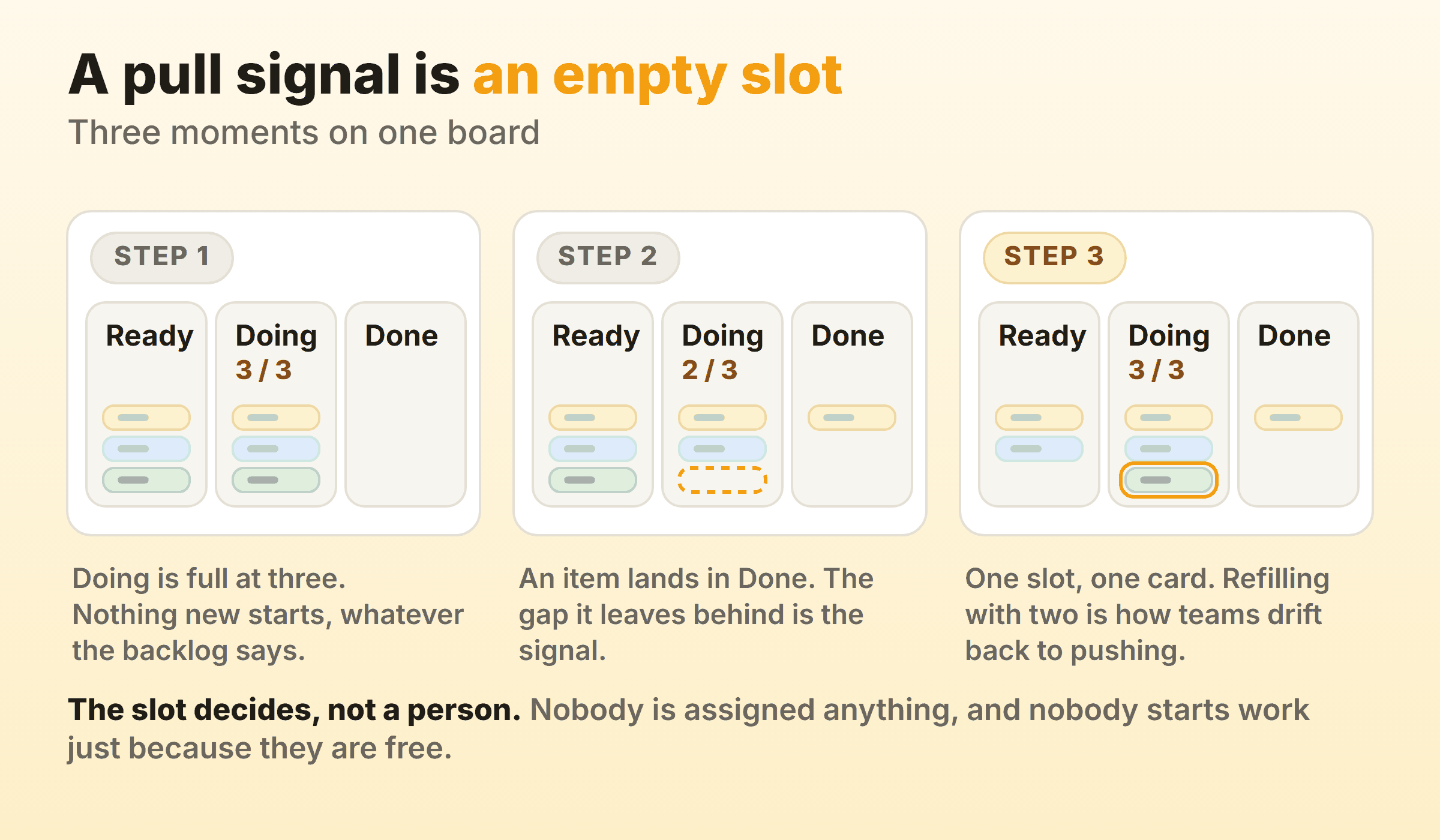
Beat four is the one teams skip. Stopping is unnatural behaviour for a working team, because a pull system asks people to sit still while a queue they can see goes unserved, and every instinct in a normal working culture pushes back against that.
Toyota describes the just-in-time half of its production system as making “only what is needed, when it is needed, and in the amount needed” on its own Toyota Production System page. Kanban is how that sentence gets enforced physically rather than remembered from a workshop. A stage cannot make more than it holds cards for, however loudly the schedule argues.
What Actually Sends the Pull Signal?
The pull signal is whatever thing has gone empty. A message does not count, and neither does somebody tapping you on the shoulder at four in the afternoon. On a board the signal is the gap left in a capped column when a card moves out of it, and in a stockroom it is the bin a nurse emptied twenty minutes ago. Whatever form it takes, it has to be readable without asking anyone, because the second a human has to interpret it you have put the delay straight back in.
What Is the Difference Between a Push and a Pull System?
The difference between a push and a pull system is what authorises work to start. Push authorises from a plan made in advance. With pull, the authority is a slot that just came free. Every other item on the kanban push pull comparison falls out of that one.
| Push system | Pull system | |
|---|---|---|
| What starts work | a schedule, a date, an assignment | a slot opening under a cap |
| Where planning happens | upstream, before anything begins | at the queue, reordered as you go |
| What piles up | half-finished work and unsold stock | a visible queue in front of the constraint |
| The usual failure | overproduction nobody ordered | starvation when upstream stalls |
| Who picks the next item | whoever wrote the plan | whoever has the free slot |
Push and pull system examples sit at opposite ends of most factories. An MRP run that schedules four thousand housings for Tuesday because a forecast said so is push. A shelf restocked only when somebody lifts a box off it is pull. In software the same split looks like a lead handing three tickets to a developer on Monday morning, against that developer taking the top card off a ready queue at the moment a slot opens.
When Push Is the Right Answer
Push is right when demand does not repeat. A pull system sizes itself from consumption history, so a one-off migration or a product line that ships four times a year gives it nothing to work from. Building stock ahead of a known seasonal spike is a push decision and a sound one. Same with a launch date somebody already sold to a customer.
Most real operations run both and stop pretending otherwise, with kanban on the hundred parts that move and conventional scheduling underneath for the rest.
What Are Some Kanban Pull System Examples?
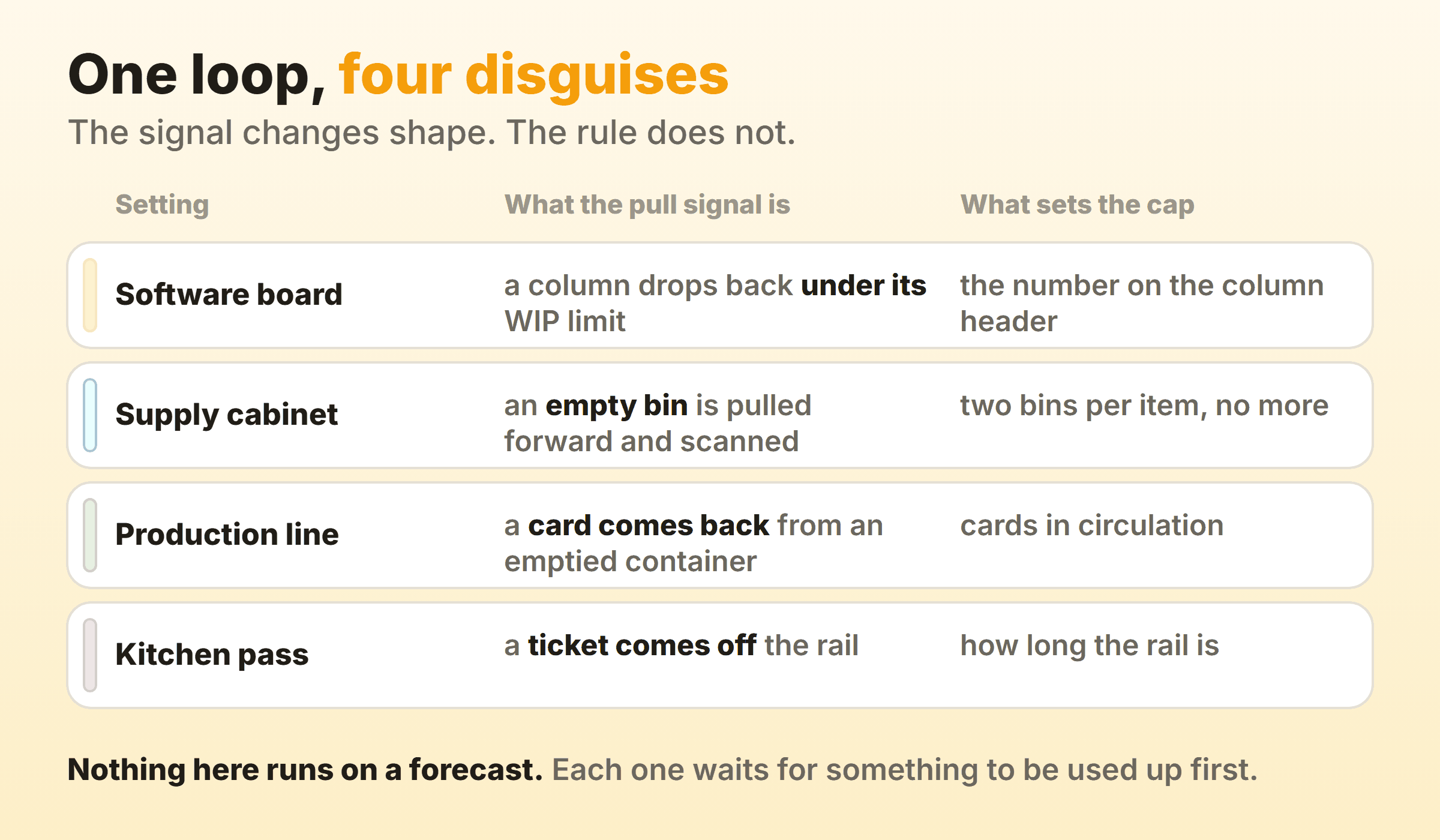
Kanban pull system examples all share one shape. Something gets used up, the empty thing is the order, and the replacement is capped at what was consumed.
On a Software Board
A team caps Doing at three. Somebody drags a card into Done, the badge flips from 3 / 3 to 2 / 3, and whoever freed that slot takes the top card off the ready queue. Nobody got assigned anything. Without the cap, that same person would have started a fourth item three days earlier and finished none of them any sooner.
In a Supply Cabinet
A hospital pull inventory system runs on two bins per item, stacked front to back inside a cabinet. Nurses take from the front bin. When it empties they pull it forward and scan the label, and that scan places the replenishment order while the back bin covers the wait. Nobody counts stock or walks the cabinet with a clipboard on a Friday, because the empty bin is doing the ordering.
On a Production Line
Every container of parts carries a card. An operator opens the container, pulls the card, and drops it in a collection post. A runner walks a fixed route gathering those cards and carrying them back to the feeding cell, which makes exactly what the cards ask for and then stops. Lean practice splits the cards in two, and the Lean Enterprise Institute lexicon names them production kanban, which tells a cell what to make, and withdrawal kanban, which authorises moving parts from one place to another.
What Are the Three Types of Pull System?
Lean practice names three types of pull system, and the Lean Enterprise Institute lists them as supermarket, sequential, and mixed. The same page defines pull production as “a method of production control in which downstream activities signal their needs to upstream activities” and treats it as one of three components of just-in-time. Almost nobody writing about the pull system in kanban for software teams mentions the split, which is a shame, because two of the three describe things software teams already do.
Supermarket Pull
Each process keeps a small stock of what it makes and refills it when a downstream process withdraws something. The withdrawal is the order. Two-bin cabinets are supermarkets, and so is the Ready column on a board, holding a handful of prepared items so the next person to free a slot never sits waiting on refinement.
Sequential Pull
Nothing sits in stock. Items get made to order in the sequence the cards arrived, which is the answer when the catalogue is too wide to hold inventory of every variant. Total stock drops. In exchange the arrangement leans hard on short and dependable lead times, because there is no buffer to hide behind when one stage has a bad week.
Mixed
Both at once, split by volume. The lexicon describes an 80/20 split where roughly a fifth of the part numbers account for most of the daily output. Fast movers get a supermarket and the long tail gets made to order. Software teams do this without ever naming it, keeping a short ready queue for routine work while anything genuinely unusual goes straight to whoever can handle it.
How Do You Set Up a Pull System on a Kanban Board?
Setting up a pull kanban system takes four steps, and only the third one is hard.
- Map the states work really passes through. Not the states you wish it passed through. If items sit waiting on review for two days, review is a column.
- Put a number on the column where the work actually happens. One column is enough to begin with. Doing, or whatever you call it.
- Say the rule out loud, once, in a room. Nothing enters a full column. When it is full, the next action is finishing or unblocking something already inside it.
- Refill the queue on a cadence rather than on demand. A weekly top-up of the ready queue keeps prioritisation out of the daily flow, which is where it does the most damage.
Step three is the training, and kanban push training really is that short. One sentence to explain and about three weeks to stick. The push habit walks back in the first time somebody senior is in a hurry.
In Kanbanee, WIP limits are off by default and get switched on per column from the column menu, with a checkbox and a number pre-filled at 3. The column counter then reads as a count / limit badge and turns red the moment you go over. The limit stays soft on purpose, so dragging a card in over the cap is never blocked. You can overrule it, and people do, but overruling in front of a red badge is a decision somebody made with the number visible.
How Tight Should the Limit Be?
Start at the number of people who pull from that column plus one, then adjust from whatever the board tells you. Three people on a Doing column gives a limit of four. One active item each, and one slot of slack for the inevitable pickup.
Cards bouncing off the cap every single day while people sit idle means the number is too tight, so raise it by one. A column that sits at exactly its limit for weeks and never once flags red means the limit is decorative, so lower it and see what falls out. Flow metrics settle the argument inside a month, because cycle time moves when the cap moves.
Why Do Kanban Pull Systems Stop Pulling?
Kanban pull systems stop pulling long before anybody announces it. Most often the cap just gets dropped. A column goes over on a busy Thursday, nothing catches fire that afternoon, and by the following month the number on the header is a suggestion nobody reads.
Something lands in Done, one slot opens, and the team pulls the three cards that have been nagging at everybody all week. The loop only holds while what you replace matches what you used, so pulling three for one puts you exactly where you were before the finish.
Parking blocked work does the same damage more politely. An item waiting on another team gets shunted into a holding pen so the slot frees up, and now the board reports four items in flight while fourteen are genuinely open. Blocked work should keep its slot. Give it a marker and the date it stopped moving, then open the standup with the oldest one.
Emergencies that go round the outside do the most damage of the four. First time an untracked urgent job bypasses the board, the whole thing starts sliding into decoration. Give urgency a legal route through instead. An expedite lane capped at one, with a written rule that pulling into it pauses a normal item rather than adding to the total.
What Do You Get From a Kanban Pull System?
What you get from a kanban pull system comes out of one piece of arithmetic. Cut the work sitting inside the system and each item spends less time waiting, without anybody working faster. A team finishing three items a week while carrying twelve in progress delivers each one in about four weeks. Cap that same team at four and each item lands in roughly a week and a half. Same people, same weekly output, and the wait cut to a third, which is Little’s Law with the algebra taken out.
Everything else follows from that number. Money stops sitting still, which means inventory in a stockroom and half-finished work nobody has been paid for on a board. A full column upstream of an empty one names your bottleneck in four seconds without a meeting. Adoption costs close to nothing, since there are no roles to appoint and no ceremonies to learn.
A pull-based method says nothing about what to build or in what order, so it sits next to prioritisation and never replaces it. It handles lumpy one-off demand badly. And the whole thing rests on people respecting a limit that nothing physically enforces, so every broken pull system I have been asked to look at was failing on policy, not on software.
FAQ
Is scrum a pull system?
Partly. Scrum teams pull individual items off the sprint backlog as capacity frees up, so the mechanic exists inside the sprint. What arrives at the sprint boundary is pushed, because scope gets committed in a planning meeting for a fixed window whatever is still in flight. Kanban applies pull continuously instead of once per sprint, which is the practical difference covered in kanban versus scrum.
What does a kanban pull system diagram show?
A useful kanban pull system diagram shows the trigger rather than the layout. Consumption at one end, the signal travelling back upstream, replenishment capped at what was used, and the stop. Column pictures only tell you where the cards happen to be sitting. The first figure on this page draws the rule that moves them.
Does a pull system mean the team picks its own work?
No. Pull decides when work starts, not which work gets built. Ordering still comes from whoever owns the backlog, and the person with the free slot simply takes whatever sits at the top of the ready queue. Pull does nothing for a badly ordered backlog. Items leave the queue top first, whatever happens to be sitting there.
Is a pull system the same as just-in-time?
Not quite. Just-in-time is the goal, which is producing only what is needed when it is needed. A pull system is one of the mechanisms that gets you there, and kanban is one implementation of a pull system. The Lean Enterprise Institute treats pull production as one of three components of a complete just-in-time system.
Do you need software to run a kanban pull system?
No, and the original ran on cardboard for decades. Index cards on a wall work perfectly for a team sharing a room, and physical cards in a factory are still common because they cannot drift out of sync with reality. Software earns its keep once the team is spread across time zones, or once the volume of cards outgrows the wall. It also measures cycle time and throughput for you, which beats counting by hand.