
Kanban System: How It Works on a Board and on a Line
Updated at
The Answer
A kanban system is a way of running work where nothing new starts until something finishes and sends back a signal asking for a replacement. Three things have to be present: a signal you can see, a fixed cap on how much work the system will hold, and a rule that only the signal lets new work in. That signal is a laminated card on a warehouse shelf in one setting and an empty slot under a WIP limit on a software board in another. The mechanics do not change. Toyota built the first one in the late 1940s to control parts moving between production stages, and software teams picked the idea up about fifty years later, keeping most of the vocabulary intact.
What Is a Kanban System?
A kanban system is a pull system with a hard cap on how much work sits inside it at any moment. Kanban means signboard in Japanese and the first ones were exactly that. A card rode along with a container of parts, came back on its own once the container had been emptied, and that returning card was the order. The Lean Enterprise Institute’s lexicon still defines kanban as a signalling device that authorises production or withdrawal.
Authorises is the word doing the work there. Under a schedule, a plan or a manager decides when the next thing starts. Kanban takes that decision away from both of them and hands it to an empty container.
The naming is loose in practice. Kanban methodology, kanban framework, kanban model and kanban process all get used for the same body of ideas, and a kanban visual system means what a visual kanban system means. Only one distinction earns its keep, between the board and the rules around it.
The Three Parts of a Kanban System
- A signal. A card, a bin, a barcode, an empty slot in a column. Whatever form it takes, it has to be readable without asking a person.
- A limit. The cards or containers in circulation are counted and fixed. That count is the total amount of work the system will ever hold.
- A pull rule. Work enters only when a signal comes back. Nobody gets to push an extra item in because it feels urgent this morning.
Drop the second and third and you have a task board. Which is fine. Plenty of teams describe theirs as a kanban board system when what they run is a shared to-do list with tidy headings. I have watched the limit get quietly dropped in week two of a rollout, repeatedly. Usually nobody announces it. A column goes over its cap during a busy Thursday, nothing catches fire that afternoon, and by the following month the number on the column header is a suggestion.
How Does a Kanban System Work?
A kanban system works as a closed loop of four beats. Something downstream gets consumed. A signal comes free and travels back up the chain. Upstream makes or moves exactly the amount that was used, then stops, and nothing else happens until the next signal shows up.
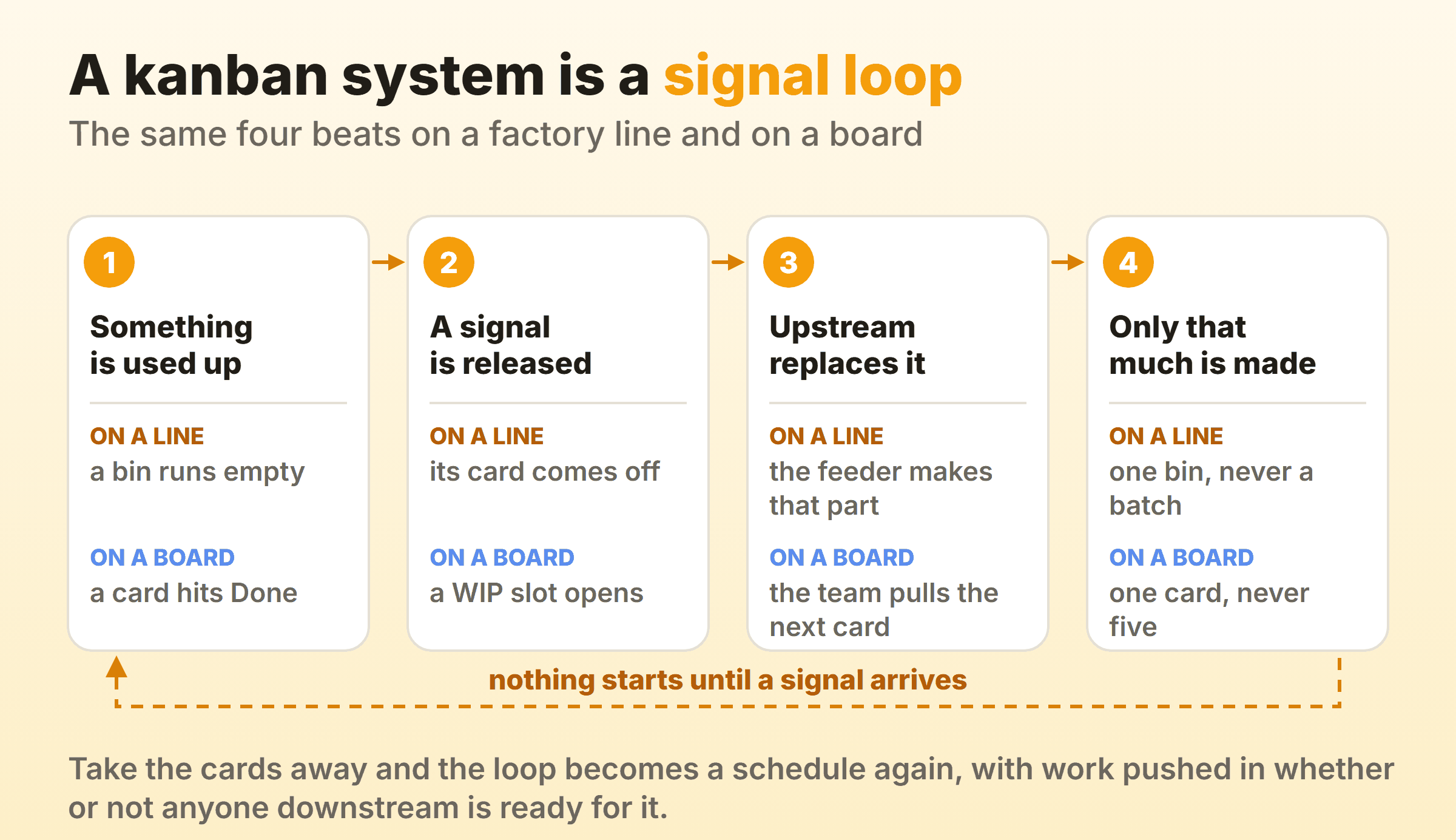
Toyota describes the just-in-time half of its production system as making “only what is needed, when it is needed, and in the amount needed” on its own Toyota Production System page. Kanban enforces that sentence physically. A stage cannot make more than it holds cards for, even when somebody senior wants it to.
The loop runs the same way on a software board. A card lands in Done, In Progress drops back under its limit, and the open slot is what tells somebody to pull the next item out of the ready queue. No assignment happens. That covers most of how kanban works, and the rest of the kanban method is instrumentation wrapped around it.
Teams break it at beat four. Something finishes, the slot opens, and instead of pulling one card they pull the three that have been waiting longest, because those three have been nagging at everybody. The loop only holds while the amount you replace matches the amount you used up, so pulling three cards for one finished item puts you straight back where you started.
What Makes a Kanban System Visual?
A visual kanban system is one where the state of every item can be read off a wall or a screen without asking anybody for an update. Columns stand for the stages of your kanban workflow, cards for the items themselves, and a running count on each column header shows how full it is against its cap.
Visibility sounds like a soft benefit until you watch what it does to arguments. A queue everybody can see gets argued about in the open. Bury the same queue three clicks into a ticket system and it will sit there for eleven months without anyone raising it. In Kanbanee, WIP limits are off by default and get switched on per column from the column menu, and the badge showing count against limit turns red the moment the cap is breached. The limit stays soft on purpose, so dragging is never blocked. You can ignore the red badge, and people do. Ignoring it is still a decision somebody made with the number in front of them.
Two choices carry most of the weight in a visual system. How you name and cut your columns settles whether the board shows real states or a tidy fiction. The second is where the limits sit, because a board with no caps on it reports what people are doing and never once interrupts them.
Where Do Kanban Systems Run Outside Software?
Kanban systems run anywhere a downstream stage consumes what an upstream stage supplies, which reaches well past kanban project management. Manufacturing has run them continuously since the 1950s. Hospitals, warehouses, commercial kitchens and parts depots all use versions of the same loop, mostly without calling any of it agile. People run a kanban organization system on a fridge door for household chores.
On a Production Line
On a line, the kanban system is an ordering system. Every container of parts carries a card. An operator opens the container, pulls the card, drops it in a collection post, and a runner walks a fixed route gathering those cards and carrying them back to the feeding process. Lean practice splits the cards into two kinds. A production kanban tells an upstream cell what to make, and a withdrawal kanban authorises moving parts from one place to another. Run a kanban parts system with both and a line can operate on hours of stock at the bench instead of weeks in a warehouse.
In a Hospital Supply Room
A hospital kanban system is usually a two-bin arrangement inside a supply cabinet. Each item gets two bins stacked front to back, nurses take from the front one, and when it empties they pull the empty bin forward and scan the label on it. That scan is the signal. It fires the replenishment order while the back bin covers the wait. A kanban system in healthcare tends to survive where paper counts do not, because it removes the weekly stock take altogether. Nobody has to estimate anything. A healthcare kanban system starts in one supply room and spreads once nurses stop being asked to count things at shift end.
In a Stockroom or Parts Cage
A kanban racking system is the two-bin idea built into the shelving itself. Flow racks get loaded from the back and picked from the front, so the geometry enforces first in first out with nobody policing it. Stockrooms that run this well carry weeks less stock than their min-max equivalents, because consumption pulls the trigger, with nobody walking the aisles on a Friday holding a clipboard.
How Many Kanban Cards Does the System Need?
The number of kanban cards a system needs comes out of a short calculation. Multiply the daily consumption rate by the replenishment lead time in days, add a safety factor, then divide by how many units fit in one container.
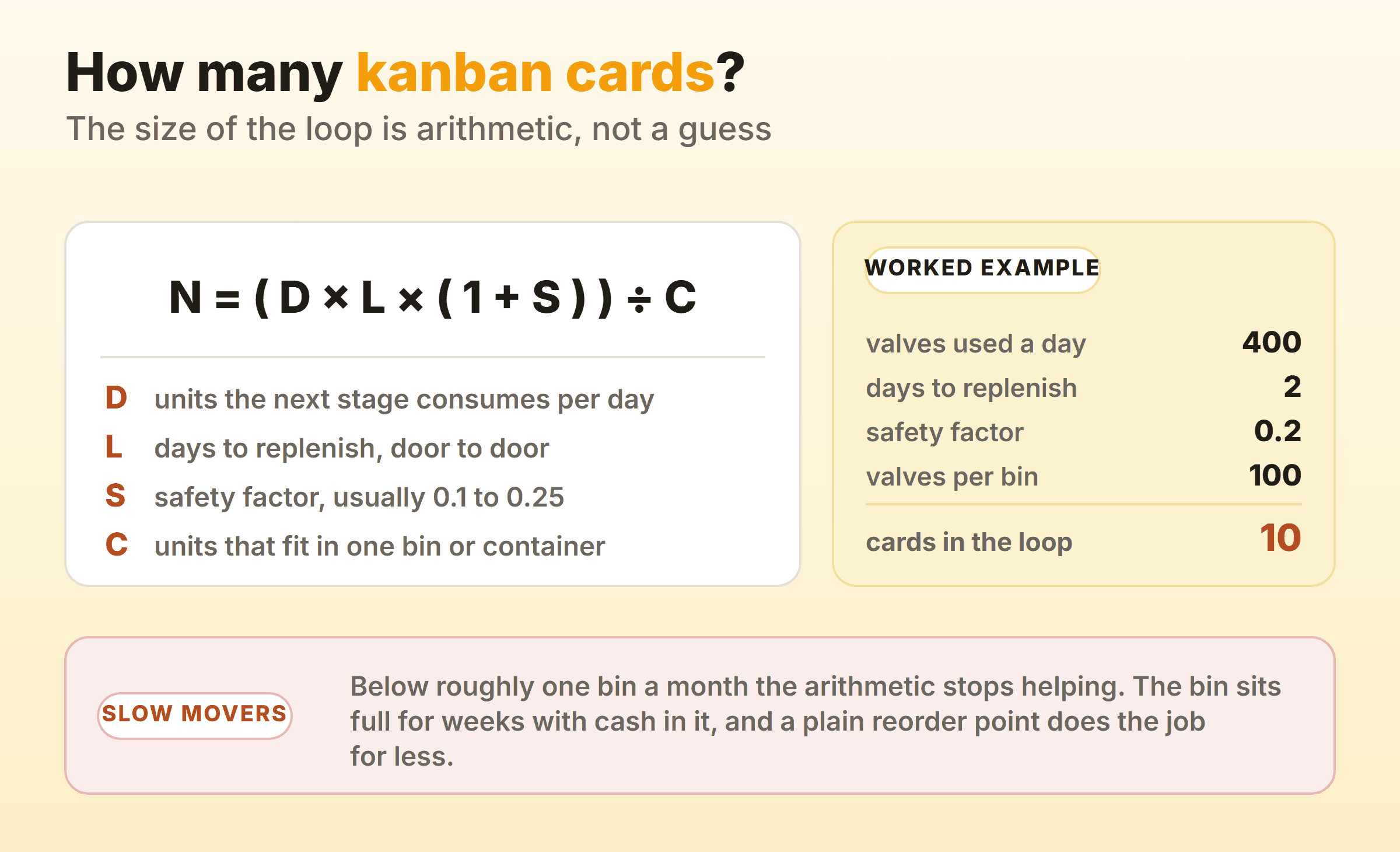
Four hundred valves a day, two days to replenish, twenty percent safety, one hundred valves per bin. Ten cards. That is a thousand valves living in the system at any given moment. Change any input and the card count moves with it, so the number belongs on a review cycle and not in a laminated procedure from 2019.
On a software board the same arithmetic wears different clothes. Cards in circulation is your WIP limit, replenishment lead time is your cycle time, and throughput is how many items a kanban team finishes in a week. Flow metrics are what let you tune the limit against evidence.
High-Turnover Parts and Slow Movers
A kanban system for high turnover parts works because the demand repeats often enough for an average to mean something. Fast movers recycle their cards within days, so an error in the count surfaces almost immediately and gets corrected before it costs anybody anything.
Slow movers are where the method stops paying for itself. A kanban system for low turnover slow moving parts looks tidy on a spreadsheet and behaves badly in a stockroom: one bin lasts four months, the card count rounds down to one, the stock sits there tying up cash, and the demand is far too lumpy for any average to describe it honestly. Below roughly one container a month I would use a reorder point or make the item to order. Most real stockrooms end up mixed anyway, with kanban on the top hundred movers and conventional ordering underneath.
What Does a Kanban System Need to Work Properly?
In order for a kanban system to work properly, everyone touching it has to obey the signal on the days when obeying it is inconvenient. Toyota codified that into six rules, and the Lean Enterprise Institute lists them in roughly the form they were taught on the line.
- The downstream process withdraws only what the kanban specifies.
- The upstream process makes only what the kanban specifies, in the order the cards arrived.
- Nothing is made or moved without a kanban.
- A kanban travels with every item.
- Defects never go downstream, because a bad part consumes a signal without satisfying any demand.
- The number of kanban gets reduced over time, deliberately.
Three and six decide whether the thing survives its first year. Three is where the discipline sits. The first time a manager pushes an untracked emergency order past the board, the whole system starts becoming decoration. Six is the improvement engine. Almost everybody skips it. You cut the card count on purpose, something breaks, you fix what broke, then you cut again.
Underneath all six sit two conditions nobody writes on the wall. Demand has to repeat closely enough that an average describes it, and replenishment has to be reliable enough that the safety factor absorbs the variation. A supplier who runs a week late every third month will empty your bins no matter how beautifully the board is drawn.
Managing Dependencies and Blocked Work
Managing dependencies in a kanban system comes down to one decision, made in advance and out loud. Does a blocked item keep its slot? It should. An item waiting on another team is still work the system committed to, and shunting it into a holding pen to free capacity is how a team ends up with fourteen things in flight while the board honestly reports four.
On my own board, blocked cards stay put, get a marker and the date they stopped moving, and the standup opens with the oldest one. If blocked items pile up faster than they clear, the dependency is the problem and no amount of limit tuning will touch it.
What Are the Benefits of a Kanban System?
The benefits of a kanban system all trace back to one piece of arithmetic. Cut the work in progress inside the system and every item spends less time waiting, with nobody working any faster. A team finishing three items a week while carrying twelve in progress delivers each one in four weeks. Cap that same team at four and each item lands in about a week and a half. Same people and the same weekly output, with the wait cut to roughly a third.
The other advantages of a kanban system fall out of that same number. Money stops sitting still, which in a stockroom means inventory and on a board means half-finished work nobody has been paid for. A full column upstream of an empty one names your constraint in about four seconds, without a meeting. Adoption is nearly free, because nobody changes title and the only new object is a number written at the top of a column. And improvement gets a dial you can turn, since lowering the card count is a change you can make on a Monday and read off the board by Friday.
Now the honest part. A kanban system says nothing about what to build or in what order, so it sits alongside prioritisation and never replaces it. It copes badly with lumpy one-off demand. And it depends completely on people respecting a limit that nothing physically enforces, which is why kanban systems improvement work is mostly a matter of policy discipline and only occasionally a matter of tooling. Teams who want a framework that assigns responsibility for those calls are usually looking for scrum, or a blend of the two.
FAQ
What is a kanban ordering system?
A kanban ordering system is the replenishment flavour of kanban, where the returning card is the purchase or production order itself. Consumption fires the order, so nobody forecasts and no one runs a weekly count. Same loop as a board, with stock in place of tasks.
Is a kanban system the same as an ERP system?
No. An ERP system is a database of record for orders, stock, finance and planning, and it pushes work out from a plan. A kanban system is a signalling rule that pulls work in from what has already been consumed. Most manufacturers run both, with kanban controlling the shop floor while ERP holds the master data, and several ERP products ship an electronic kanban module that swaps the physical cards for barcode scans.
What is the difference between a kanban system and a kanban board?
A kanban board is the visual surface: columns, cards, and whatever you write on them. A kanban system is that board plus the limits plus the written policies saying who may pull what and when. Every kanban system needs a board of some description. Most kanban board systems on the market ship the board and leave the limits and policies to you.
Can a kanban system work on paper?
Yes, and the original ran on cardboard for decades. Index cards on a wall are perfectly adequate for a team sitting in one room, and physical cards in a factory are still common because they cannot desync from reality. Kanban software earns its place when the team is spread across time zones, when you want cycle time and throughput measured for you, or when the card volume outgrows the wall.
What does a kanban system diagram show?
Two things, and most published diagrams stop after the first. One is the loop: something gets consumed, a signal travels back, upstream replaces that amount and then stops. The other is the size of the loop, meaning the card count, because a loop with no number attached is a policy nobody has costed yet. A screenshot of columns shows neither of them.