
Kanban Comparisons: Kanban vs Scrum, Lean, Waterfall and More
Updated at
The Answer
Most kanban comparisons argue about the wrong thing, because kanban and whatever it is being weighed against usually belong to different categories. Kanban is a method for controlling flow. You visualise the work, cap how much is in progress, and measure how long items take to finish. Scrum, scrumban and SAFe are frameworks with prescribed roles and events. Agile, lean and kaizen are philosophies that prescribe no practices at all. Waterfall and MRP plan first and push work out on a schedule. A Gantt chart and a task board are artefacts rather than methods. Only CONWIP sits in kanban’s own category and makes a true like-for-like rival. So in any kanban vs X question, work out what X is before asking which one wins, because the category decides whether you are picking one or running both.
Why Do Most Kanban Comparisons Compare the Wrong Things?
Kanban comparisons go wrong because the same word covers three different objects. A kanban is a card. A kanban board is the wall those cards live on. The Kanban Method is the set of practices David Anderson wrote up in 2010 for knowledge work, built on the card system Taiichi Ohno had running at Toyota decades earlier. Ask “kanban vs waterfall” and you mean the method. Ask “kanban vs task board” and you mean the board. Ask about one-card versus two-card systems and you mean the card.
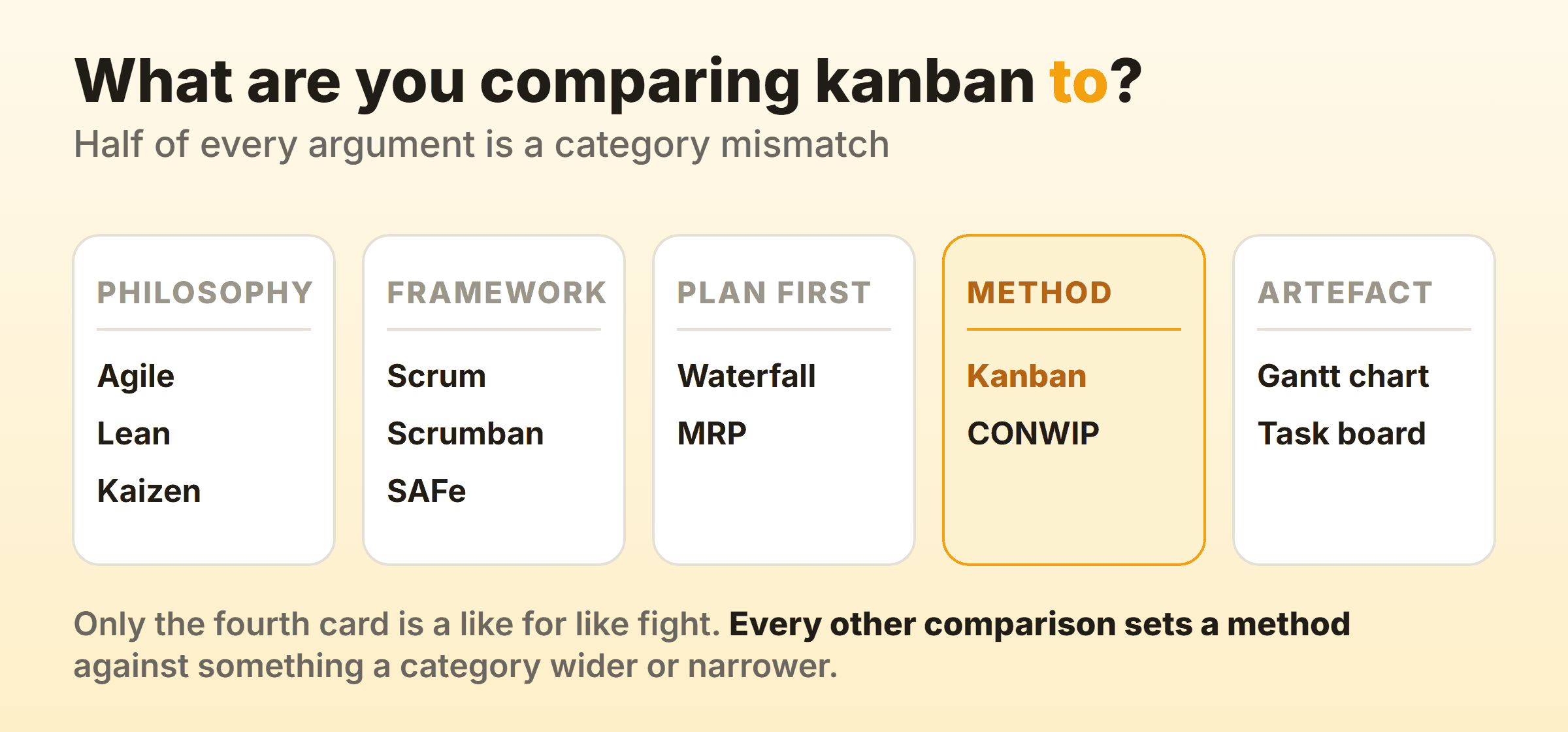
Sort the rival by category and the answer usually falls out on its own.
A philosophy tells you what to value. Agile is four value statements and twelve principles, and it names no practice you could run on Monday. Lean and kaizen are the same shape, older, and from manufacturing. None of them competes with kanban, because none of them tells you what to do.
A framework tells you who does what and when. Scrum has three accountabilities and five events. SAFe stacks more of the same across many teams. Frameworks and kanban really do overlap, which is why kanban vs scrum is the only comparison in this set that most teams have to settle rather than dissolve.
A plan-first system decides the whole schedule up front and releases work against it. Waterfall does this for projects, MRP does it for parts. Both push. Kanban pulls. That is the entire argument.
An artefact is a thing you look at. Gantt charts and task boards belong here, and comparing one to a method is like comparing a speedometer to defensive driving.
Kanban vs Scrum, Sprints, Scrumban and Agile
The agile family produces four of the five most searched kanban comparisons, and each one turns on a different mechanic.
| Compared with kanban | What it actually is | The difference that decides it |
|---|---|---|
| Scrum | Framework | Scrum commits to a fixed time box, kanban never does |
| Sprints | One scrum artefact | A sprint batches work by date, kanban releases items one at a time |
| Scrumban | Hybrid | Keeps scrum’s planning rhythm, drops the sprint commitment, adds WIP limits |
| Agile | Philosophy | Agile sets values, kanban sets practices, so they stack |
| SAFe | Scaling framework | SAFe coordinates many teams, kanban governs one team’s flow |
Scrum is the real fight. The Scrum Guide defines a sprint as a fixed period of one month or less, and everything else in scrum exists to protect that boundary. Kanban has no boundary to protect, so it drops planning, review and the commitment along with it. Teams whose priorities survive two weeks are usually better off in scrum. Teams interrupted every Tuesday are not.
The other three are not really contests. Sprints are a scrum mechanic, so kanban vs sprint is scrum vs kanban asked from a narrower angle. Scrumban is what you get when a scrum team keeps the calendar and borrows the caps. Agile is a philosophy that kanban happens to satisfy, which is why nobody blinks at the phrase “agile kanban”.
Kanban vs Waterfall
Kanban and waterfall disagree about when you are allowed to decide. Waterfall fixes scope, sequence and dates before the work starts, then moves through phases in order: requirements, design, build, test, release. Kanban fixes nothing except how much can be in progress at once, and lets the order change whenever priorities do.
Winston Royce’s 1970 paper is usually blamed for waterfall, which is unfair, since he described the sequential model and then argued it was risky without iteration. The model spread anyway, because a plan is easier to fund than a promise to keep deciding.
Waterfall still wins where change is genuinely expensive. Pouring concrete, shipping firmware to a device you cannot patch, anything regulated where the approval is the deliverable. Kanban wins where requirements arrive mid-flight. Most real projects are a mixture, and the honest hybrid is a fixed outer date with a board handling the work inside it.
Kanban vs Lean and Kaizen
Lean and kaizen are ancestors of kanban rather than alternatives to it, so both comparisons resolve into a hierarchy rather than a choice.
Kanban vs Lean
Lean is the philosophy, and kanban is one of its tools. James Womack and Daniel Jones set out lean’s five principles in Lean Thinking: define value, map the value stream, create flow, establish pull, pursue perfection. Kanban is the mechanism for the fourth one. You can run lean without a single kanban card, using takt time or levelled scheduling instead. You cannot really run kanban and claim you are ignoring lean, since limiting work in progress is a lean idea wearing a different hat.
The difference between lean and kanban shows up in scope. Lean covers the whole value stream, including things a board never touches, like setup times and supplier contracts. Kanban covers what happens between the first column and the last.
Kanban vs Kaizen
Kaizen means continuous improvement, and it is the habit rather than the system. Masaaki Imai’s 1986 book put the word into English management vocabulary. Kanban gives you a system that makes problems visible, and kaizen is what you do about them once they are. A board with a card stuck in review for nine days is doing its job. Nothing improves until somebody asks why.
Teams that adopt kanban and skip the kaizen half end up with a very tidy picture of a broken process. That is the most common failure I see, and it is not a tooling problem.
Kanban vs Task Boards, Project Management and Gantt Charts
These three comparisons all put a method against something narrower, and each one hides a different assumption.
Task Board vs Kanban
A task board and a kanban board look identical and behave differently. Both have columns and cards. Only one caps the middle. Take a team board with To do, Doing and Done, let anybody drag anything across at any time, and you have a task board that visualises work without governing it. A board only becomes a kanban system when something limits how many cards can sit in the middle at once. In Kanbanee that cap is a per-column number that turns the count badge red when you exceed it, and that WIP limit is the one feature separating the two.
Kanban vs Project Management
Kanban is not a substitute for project management, and treating it as one is how teams end up with a beautiful board and a missed launch. Project management covers scope, budget, stakeholders, risk and dependencies between teams. Kanban covers the flow of work items through a process. A board tells you nothing about whether the budget holds or whether the vendor signed.
Kanban vs Gantt Charts
A Gantt chart plots work against time, so its horizontal axis is dates and the length of a bar is a duration. A kanban board plots work against state, so its columns are process steps and a card’s position is a status. That one difference decides what each artefact can tell you. A Gantt chart answers when something is due and what it blocks downstream. A board answers what is moving right now and where it is stuck. Neither reads the other’s question, which is why the two coexist more often than they compete, and the full Gantt chart comparison works through the swap in both directions.
Kanban vs MRP, Just in Time and CONWIP
MRP, just in time and CONWIP are all production control systems, so these are the comparisons where kanban is fighting in its own weight class.
MRP calculates what to build from a forecast and a bill of materials, then releases orders on that schedule. It pushes. Kanban releases nothing until a downstream signal asks for it. The practical split is by part behaviour rather than by ideology. High turnover parts with steady demand suit kanban, because the loop refills often enough to stay tuned. Low turnover parts with lumpy demand suit MRP or a plain reorder point, since a card sitting in a rack for four months is just inventory with extra steps.
Just in time is the goal and kanban is the means. Ohno described the card system as the operating method that makes just in time work, so kanban vs just in time inventory is a means-and-ends question rather than a versus.
CONWIP is the genuine rival. It caps total work in the whole line instead of between each pair of stations, which is why Mark Spearman, David Woodruff and Wallace Hopp introduced it in 1990 as a pull alternative to kanban. Kanban tunes better when the mix is stable. CONWIP copes better when it varies, because it does not need a card count per part number.
One-Card vs Two-Card Kanban Systems
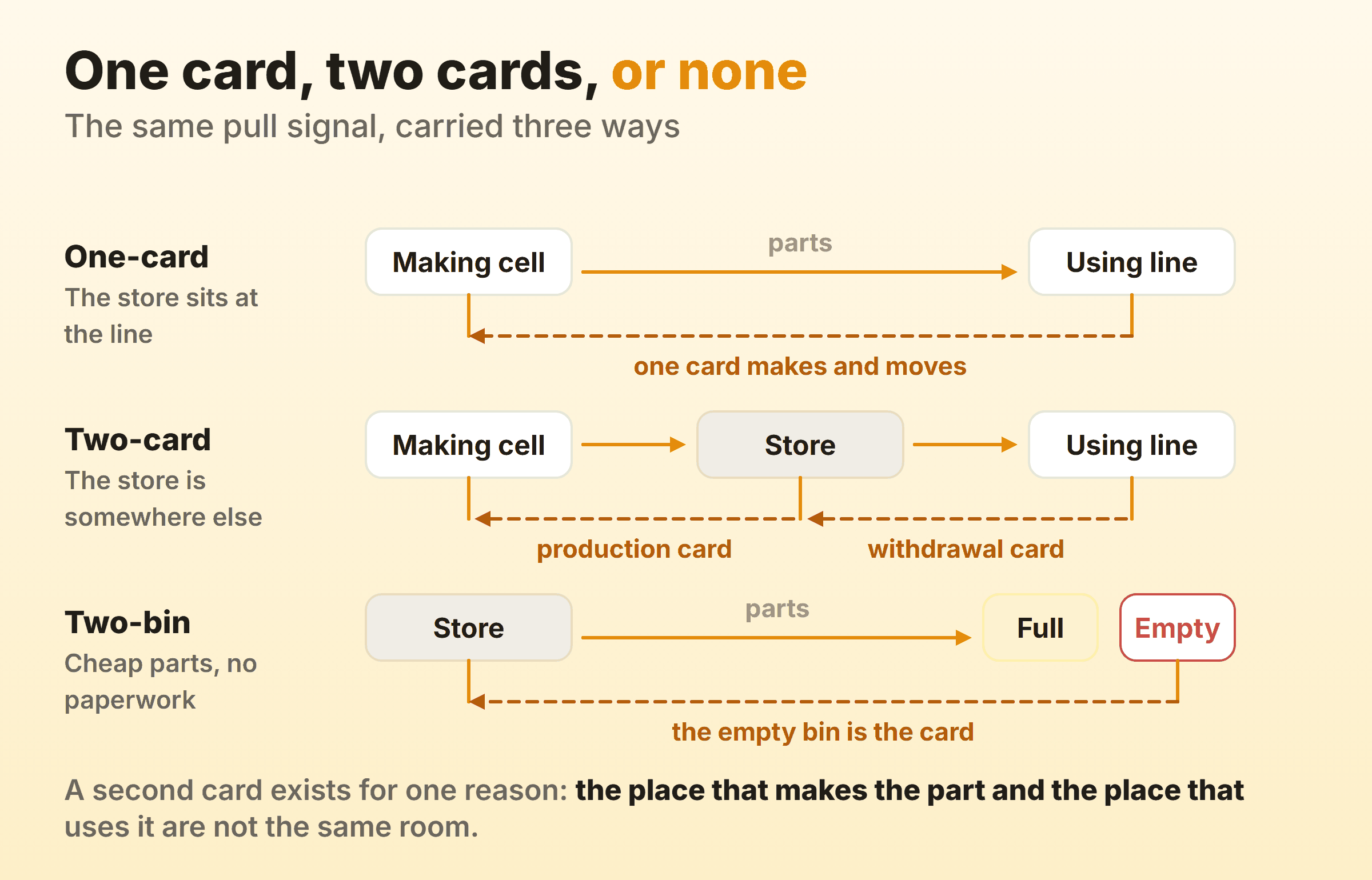
The one-card versus two-card kanban question is about distance, not sophistication. A single card system uses one card to carry both signals: make more of this, and move it to where it is used. A dual card system splits that into two cards moving in two loops, with a store sitting between them.
When One Card Is Enough
One card is enough when the place that makes the part and the place that uses it are effectively the same place. The card comes back with the empty container, and the same piece of paper authorises production and movement at once. Fewer cards, fewer racks, fewer chances to lose the signal. Most cell layouts and every software board in existence run this way, since a Jira ticket does not need a separate movement authorisation.
When You Need Two Cards
You need two cards once material has to sit somewhere between making and using. The withdrawal kanban travels from the using line to the store and authorises a container to move. The production kanban travels from the store back to the making cell and authorises a replacement to be built. Two loops, two card types, one buffer in the middle. That is the difference between one-card and two-card kanban in a sentence: the second card exists to manage a store that the first system does not have.
The cost is real. Twice the cards to print, audit and recalculate whenever demand shifts. Do not adopt a dual card system because it looks more serious.
One-Card Kanban vs the Two-Bin System
The two-bin system removes the card entirely. Two containers of the same part sit at the point of use, work draws from the first, and when it empties the bin itself goes back as the reorder signal while the second bin covers the lead time. No printing, no scanning, nothing to lose. It is the cheapest pull system that works, which is why it dominates fasteners, gloves and consumables, and it is covered further in kanban inventory management. The limit is information. A bin can say “send more” and nothing else, so as soon as you need part numbers, quantities or routing on the signal, you are back to cards.
What Do the Comparisons Inside Kanban Mean?
Four more comparisons come up constantly, and all of them are internal distinctions rather than rival systems.
Kanban Board vs Kanban System
A kanban board is the display, and a kanban system is the set of rules governing what moves across it. Board plus limits plus pull plus an explicit policy for each column equals a system. Board on its own equals a picture.
Production Kanban vs Withdrawal Kanban
Production kanban authorises making something. Withdrawal kanban authorises moving something that already exists. In a one-card system the same card does both jobs, which is exactly why the two names only matter once you run two cards.
Push vs Pull
Push starts work because a schedule says so. Pull starts work because capacity freed up downstream. Every kanban system is a pull system by definition, and most boards that fail are failing because they kept pushing under a new layout. There is a longer treatment in the pull system article.
Cycle Time vs Lead Time
Cycle time measures from the moment the team starts an item to the moment it is done. Lead time measures from the moment the customer asked. The gap between them is queue time, and it is usually the larger number, which is why a team can post excellent cycle times while customers complain about waiting. Measure both. The created versus resolved chart in Jira answers a third question again, whether arrivals are outpacing departures, and a growing gap there means the queue is filling faster than you can drain it.
Personal Kanban vs GTD and Bullet Journals
Personal kanban is the same method shrunk to one person, and Jim Benson reduced it to two rules: visualise your work, limit your work in progress. That is the whole system. No roles, no cadences, no columns you did not choose yourself.
Against Getting Things Done, the difference is what each one optimises. David Allen’s method is a capture and retrieval system built to get everything out of your head and into trusted lists sorted by context. It is excellent at making sure nothing is forgotten and silent on how much you take on at once. Personal kanban is the reverse. It holds very little and makes overcommitment physically visible, because a fourth card will not fit in a column capped at three. Plenty of people run both, using GTD to capture and a board to limit.
Against a bullet journal, the split is time versus state. A bullet journal is chronological, so a task migrating forward day after day is visible only if you flip pages. A board is spatial, so the same task sits in the same column looking increasingly stale. Journals are better for reflection and for anything dated. Boards are better at showing you the pile.
FAQ
Which kanban comparison actually matters for my team?
If you are choosing how to run delivery, only kanban vs scrum needs deciding, since the rest either sit above kanban as philosophy or below it as artefacts. If you are running a stockroom, the real question is one-card versus two-card versus two-bin, and it comes down to whether a store sits between making and using.
Is CONWIP better than kanban?
Neither is better in general. CONWIP caps the whole line and copes better with a changing product mix, while kanban caps each link and tunes more precisely when the mix is stable. Lines with many part numbers and unpredictable orders tend to find CONWIP easier to maintain, because there are no per-part card counts to recalculate.
When should you use a single card kanban system instead of a dual card one?
Use a single card system when the making point and the using point are close enough that one card can authorise production and movement together. Switch to dual card once a store sits between them, or once material has to travel far enough that movement needs its own authorisation and its own timing.
Does kanban replace project management software?
No. Kanban governs how work items flow through a process and says nothing about budgets, contracts, resourcing or cross-team dependencies. Teams running projects with hard external dates usually keep a schedule for the milestone layer and a board for the daily one.
Is personal kanban different from kanban?
Personal kanban is the same two core practices applied to one person’s work rather than a team’s. What it drops is everything social: no shared policies, no replenishment meeting, no handoff columns. What it keeps is the part that does the work, which is the limit.
Kanban Comparisons With a Full Guide of Their Own
Each of these gets the full treatment on its own page.
- Kanban vs Scrum covers cadence, roles, planning, metrics, and how to move from one to the other.
- Kanban vs Sprints explains what replaces sprint planning and when a fixed time box is still worth keeping.
- Scrumban sets out the three versions teams actually run and when the hybrid is just scrum with extra steps.
- Kanban vs Agile settles whether a method can be compared with a philosophy at all.
- Gantt Chart vs Kanban compares a time axis with a state axis, and shows which flow charts kanban gives you instead.