
Kanban Inventory: How Two-Bin Systems and Card Counts Work
Updated at
The Answer
Kanban inventory is stock control where the empty container places the order. Every part gets a fixed number of bins or cards in circulation, stock is replaced only when one comes back empty, and nothing is bought against a forecast. The common version is the two-bin system. A line picks from the front bin, and the moment that bin runs dry the bin itself, or the card taped to it, becomes the reorder signal while the reserve bin covers the supplier lead time. Parts on the floor can never exceed the containers in circulation, so sizing the loop sets your inventory ceiling before a single order goes out. The arithmetic behind it is small. Demand during the replenishment lead time, plus a safety factor, divided by how many pieces fit in one container.
What Is Kanban Inventory?
Kanban inventory is a method of inventory control where the act of consuming a part authorises its replacement. A kanban is a signal card, and one rule rides with it everywhere. No card, no replenishment. Stock sits in standard containers holding a known quantity, and when a container empties its card goes back to a collection point for whoever supplies that part to refill. Until the card returns, nobody upstream may make or buy anything at all.
Push works the other way round. MRP explodes a forecast into a schedule and releases orders against dates it calculated weeks earlier, which is fine while the forecast holds and expensive the week it stops. A kanban inventory system is a pull system, so it responds to what actually left the shelf this morning. Both want the right part in the right place at the right time. They split over who spots the shortage, a scheduler running overnight or an operator looking at an empty bin.
Taiichi Ohno built the first version at Toyota after watching American supermarkets restock shelves from what shoppers had taken off them, and the history of kanban still shows in the vocabulary. A store of parts between two processes is a supermarket. Toyota describes the just-in-time half of its production system as making “only what is needed, when it is needed, and in the amount needed” on its own Toyota Production System page.
What Kanban Inventory Management Controls, and What It Leaves Alone
Kanban inventory management controls the timing and the size of replenishment for parts you consume over and over. Forecasting and scheduling stay somebody else’s job. Fast movers are where it pays, because a part with frequent signals turns its loop often enough for errors to surface in days instead of quarters. Fasteners, gloves, seals, labels, printed film.
So most plants run kanban over a minority of their part numbers. That is the right answer, whatever a coverage chart says. Lumpy demand stays on conventional planning, because a loop turning three times a year never corrects itself.
How Does a Two-Bin Kanban System Work?
A two-bin kanban system works by holding every part in two containers, drawing from one until it empties, and treating that empty container as the order. Nobody counts a shelf. There is no Friday walk round the rack with a clipboard, which is the whole reason the 2 bin kanban system survived decades of software promising to replace it.
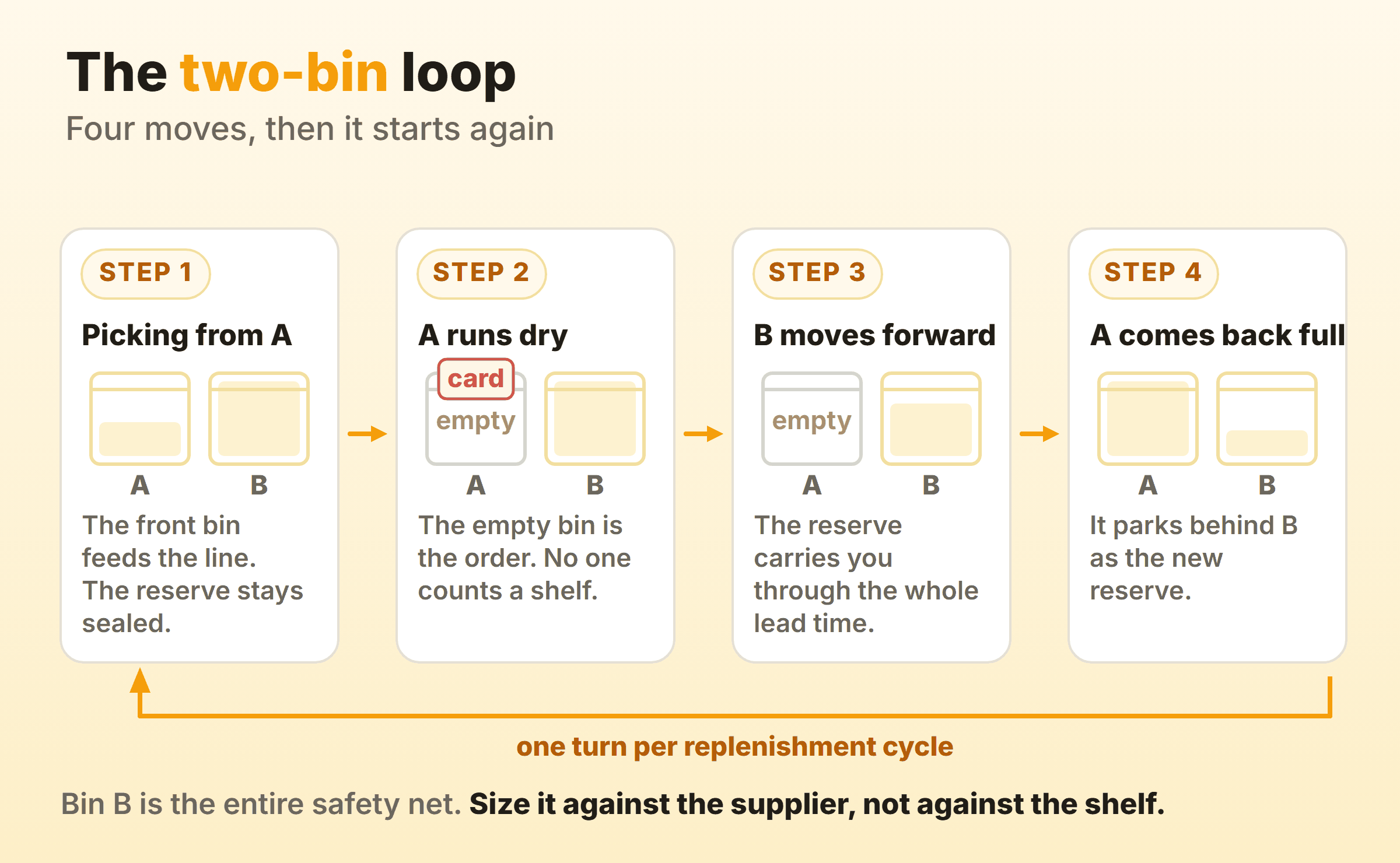
The reserve bin does all the work in that picture. It covers the entire replenishment lead time, so its quantity, and nothing about the front bin, decides whether you stock out. Size bin B against your supplier and the system stays quiet. Fill it with whatever happens to fit the rack and you will be expediting by month end.
Why a Two-Bin System Is a One-Card Kanban
A two-bin system is the physical form of a one-card kanban, because the bin carries the only signal in the loop. There is no second card authorising a separate move, and nothing to laminate. The empty container is the order and the shipping instruction back to the rack, both at once. Hospital supply rooms are where most people have actually seen it working.
Two-card systems appear only where making and moving are separate jobs done by separate people. Until then a single labelled bin covers it.
When to Add a Third Bin
Add a third bin when one bin of demand is shorter than the replenishment lead time. A bin holding four days of parts against a supplier who takes six days cannot cover the gap, and no amount of discipline fixes arithmetic. Add a bin, shrink the container so more of them cycle, or shorten the lead time.
Three-bin setups also suit a supplier shipping on a fixed weekly route. One bin in use, one waiting on the rack, one on a truck somewhere. It puts half again as much stock on the floor and buys immunity from a late delivery.
How Do You Calculate Kanban Card and Bin Quantities?
Calculate kanban card and bin quantities from demand during the replenishment lead time, inflated by a safety factor, divided by the container quantity. This is the part of a kanban inventory system that goes wrong quietly, because a wrong card count looks exactly like a right one until a line stops.
kanban cards = (D x L x (1 + S)) / C

D = average demand per day
L = replenishment lead time in days
S = safety factor, expressed as a decimal
C = pieces per container
Take a fastener consumed at 480 pieces a day, a supplier who delivers in three days, a 20 percent safety factor and a standard box of 500. That is (480 x 3 x 1.2) / 500, which comes to 3.46, and you always round up. Four cards, four boxes, 2000 pieces on the floor at the ceiling. Cards in circulation are your maximum inventory, stated in advance. No reorder report gives you that.
Now halve the lead time to a day and a half. The same part needs 1.73 cards, so two, and half the stock leaves the floor without anyone touching the safety factor. When a loop finally gets reviewed the argument goes straight to safety stock, and the lead time never gets challenged. That is backwards. Lead time is the input that also improves everything downstream of it.
Setting the Trigger Point
The trigger point is the stock level at which the signal has to fire, and in a bin system nobody ever writes that level down. One full bin left on the rack is the trigger. It is a reorder point in physical form, readable without opening anything.
The reorder point comes back as arithmetic on parts too large or awkward for bins, such as coil stock, bar or bulk resin. There the kanban reorder point formula is demand per day multiplied by lead time, plus safety stock, and a card hangs on the rack at that height. Steel service centres do it with a painted line. Cross the line, the card comes off, and the card is the order.
Choosing a Safety Factor
Choose a safety factor from how unreliable your supplier and your demand actually are. Measure both first. Start somewhere in the 10 to 20 percent band and move from there. A supplier who has never missed a date on a steady part sits at the bottom of it, while a single-source import with a four-week ocean leg belongs well above.
A safety factor is the price of variation you have chosen not to fix, so a number creeping upward every year is a purchasing problem wearing a stock disguise. Review it whenever you review the card count. Demand from two years ago is still sitting in a lot of live card counts.
What Goes on a Kanban Card, and Where Does It Live?
A kanban card carries everything needed to refill one container without a conversation. Part number and description, the quantity that container holds, where the parts come from, where they go back to, and a sequence such as 2 of 4 so anybody can tell how many are meant to be in circulation. That last field earns its space, because a card marked 2 of 4 makes a missing card visible, and a lost card is the quietest failure a kanban inventory system has.
Production, Withdrawal and Supplier Kanban
The Lean Enterprise Institute lexicon splits kanban cards into two kinds, and inventory work adds a third in practice. A production kanban tells a cell what to make and how many. A withdrawal kanban authorises moving parts from a supermarket to the point of use, and it governs internal replenishment between stores and lines. A supplier kanban is a withdrawal card that crosses the company boundary, so it carries a supplier code, a route and a pickup time.
Signal kanban is the fourth name you will meet, used where a batch process cannot economically make one container at a time. A press waits until cards accumulate to a trigger quantity, then runs the batch. Same loop. The trigger is a stack.
Racks, Carts and Card Posts
Kanban racks are the storage half of the system, tilted so full containers roll to the picking face while empties come back down a return lane underneath. Gravity does the sequencing, which ends the argument about which bin is older. Kanban carts do the same job mobile, wheeled to the line and swapped whole, so nobody refills anything at the point of use.
The card post is the piece everyone forgets to design. Cards need one visible agreed place to land, because a card in an operator’s pocket is stock nobody will reorder.
How Does Kanban Replenishment Work Across a Supply Chain?
Kanban replenishment works across a supply chain by repeating the same loop at every handoff, so a card returning from a line pulls from a supermarket, and the supermarket’s own card pulls from the supplier. No forecast goes down the chain. Each link replaces what the link after it consumed.
Inside the plant that turns into a route, not a delivery. A water spider walks a fixed circuit every hour or two, collecting cards and dropping replacement containers, which makes kanban logistics a timetable job. Circuit time decides how much stock sits between processes, and order size barely gets a vote.
Across the factory gate it becomes supplier kanban. The card authorises a shipment against a standing agreement, so no purchase order is raised per delivery and the supplier ships on a milk run against cards received by a cutoff. Industrial distributors run branded versions for consumables, which is how a plant ends up with several vendor programmes that never talk to each other.
A kanban replenishment meeting exists to change loop parameters. Orders never come up at one. The agenda is consumption since the last review, card counts that no longer match demand, and lead times that drifted quietly. Half an hour a quarter, and skipping it is how a working system stops being one.
Why Do Kanban Inventory Systems Still Run Out of Stock?
Kanban inventory systems run out of stock when an input to the loop moves and the loop does not move with it. The mechanism itself almost never fails. The arithmetic was correct eighteen months ago and nobody has looked since, so the causes of stockouts in kanban systems come down to a short list.
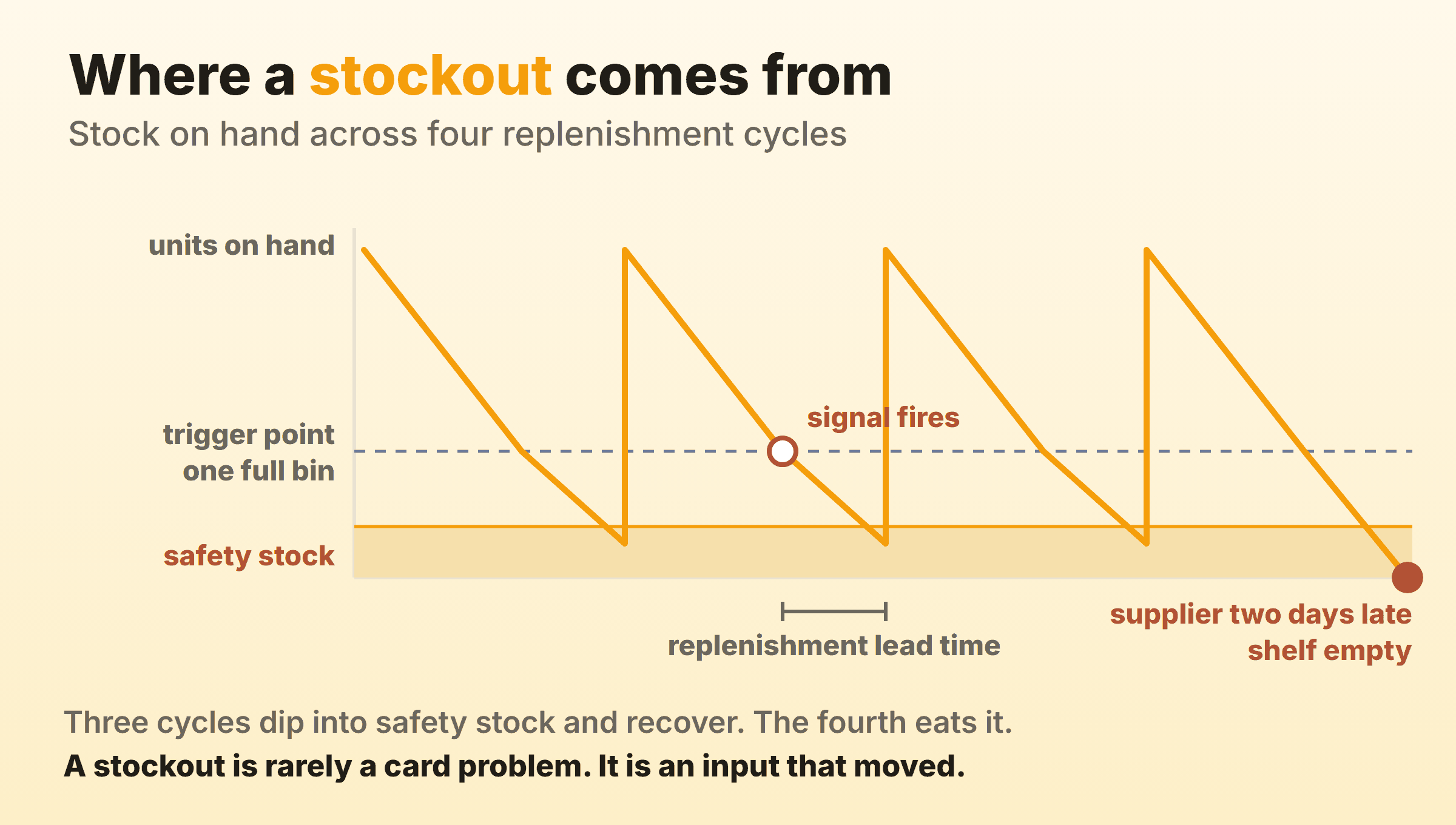
- Demand grew and nobody recalculated. The usual culprit. Card counts get set at implementation and then treated as permanent, so a part whose daily draw doubled is running on half the bins it now needs.
- The supplier lead time drifted. Quoted at three days, actually running at five since they changed carrier. The formula is still using the quote.
- Cards go missing. Pocketed, or binned with the packaging. Every lost card permanently removes one container of stock from the loop, and nothing alerts you.
- Somebody raided the reserve bin. An operator short of parts takes from bin B without signalling, so the trigger never fires and the shelf empties at full speed.
- The supplier batches upstream. Cards arrive daily, the supplier makes monthly, and their queue quietly reintroduces the lead time you thought you had removed.
- Parts on kanban that never should have been. Seasonal or engineered-to-order items break the steady-draw assumption the calculation rests on.
Most of that list traces back to a number nobody revisited, which is the honest argument for wiring a scanner onto the rack.
When Should Kanban Inventory Go Digital?
Kanban inventory should go digital when the card count changes faster than you can reprint cards, or when the signal has to reach somebody who will never walk past your rack. Below that, paper wins on cost and on being readable without an account.
Most plants start with a barcode on the bin label, scanned at the return rail, which writes the order and timestamps the loop. RFID takes the scan off the operator and earns its cost where containers move constantly. Oracle and SAP both ship kanban planning inside their ERP suites, and pulling consumption history out of one turns quarterly card recalculation into a query instead of a survey.
The same mechanic runs on a team board, which is where most people meet kanban now. A column capped at 3 is a bin with three slots, and a kanban card leaving that column is the empty bin coming back. Kanbanee shows count against limit as a badge on the column, 3 / 3, and turns it red when a fourth card lands there, so an overloaded stage is as obvious as an empty rack. Parts and tasks behave differently in every other respect, and the signal is the same object either way.
Start with the bins you already have. Count what leaves them over a fortnight, work the card count out from that, and leave the scanner decision until later.
FAQ
What is an example of a kanban inventory system?
A hospital supply room is the clearest one. Every item sits in two bins on a shelf, nurses take from the front bin, and the empty one gets pushed onto a return rail. Materials management walks the route, scans the empties and refills them behind the bin now in use. No counting, no requisitions, and a stockroom that shows its own shortages to anyone glancing at it.
Does kanban prevent stockouts?
No. Kanban caps how much inventory you hold and makes a shortage visible early, but a loop sized against last year’s demand will still empty the shelf. It removes the mystery instead. When a shelf empties, count the cards first, because a full set means the arithmetic went stale and there is nothing to investigate on the floor.
How many bins should each kanban part have?
Two, unless one bin of demand covers less time than the supplier needs to deliver, in which case add a third. Work it out as demand per day multiplied by lead time in days, times one plus your safety factor, divided by the container quantity, then round up.
What is the difference between kanban and MRP?
Both share the goal of having the right material available at the right moment, arriving from opposite directions. MRP calculates requirements from a forecast and a bill of materials, then pushes orders out on planned dates. Kanban ignores the forecast and replaces what was consumed. Most plants run both, kanban on the fast movers and MRP for the long tail.
Is a two-bin kanban system the same as min-max?
They behave alike and get set up differently. Min-max reorders the difference between a minimum and a maximum quantity once the count drops below the minimum, so it needs the stock record to match the shelf. A two-bin kanban replaces that count with an object. It only asks people to put empty bins where they belong, a lower bar in most stockrooms.