
Types of Kanban: Every Card Type and System Explained
Updated at
The Answer
Lean sources describe two jobs and three types of kanban that do them. A kanban either tells a process to make something or tells a handler to move something, which the Lean Enterprise Institute names a production kanban and a withdrawal kanban. The third, the signal kanban, is a production kanban for batch work, usually a triangular plate placed in a stack of containers that fires a changeover once stock drops far enough to expose it. Withdrawal then takes two forms depending on where the parts come from, an interprocess kanban for an internal process and a supplier kanban for an external supplier. Several other names describe what carries one of those signals rather than a new job, such as a two-bin rack where the empty bin is the signal, coloured balls or an electronic signal, while the software task board is a separate system that borrowed the word. The rule underneath the factory versions holds. No kanban, nothing gets made and nothing gets moved.
What Are the Main Types of Kanban?
The main types of kanban are production, withdrawal and signal, and the split follows what each one is allowed to authorise. The Lean Enterprise Institute lexicon defines a kanban as “a signaling device that gives authorization and instructions for the production or withdrawal (conveyance) of items in a pull system”, then says the signals “have two functions in a production operation: They instruct processes to make products and they instruct material handlers to move products”. Make and move. The card names follow from those two jobs.
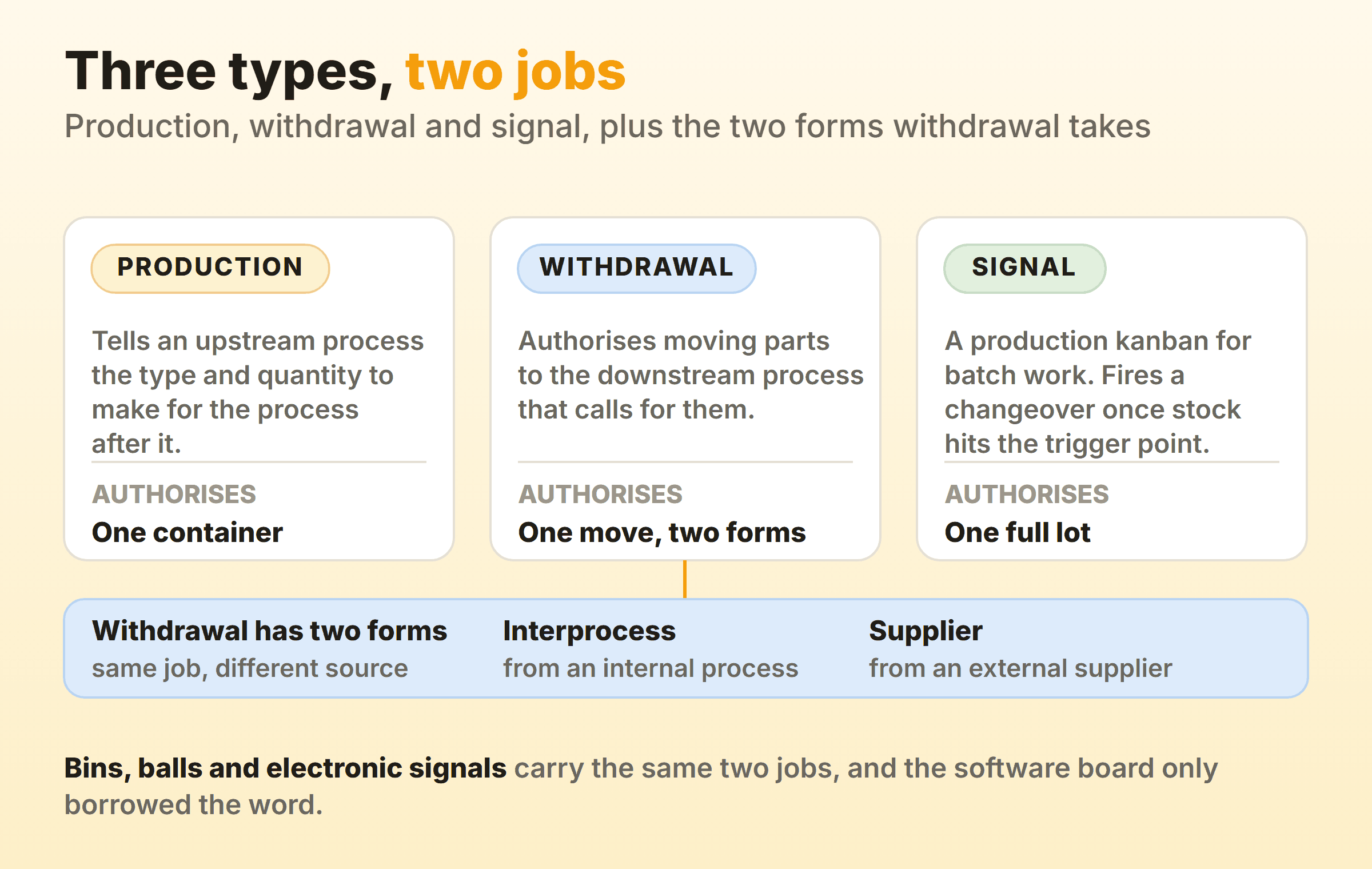
| Type | What it authorises | Who acts on it | Usual form |
|---|---|---|---|
| Production kanban | making one container of parts | the upstream process | card on the container |
| Withdrawal kanban, interprocess | moving parts from an internal process | the material handler | card in a collection box |
| Supplier kanban | withdrawal from an external supplier | the external supplier | electronic at considerable distances |
| Signal kanban | one full lot after a changeover | a batch process | triangular plate in the stack |
Toyota built the original and the dates are on record. Its own 75-year history says kanban “were first tested in the Honsha Plant Machining Division”, that “the new kanban management system was adopted at all plants in 1963”, and that “through 1965 kanban were also adopted for retrieving parts from suppliers”. Toyota calls the card “a tool that describes which and how many parts are used where and when”. Nothing there is about columns on a wall, which is worth settling before comparing kanban in manufacturing with the boards most people now mean.
Types of Kanban Cards Versus Types of Kanban System
Types of kanban cards and types of kanban system answer different questions, and mixing them up is what makes lists of kanban types so hard to compare. A card type says what the signal permits. A system shape says how many signals circulate and what object carries them, which is where two-bin, one-card and two-card belong. The third bucket is the medium, and the lexicon keeps that one wide. Besides cards, “kanban can be triangular metal plates, colored balls, electronic signals, or any other device that can convey the needed information while preventing the introduction of erroneous instructions”. Sort any kanban types list into permission, shape and medium, and most of the contradictions dissolve.
What Does a Production Kanban Do?
A production kanban tells an upstream process the type and quantity of products to make for a downstream process, and in the lexicon’s simplest situation one card corresponds to one container of parts, made for the supermarket ahead of the next downstream process. One card, one container, so an operator who fancies a longer run because the machine is already set up has no card for the extra.
The University of Cambridge Institute for Manufacturing notes in its kanbans reference that “the production-ordering Kanban is often called an in-process Kanban or simply a production Kanban”, so in-process kanban, production-ordering kanban and production kanban are one card carrying three names. The same page says production-ordering kanban are periodically removed from their post-box and used to define what parts and quantities to produce next.
The lexicon also lists the kind of information such a card states. Part name, part number, the external supplier or internal supplying process, pack-out quantity, storage address, consuming process address. Six fields, and none of them is a date or a person. What belongs on a kanban card on a team board is a longer argument, because a task has no pack-out quantity and a sprint has no bill of materials.
What Does a Withdrawal Kanban Do?
A withdrawal kanban authorises the conveyance of parts to a downstream process, and the lexicon defines withdrawal as “the conveyance called on by the downstream operation”. The downstream process asks. Nothing arrives because somebody upstream decided it was time. The lexicon puts conveyance in brackets after withdrawal and the Cambridge IfM writes it as a conveyancing kanban, so a conveyance kanban is the same card under its other name.
The IfM’s illustrated withdrawal kanban sends whoever carries it to position B-2 of the forging department to withdraw drive pinions, 20 to a box, and records that it is the 4th of 8 issued. A card numbered 4 of 8 earns its space, because a numbered set shows at a glance when one has gone missing.
The IfM also describes each process on the line keeping two kanban post-boxes, one for withdrawal cards and one for production-ordering cards. That arrangement is a plain sign that two separate permissions are in play. Two cards, two boxes, one loop, and that loop is a pull system in physical form.
Interprocess Kanban
An interprocess kanban is a withdrawal kanban for withdrawal from an internal process, which the lexicon also calls an internal kanban. The IfM describes the trip on a production line. At regular intervals a worker takes the withdrawal kanban that have accumulated in the process post-box, plus any empty pallets, to where the preceding process stores its finished parts, attaches a withdrawal kanban to a full pallet and takes it back.
Supplier Kanban
A supplier kanban is a withdrawal kanban for withdrawal from an external supplier, and it is the type the lexicon singles out for a change of form. The lexicon says that “in their original application around Toyota City, cards commonly were used for both purposes”, but that “as lean production has spread, supplier kanban for firms at considerable distances have typically taken an electronic form”. Distance is the condition it attaches to that change, and the mechanics of the switch are covered under electronic kanban.
What Is a Signal Kanban?
A signal kanban is the production kanban for batch work, used where changing over for every single part would not be economical. Art of Lean’s TPS encyclopedia entry for the signal kanban describes it as “a special type of production kanban used for processes that produce in batches rather than one piece at a time”, typically stamping presses or injection moulding, “where changeover time makes one-piece flow impractical”. The lexicon frames the same case from the machine’s side: in large batch situations, such as a stamping press with very short cycle times and long changeover times, a signal kanban triggers production when a minimum quantity of containers is reached.
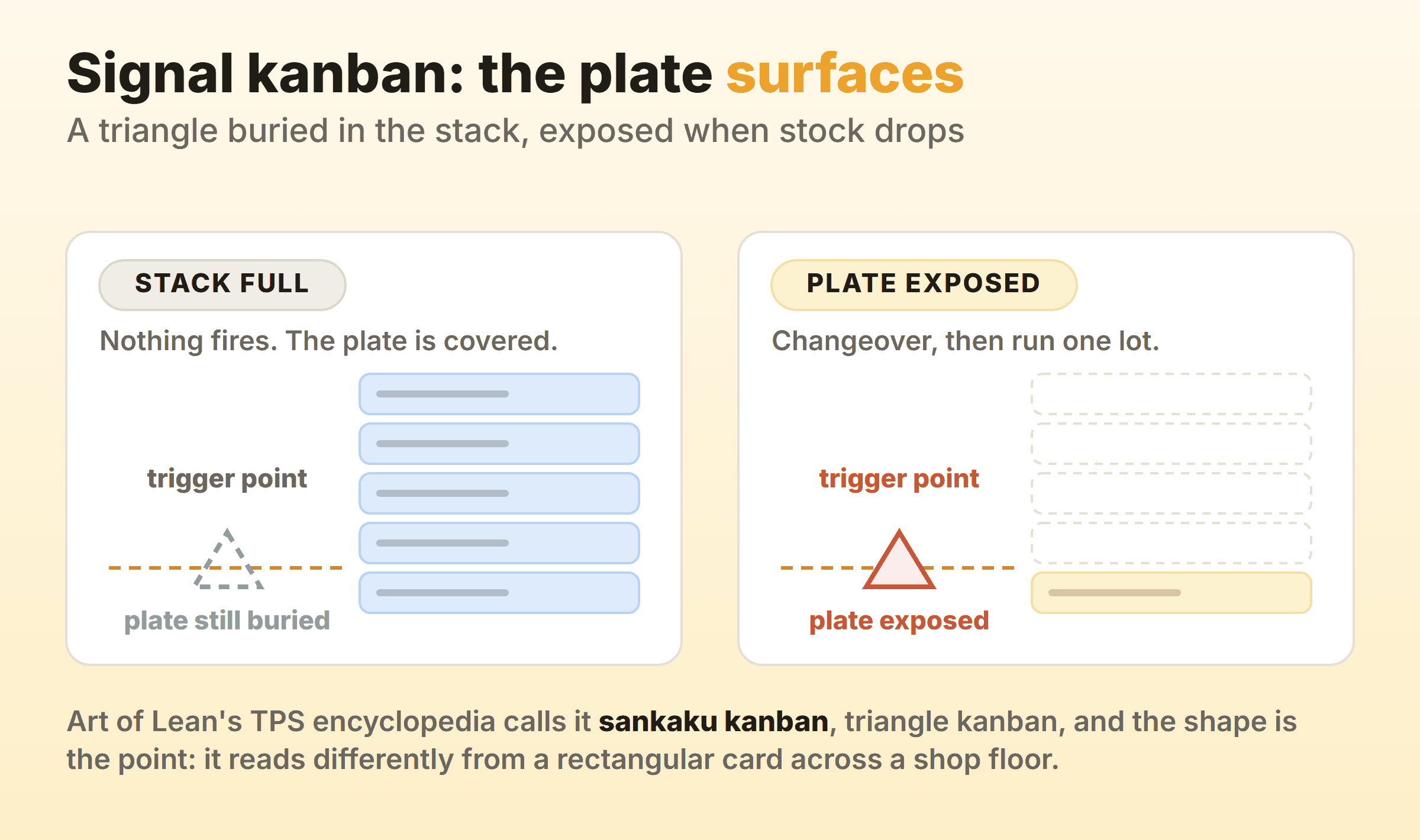
Art of Lean gives the Japanese name as sankaku kanban, literally triangle kanban, and notes that the triangle “is visually distinct from the rectangular production and withdrawal kanban cards, making it immediately identifiable on the shop floor”. It sits at a specific point inside the supermarket inventory, and when consumption drops the stock far enough to expose it, that is the instruction to change over and run a replenishment lot. The same entry says some Toyota literature also calls it the lot-making kanban. The IfM describes signal kanban as inserted near the bottom of a stack to initiate production of batch produced items once stock reaches a pre-set re-order level, telling the same mechanism from the rack end.
The lexicon adds that although a triangle kanban is the standard way lean manufacturing schedules a batch production process, it is only one type of signal, and the IfM likewise refers to two types of signal kanban.
Pattern Production and Lot Making
Pattern production and lot making are the other basic means the lexicon names for controlling batch operations. Pattern production runs a fixed sequence that keeps repeating, so in the lexicon’s example an eight-hour cycle always runs part numbers A through F, while the amount made each time may vary with customer needs. Inventory in the market then follows the length of the replenishment cycle. A one-day cycle implies a day of stock, a one-week cycle a week of it. The sequence is also the drawback, since you cannot jump from making part D to part F.
A lot-making board takes the other route. Every container in the system gets a physical kanban, and as material is consumed the cards come back to the producing process and go up on a board with an outlined shadow space for each one. Returned cards mean that stock has been consumed, unreturned cards represent stock still sitting in the market, and predefined trigger points tell the operator when to start. The lexicon is clear about the cost: it may take many cards, the cards have to come back in a timely and reliable way for the board to be accurate, and discipline is required not to build ahead of need.
What Is the Difference Between One-Card and Two-Card Kanban?
The difference between one-card and two-card kanban is whether production waits for a card of its own. In a two-card system a production kanban and a withdrawal kanban work together. The lexicon’s loop starts when an operator removes the withdrawal kanban on using the first item in a container, and it closes when the production kanban taken off a full container in the upstream supermarket goes back to its process as the signal to produce one more. As long as no parts are produced or moved without a kanban, the lexicon calls the result a true pull system.
In the Cambridge IfM’s definition, a single-card system is one where “parts are produced and bought according to a daily schedule, and deliveries to the user are controlled by a ‘conveyancing’ (withdrawal) Kanban”, and the page adds the part that matters: “in effect, the single-card system is a push system for production coupled with a pull system for delivery to the point of use”. Production is still scheduled. Only delivery pulls. The IfM says single-card systems work well where component needs are easy to tie to the end-product schedule, usually in companies with a relatively small range of end products or products not subject to rapid, unexpected changes in demand, and that the using work centre never has more than a container or two of parts.
So a plant running single-card kanban in the IfM’s sense pulls its deliveries and still pushes its production, whatever the poster in reception says.
Is a Two-Bin System a Type of Kanban?
A two-bin system is a physical form of kanban, with the container acting as the card. The Lean Management Institute’s lexicon entry for the two-bin system defines it as “a simple visual inventory management system that uses two bins per item to control the replenishment of small parts or materials without manual inventory tracking”, and states outright that it “is essentially a physical form of kanban: the empty bin serves as the signal”. The first bin holds the active stock, the second holds a reserve calculated on the item’s lead time, and once the first bin is empty it goes to a collection point or gets tagged with a kanban card.
That entry is also honest about the fit. Two bins suit low-cost, small items with relatively stable and predictable demand, and fall short for items with highly variable demand, long lead times or high value, where the entry recommends more detailed kanban systems or other inventory management methods. Sizing and card counts belong to kanban inventory.
Which Type of Kanban Do You Actually Need?
The type of kanban you need falls out of five questions about the work itself:
- Is production already scheduled, so only delivery to the line needs control? A single-card system, which the IfM describes as push for production and pull for delivery.
- Should making and moving both wait for a signal? Two cards, a production kanban and a withdrawal kanban, with a post-box for each at every process.
- Does the process run batches because changeovers are long? A signal kanban, or the lexicon’s pattern production or lot-making board.
- Is it a small, low-cost part with stable demand? A two-bin system, where the empty bin is the signal.
- Does the signal leave your company? A supplier kanban, which for firms at considerable distances has typically gone electronic.
All of these answers assume demand that repeats, and the IfM puts a number on the range, describing kanban as helping fine-tune production to meet changing customer demand of up to plus or minus 10 percent while still requiring planned monthly and weekly production schedules. Swings beyond that band put more of the work on those planned schedules. The IfM is equally clear about the cost of tightening a loop: removing cards or reducing the number of parts on a pallet speeds flow and cuts lead times, and it also makes the system more vulnerable to breakdowns.
And if the work has no container at all, this taxonomy has nothing to offer. An engineering change, a support ticket and a landing page never sat in a bin.
Where Does the Software Kanban Board Fit?
The software kanban board is a separate system that took the same word, and the collision is a steady source of confusion in the kanban vocabulary. The Kanban Guide defines its subject as “a strategy for optimizing the flow of value through a process”, built from three practices: defining and visualizing a workflow, actively managing items in a workflow, and improving a workflow. Those practices together “are collectively called a Kanban system”. The Guide calls the visualization of its Definition of Workflow a Kanban board, and treats WIP dropping below the agreed control as a signal to select new work, with no card attached to any parts.
The cap does carry across. A fixed number of cards in a factory loop is a ceiling on inventory, a column limit is a ceiling on work in progress, and both turn an overload into something you can see from across the room. In Kanbanee that shows up as a badge reading count over limit, off until you switch it on per column, red the moment you cross it, and deliberately soft so a drag over the cap is never blocked. I keep my own Doing column capped at three and let the badge go red, because the red starts a conversation and a hard block only teaches people to route work around the board. No cap decides anything by itself, which is as true of a WIP limit on a screen as of a card count on a rack.
Both halves are one kanban system in the loosest sense, a capped loop that makes overload visible, and very little else carries across between them.
FAQ
What are the three types of kanban?
Production, withdrawal and signal. Production kanban authorise making a container, withdrawal kanban authorise moving one, and signal kanban are production kanban for batch processes that fire when stock hits a trigger point. The Lean Enterprise Institute treats make and move as the two functions and describes signal kanban under production kanban, while the Cambridge IfM names withdrawal and production-ordering kanban as the two kinds mainly used and lists supplier and signal kanban as other types.
What is an in-process kanban?
In-process kanban is another name for the production kanban. The Cambridge IfM says the production-ordering kanban is often called an in-process kanban or simply a production kanban, and describes it as specifying the kind and quantity of product the preceding process must produce.
What is a conveyance kanban?
Conveyance kanban is another name for the withdrawal kanban. The Lean Enterprise Institute’s own term is withdrawal, with conveyance in brackets, and the Cambridge IfM writes it as a conveyancing kanban. Either way it is the card that authorises a move.
Is e-kanban a separate type of kanban?
Not in the lexicon’s terms. It lists electronic signals alongside cards, triangular metal plates and colored balls as forms a kanban can take, and says that whatever the form, a kanban has the same two functions of making and moving. It also notes that supplier kanban for firms at considerable distances have typically taken an electronic form, which is where the switch shows up in its own account.
Are manufacturing kanban and software kanban the same thing?
They share a word and a principle and very little else. Manufacturing kanban is a signal attached to a known quantity of parts. Software kanban, in the Kanban Guide’s terms, is a strategy for optimising flow, visualised on a board, with an explicit control on work in progress instead of a fixed card count. One authorises production, the other makes a queue visible, and a glossary of the kanban vocabulary is worth keeping to hand when a conversation mixes the two.