
Kanban Glossary: Kanban Terms Defined in Plain English
Updated at
The Answer
A kanban glossary is the working vocabulary of the method, and about fifteen terms carry nearly all of it: board, card, column, swimlane, backlog, work in progress, WIP limit, blocker, bottleneck, pull system, cycle time, lead time, throughput, work item age and the cumulative flow diagram. Beyond those sit the Japanese words inherited from Toyota, a handful of metrics assembled out of the first fifteen, and the Kanban Method vocabulary a small team can go years without saying out loud. This kanban glossary groups terms by where you meet them rather than by first letter. Looking up a definition takes ten seconds. Working out whether the person across the table means cycle time or lead time takes a meeting, which is why the confusable pairs of kanban terminology get a section of their own below.
What Are the Core Kanban Terms on a Board?
The core kanban terms describe the furniture: what the board is, what sits on it, and how it gets divided. Learn these twelve and you can read any board a team puts in front of you, including one drawn on a whiteboard in marker.
| Term | What it means |
|---|---|
| Board | The whole visual system. Columns, cards, and the rules for moving between them. |
| Card | One work item, shown as a tile that moves across the board. |
| Column | A stage the work passes through, read left to right. |
| Swimlane | A horizontal row that splits the same columns by work type, team or urgency. |
| Backlog | Everything requested and not yet started. Usually uncapped and loosely ordered. |
| Ready | A short queue of items the team has committed to start next. Capped on purpose. |
| Done | Finished against a written definition rather than against optimism. |
| Work item | The unit of value being tracked. A bug, a page, a hire, an insurance claim. |
| Work item type | A category that flows differently from the others. Feature, defect, expedite. |
| Explicit policy | The written rule for entering or leaving a column. |
| Definition of done | The checklist an item satisfies before it reaches the last column. |
| Blocked | A flag on a card rather than a stage of its own. Progress waits on someone outside. |
The explicit policy row does the heaviest lifting in that table. Policies are what separates a kanban board from a wall of sticky notes: the team agrees a rule and writes it on the column. “Nothing enters Review without a test” is a policy. So is “whoever pulls the card owns it until it moves.” Every board also runs on unwritten policies, which get enforced when somebody is in the mood and argued about in standups.
One more term belongs beside that table. The Kanban Guide uses definition of workflow, abbreviated DoW, for the full list a kanban system has to spell out: what counts as a work item, when items start and finish, the states in between, how WIP gets controlled, the policy for each state, and a service level expectation. A team saying they have a DoW means they have written that list down.
What Do the Kanban Flow and Limit Terms Mean?
The kanban flow terms describe movement and constraint: how work gets started, what stops it, and where it piles up. Each one maps to a decision somebody makes on a Tuesday morning.
| Term | What it means |
|---|---|
| WIP | Work in progress. The count of items started and not yet finished. |
| WIP limit | The agreed maximum number of items allowed in a column or on the board. |
| Pull system | The team starts work when a slot opens, taking the next item itself. |
| Push system | Work arrives on a schedule, whatever the team already has in flight. |
| CONWIP | Constant work in progress. One cap for the whole board instead of per column. |
| Blocker | Something outside the team stopping one specific card. |
| Bottleneck | The slowest stage, which sets the pace of everything downstream. |
| Expedite | The lane or class reserved for the one item allowed to jump the queue. |
| Class of service | A policy bundle attached to a work item type: standard, fixed date, expedite, intangible. |
| Commitment point | The line on the board past which the team has promised to finish the item. |
| Replenishment | The recurring decision that refills the Ready queue from the backlog. |
| Work item age | How long the card in front of you has been in progress so far. |
| Flow efficiency | Time actually worked divided by total elapsed time, as a percentage. |
Pull is the term where the watering down usually starts. The Lean Enterprise Institute’s lexicon entry for kanban states the rule plainly: as long as nothing is produced or moved without a kanban, the system stays a genuine pull system. On a board, one card equals one permission to work. Hand three tickets to a developer who already has four in flight and you have a push system wearing kanban paint.
Flow efficiency is the term most teams have never calculated and would rather not. It asks what share of an item’s total elapsed time had somebody actually touching it. Most of a card’s life is spent waiting between columns, and a board showing only In Progress hides every hour of that. On our own board I keep Doing capped at two for exactly this reason. Putting a number on the waiting takes the metrics vocabulary.
What Do the Kanban Metrics Terms Mean?
The kanban metrics terms are the four measures of flow plus the charts built from them. The Kanban Guide names those four precisely: WIP is items started but not finished, throughput is items finished per unit of time, work item age is elapsed time since an item started, and cycle time is elapsed time between an item starting and finishing.
| Term | What it means |
|---|---|
| Cycle time | Elapsed time from an item starting to that item finishing. |
| Lead time | Elapsed time from the request arriving to the item finishing. Includes the queue. |
| Throughput | Items finished per unit of time, usually counted per week. |
| Work in progress | Items started and not finished, counted at this moment. |
| Work item age | Elapsed time since the item currently in progress was started. |
| Cumulative flow diagram | Stacked bands showing how many items sat in each state over time. |
| Control chart | Cycle time per finished item plotted over time, with the spread visible. |
| Little’s Law | Average cycle time equals average WIP divided by average throughput. |
| Service level expectation | A forecast with a probability attached. “85% of items finish in nine days.” |
| Delivery rate | Kanban University’s name for throughput. Same measure, different glossary. |
If you add one more measure this quarter, make it work item age. Cycle time and throughput both describe finished work, so they look backwards. Age is a live number, and it answers which card is in trouble this morning, which happens to be the only metric question a standup can act on.
Little’s Law is where the argument for limiting work actually sits. Cut WIP without changing throughput and cycle time drops, because the arithmetic leaves it nowhere else to go. Nobody works faster. Items stop queueing behind each other. Kanbanee’s Pro reports build cycle time, throughput and a cumulative flow diagram out of card history, which is the practical reason these kanban metrics are worth naming precisely.
Which Kanban Terms Get Confused With Each Other?
Six pairs of kanban terms get used interchangeably in meetings, and every swap changes what somebody decides.
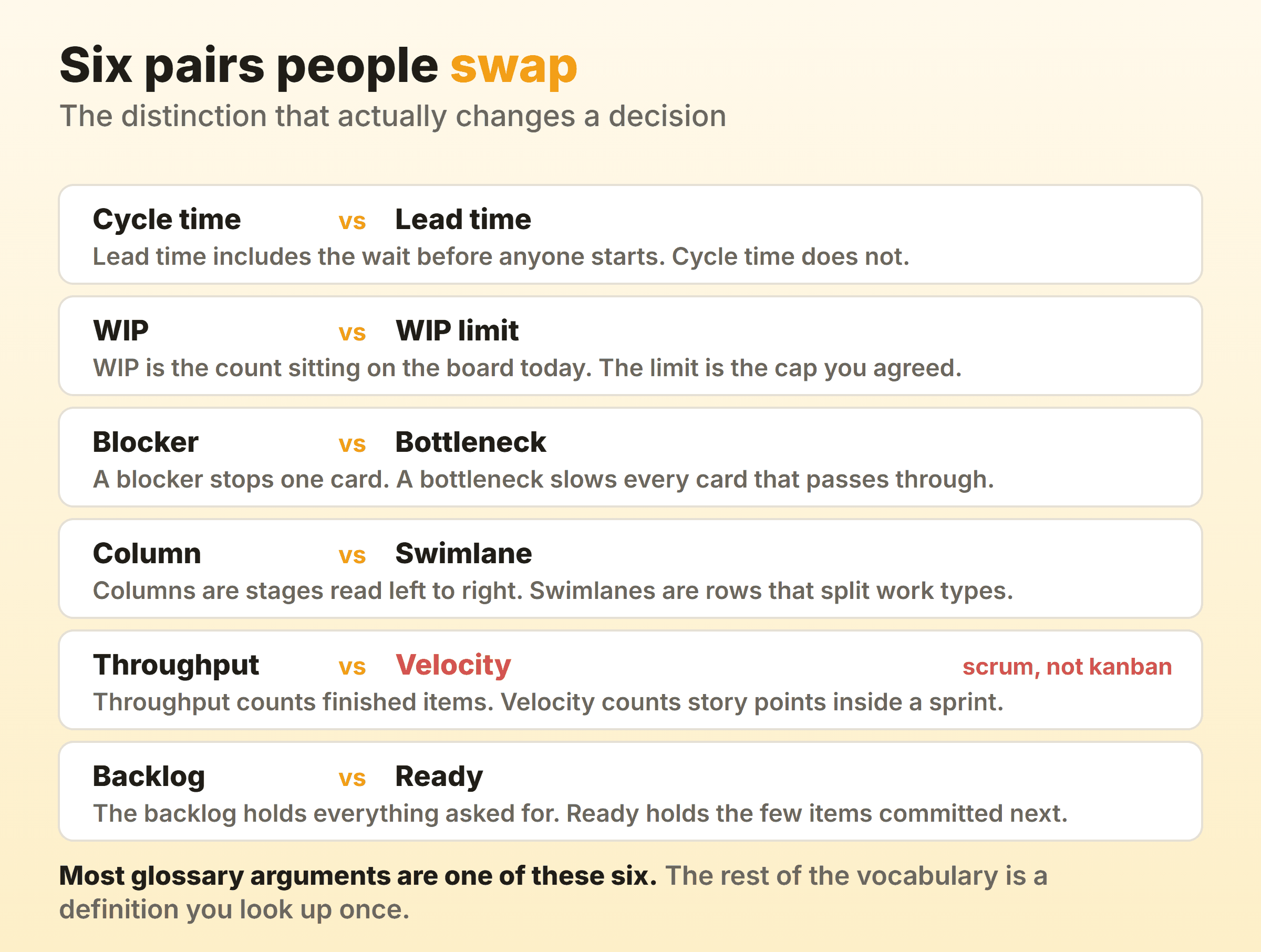
Cycle time and lead time. Lead time starts the moment the customer asks. The clock on cycle time only starts once the team picks the item up, so the gap between the two is pure queue, and it runs longer than people inside the team expect. Report cycle time internally. Whoever is waiting on you wants the lead time number.
WIP and WIP limit. WIP counts what sits on the board right now. The WIP limit is the cap you agreed to earlier. “Our WIP is 3” reports the weather. “Our WIP limit is 3” states a rule, and a team that has only ever said the second one has no idea what the first one is.
Blocker and bottleneck. A blocker halts one card and usually has a name attached, like a client who has not replied to the design proof. Bottlenecks are structural. One stage slows every card passing through it, and clearing that takes a change to how the work is staffed or sequenced.
Column and swimlane. Columns run vertically and stand for stages. Swimlanes are the horizontal rows cutting across those same stages, splitting the work by type, team or urgency. Call a swimlane a column and the board stops being readable at a glance.
Throughput and velocity. Throughput counts finished items per period. Velocity is a scrum measure, story points completed inside a sprint. Kanban has no sprint boundary, so it has no velocity, and a team reporting both is running a hybrid it has not admitted to yet.
Backlog and Ready. Everything anyone has ever asked for lives in the backlog. Ready holds the small committed set that gets pulled next. Merging the two produces a hundred-item column, reprioritised every week and finished never.
One more pair sits outside the diagram. Lowercase kanban is the card, the signal, the board. Capital-K Kanban is the method David J. Anderson formalised for knowledge work. Most writing ignores the distinction and context rescues you, though it does explain how a glossary can define kanban twice without contradicting itself.
Where Does Kanban Terminology Come From?
Kanban terminology comes from the Toyota Production System, where kanban literally means signboard, and most of the vocabulary arrived in software carrying its original meaning intact. Taiichi Ohno built the system around physical cards that authorised making or moving parts. The card was the authorisation. No card, no work.
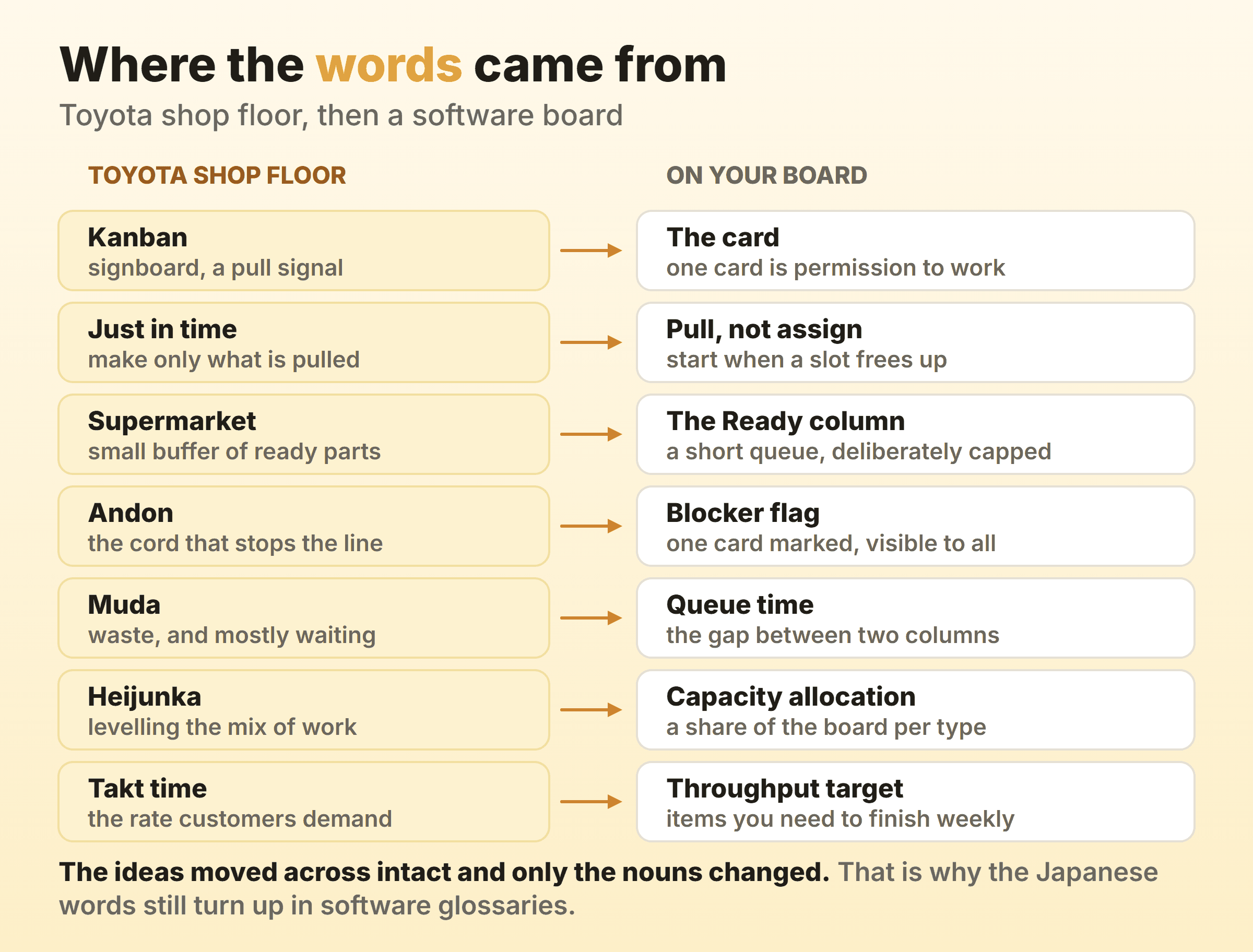
The manufacturing terms you still meet in kanban glossaries:
- Kanban signboard or signal card. The origin of the whole kanban word and meaning.
- Just in time produce only what the next step has pulled, when it pulls it.
- Supermarket the place a set standard inventory is held for the next process to withdraw from. The Ready column is its board equivalent.
- Kaizen continuous improvement made in small increments by the people doing the work.
- Muda, mura, muri waste, unevenness and overburden. The three things lean removes.
- Heijunka levelling the mix and volume of production so demand does not arrive in spikes.
- Andon the signal or cord that stops the line when something is wrong.
- Gemba the actual place the work happens, visited rather than reported on.
- Takt time the rate of customer demand, used to set the pace of production.
- Two-bin system a stock control loop where an empty bin is itself the reorder signal.
Ohno’s shop floor and a software team’s board part company on one point. Manufacturing kanban regulates identical, repeating parts, so a card really does stand for a fixed quantity of a known thing. Knowledge work items come in wildly different sizes, which is why software kanban leans on cycle time distributions and percentile forecasts rather than counting bins. Software kanban kept the signal and left behind the uniform batch size the original depended on.
Which Kanban Glossary Terms Can a Small Team Ignore?
Plenty of the kanban glossary belongs to the consulting and certification layer, and a six-person team will get through a year without saying most of it. Kanban University’s glossary carries three of the terms below, STATIK, the Kanban Maturity Model and failure demand. The rest come from the wider practice literature and from tool vendors. All of them are real, and all of them solve coordination problems that arrive later, if they arrive at all.
| Term | What it means | Who needs it |
|---|---|---|
| STATIK | Systems Thinking Approach to Introducing Kanban. The recommended way to introduce kanban in a new context. | Consultants designing a system for a client |
| Kanban Maturity Model | Seven organisational maturity levels with practices mapped to each. | Large transformations and assessors |
| Portfolio kanban | A board of projects or initiatives rather than tasks. | Organisations coordinating many teams |
| Upstream kanban | A board for the discovery and option work that happens before commitment. | Teams with more requests than capacity to triage |
| Blocker clustering | Grouping recurring blockers to find common causes. | Teams with enough blocker history to cluster |
| Service delivery manager | The role accountable for flow through a kanban service. | Scaled setups with named service roles |
| Failure demand | Work created by failing to do something right the first time. | Support and operations teams |
| Kanplan | Atlassian’s name for a kanban board with a separate backlog screen for planning, and no sprints. | Jira teams who want a planning list beside the board |
None of that is wrong. Most of it is scaffolding built for organisations running dozens of interlocking services, and importing it early tends to produce process for its own sake. Get the board, the WIP limits and the cycle time honest first.
A few method terms do earn their place on a small team, though. Cadences are the recurring meetings that drive the system, and the replenishment meeting plus the retrospective are the two most teams keep. Feedback loop is the umbrella term covering all of them. Cost of delay puts a weekly price on finishing something later, which is how classes of service get justified. Evolutionary change is the Kanban Method’s position that you start where you are and improve in small steps instead of reorganising first. Scrumban belongs to the agile vocabulary as much as the kanban one, being what a scrum team gets when it keeps the ceremonies it likes and moves to a pull board.
Twelve years into running delivery I have never needed STATIK, and the teams I have watched reach for this vocabulary early were mostly doing it before they had a board worth describing. If portfolio kanban does become necessary you will know, because somebody will ask a question about six teams at once that your board cannot answer.
FAQ
Is kanban an acronym?
Kanban is not an acronym. It is a Japanese compound word meaning signboard or signal card, written with the characters for “look at” and “board”. Writing it in capitals as KANBAN is a common mistake in project documents.
What does WIP stand for in kanban?
WIP stands for work in progress, the number of items started but not yet finished. Some manufacturing sources expand it as work in process instead. The two mean the same thing in a kanban context, and WIP limit refers to the cap you place on that number.
What is the difference between a kanban board and a kanban system?
A kanban board is the visual artefact with columns and cards. A kanban system is the board plus the rules that govern it: the WIP limits, the explicit policies, the pull mechanism and the commitment point. A board with no WIP limit and no written policies will happily show you fourteen cards in Doing.
What is a kanban card called in manufacturing?
In manufacturing the card is still called a kanban, and it comes in named varieties. A production kanban tells an upstream process what to make, and a withdrawal kanban authorises moving parts to a downstream process. Supplier kanban is a withdrawal card sent outside the factory.
How many kanban terms does a new team need?
About ten. Board, card, column, WIP, WIP limit, blocker, pull, backlog, cycle time and throughput will carry a team through its first six months. Add work item age when somebody asks why a card has been sitting in Doing since last month.
What is a service level expectation?
A service level expectation, or SLE, is a forecast stating how long an item should take and how confident you are. “85% of items finish within nine days” is an SLE. It replaces a single confident date with a range and a probability, which is easier to defend when the date slips.