
Kanban Origin and History: Who Invented It and When
Updated at
The Answer
The kanban origin is a Toyota machine shop in Japan. Taiichi Ohno, an industrial engineer there, built a card-based signalling system in the early 1950s so that each stage of production made only what the next stage had already taken, an idea he credited to the way American supermarkets restocked their shelves. The word is Japanese, written 看板, and it means signboard. Toyota ran kanban across all of its plants by 1963 and out to its suppliers by 1965. Software came to it half a century later, when David Anderson and a team at Corbis in Seattle put work items on a whiteboard in January 2007 and kept the name.
What Does Kanban Mean in Japanese?
Kanban means signboard in Japanese. It is written 看板, from 看 (kan, to watch or look at) and 板 (ban, a board or plank). Signboard or billboard is the kanban translation most dictionaries give, and the literal reading sits closer to a board you look at.
Kanban in Japanese is an ordinary noun. It is the sign hanging outside a restaurant. The kanban meaning in Japanese stretches into figurative use too, the way an English speaker might call somebody the face of a company, and none of that carries any management flavour.
Where Does the Word Kanban Come From?
The word kanban comes from everyday Japanese. Merchants in Edo-period Japan hung carved and lacquered signboards outside their shops, plenty of which survive in museums, and that is why so many articles reach back to the 1600s to explain the kanban word origin.
Nobody in the machining division was reviving a seventeenth-century merchant tradition. They needed a name for a small piece of card you look at, and they used the obvious one. An Edo signboard and a Toyota card share a word, and the word is all they share. The kanban name origin is that mundane, and the same thing happened again when software teams started calling a whiteboard full of sticky notes a kanban board.
Who Invented Kanban?
Taiichi Ohno invented kanban. He was an industrial engineer at Toyota, and Toyota’s own account of the production system credits him with creating the basic framework for the just-in-time method, with backing from Eiji Toyoda. Ohno lived from 1912 to 1990 and spent almost his whole career inside Toyota, moving up from the loom works into car manufacturing.
He did not invent the goal, though. Kiichiro Toyoda had been pushing just-in-time production since the late 1930s, and the other pillar of the system, jidoka, came from his father Sakichi Toyoda and a loom that stopped itself when a thread broke. Ohno contributed the mechanism. Just-in-time stayed an ambition until somebody worked out how a machine shop knows what to make next, and the answer was a card.
Ask who created kanban and you get one name. Ohno. Every serious account of the origin of kanban lands there. The fuller version is that kanban was developed by a company which had been chasing the same idea since the 1930s and finally found a piece of paper that made it work.
Why a Supermarket Was the Model
Ohno pointed to American supermarkets as the model, and the analogy carries the whole idea. A shopper takes what they need off the shelf, and the shelf gets refilled to match what was taken. Nobody in the back room guesses how many tins of tomatoes the afternoon will need and stacks them in the aisle in advance.
Toyota’s factories had been doing the guessing version. A stage produced to a schedule and pushed its output downstream whether or not anyone was ready for it, which is how you end up with parts piled between machines and a shortage of the one component you actually need. Under the supermarket model the downstream stage takes what it needs, and that act of taking is what authorises the upstream stage to make more.
Accounts differ on when Ohno first saw an American supermarket in person. Some put the trip in 1953, others in 1956, and Ohno himself wrote that the supermarket idea had been under study at Toyota since around 1950, before any visit. The date barely matters. Cards were already being tested on the shop floor while the story was still being told.
When Was Kanban Invented? A Kanban History Timeline
Kanban was invented across roughly a decade instead of on a date, which is why any history of kanban you read gives a different year. Toyota’s 75-year corporate history is the primary record for the history of the kanban system, and it is careful about this. Kanban were first tested in the Honsha plant machining division, use expanded steadily from there, the system was adopted at all plants in 1963, and through 1965 kanban were also used for retrieving parts from suppliers.
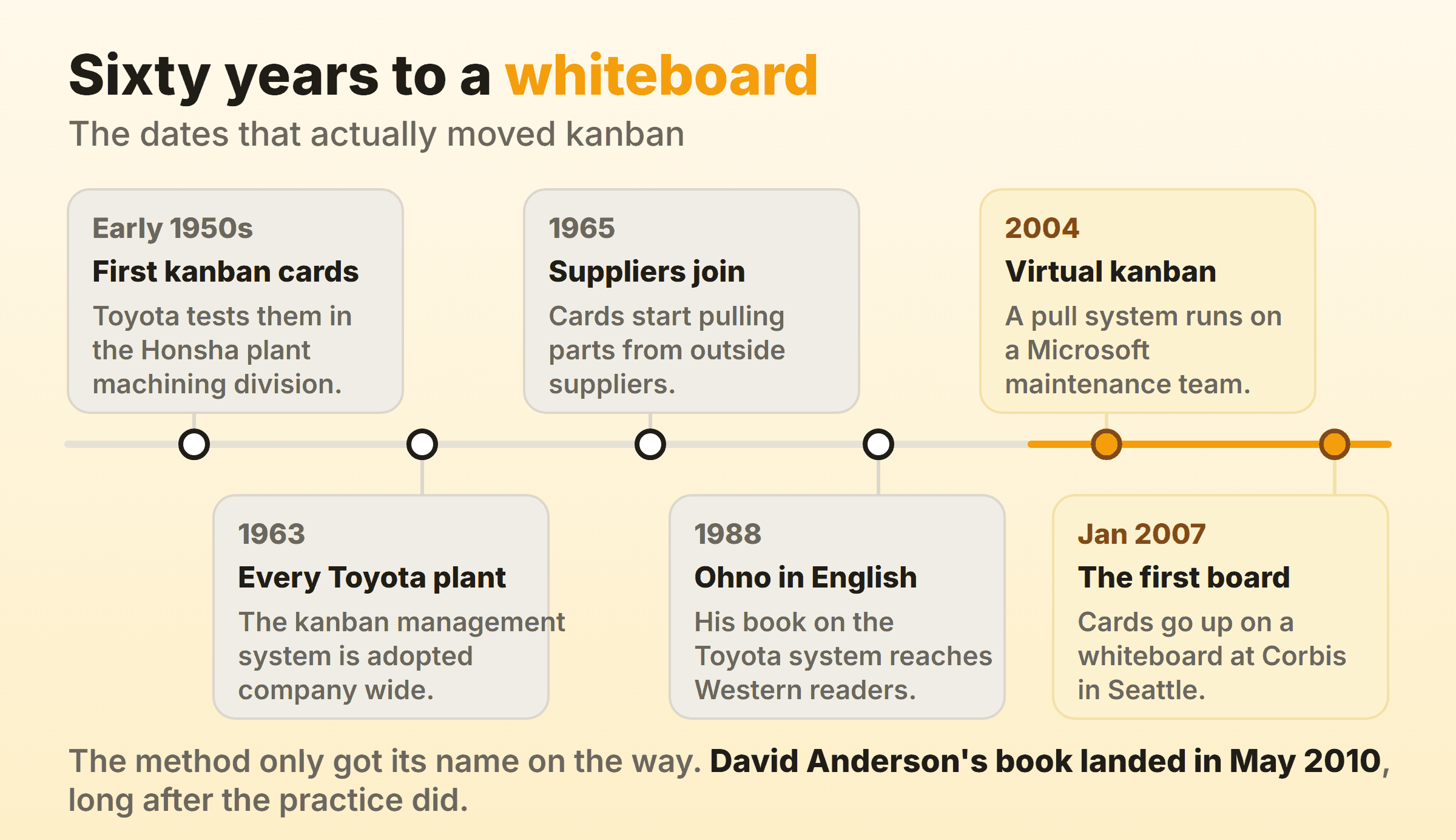
Notice how long the middle stretch is. Fifteen years passed between the first cards and the last supplier, inside one company, on a shop floor where every part had a known shape and a known cycle time. Anyone who tells you a kanban rollout is a two-week project should sit with that number.
Kanban origins get compressed in the retelling, normally into a single anecdote about a supermarket. Underneath it sits a decade of trial and error across divisions that did not all want it, and every one of those divisions was moving physical cards.
What Did an Actual Kanban Card Do?
An actual kanban card was a reorder slip. It carried a part number, a quantity and the two stages it travelled between, and it moved in the opposite direction to the work. When assembly emptied a bin of brackets, the card in that bin went back to the machine shop, and the arrival of the card was the instruction to make exactly that many brackets, with no schedule and no forecast involved anywhere in it.
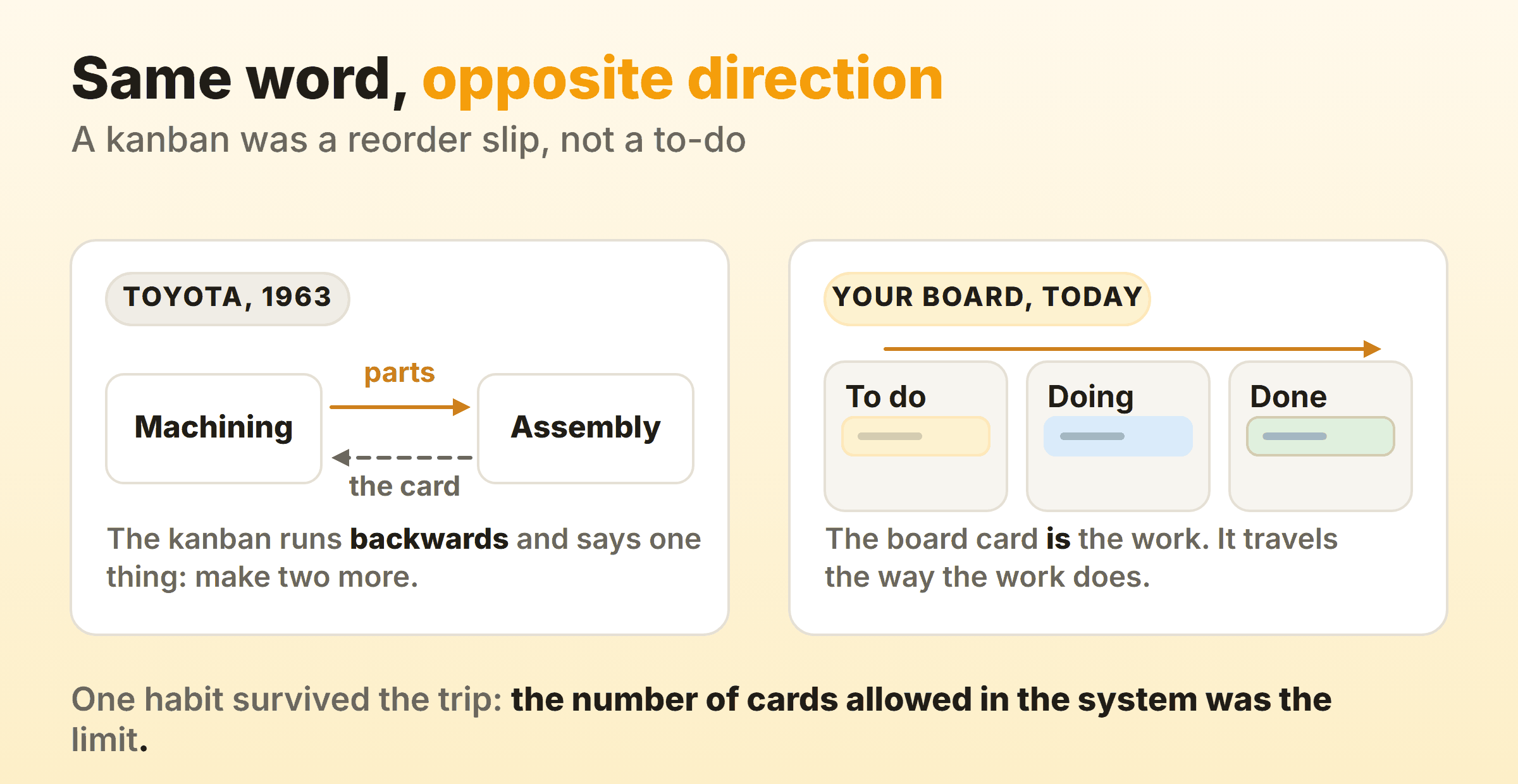
Toyota ran two basic types. A withdrawal kanban authorised moving parts from one stage to the next, and making those parts in the first place took a production kanban. Between the two, the card count decided everything. A stage could only work on parts it held a card for.
The number of cards in circulation was the ceiling on how much work could sit between two stages, and that ceiling was physical. You could not start a batch without a card in your hand. Modern WIP limits are the descendant of that count, softened into a number in a column header that you can override when you feel like it. Toyota had nothing to override, because when the cards ran out they ran out.
Two-bin systems still run in warehouses and hospital supply rooms with the original mechanism intact, where the empty bin is the card and whoever finds it empty refills it.
How Did Kanban Reach the West?
Kanban reached the West as one component of a much larger export, which was Western interest in why Japanese manufacturers were suddenly winning. The 1973 oil shock is where most accounts start. Toyota came through it in better shape than its rivals, and by the time American and European plants went looking for the kanban system Japan had built, the question of how had become an industry obsession.
The books did the rest. Ohno published his own account in Japanese in 1978, and the English translation, Toyota Production System: Beyond Large-Scale Production, appeared in 1988. Along the way American academics and consultants produced their own studies, and in 1990 The Machine That Changed the World by James Womack, Daniel Jones and Daniel Roos gave the whole body of practice the name it still carries, lean production.
Software borrowed from lean before it borrowed kanban specifically. Mary and Tom Poppendieck published Lean Software Development: An Agile Toolkit in 2003, translating waste, flow and pull into terms a development team recognised. The vocabulary was in the room by then, but nobody had built a working implementation.
What Is the Origin of the Kanban Board?
The kanban board origin is a whiteboard at Corbis, a Seattle photo licensing company, in January 2007. The first kanban system in software had already run three years earlier on a Microsoft maintenance team, with no board at all, and the gap between those two implementations is the reason the board exists. So kanban board history starts in 2007, half a century behind the cards it borrows its name from.
David Anderson has documented the sequence himself. In October 2004 he designed a pull system for a sustained engineering group at Microsoft, which he took from Theory of Constraints. The kanban were virtual. The system sent an email when a slot opened in the work tracking database, and there was no board of any kind. Donald Reinertsen pushed him to look properly at kanban systems in 2005, at which point the Microsoft work got its name retroactively.
Anderson moved to Corbis in September 2006 and built a similar system for software maintenance there. In January 2007 someone on the team suggested visualising the workflow as a card wall on a whiteboard. That is the moment the object you are picturing came into existence. Within months the method around it had classes of service and capacity allocation, and in August 2007 Anderson presented it at the Agile 2007 conference in Washington DC. The kanbandev mailing list was created the same day.
The rest moved quickly. Corey Ladas published his essays on scrumban in 2008 and 2009, the first Lean Kanban conference ran in Miami in May 2009, and Anderson’s book Kanban: Successful Evolutionary Change for Your Technology Business was published in May 2010. Everything now taught as the kanban methodology got its name after the fact, reverse-engineered from teams who had been working that way for a couple of years.
What the Kanban Origin Story Tells You About Your Board
The kanban story gets told as a clean line from Toyota to your browser tab. The line has a couple of breaks in it.
| The idea | Toyota, 1963 | Your board, today |
|---|---|---|
| The card | a reorder signal moving backwards | the work item moving forwards |
| The cap | the count of cards printed | a WIP limit on a column |
| What flows | identical parts, known cycle time | one-off items of unpredictable size |
| The trigger to start | a downstream stage consumed something | a person finished and has capacity |
| The failure signal | the line stops | a number turns red and everyone keeps going |
Pull carried across. So did the cap. The arithmetic did not, because Toyota was buffering identical brackets with a measurable cycle time and you are buffering a bug fix next to a redesign. Flow maths still works on knowledge work, though it works as a distribution instead of a formula, which is why kanban forecasting talks in percentiles.
That soft limit is the honest compromise, and it is how we built it into Kanbanee. A column shows its count against its limit, the badge turns red once you go over, and the drag still completes. Toyota never needed a red badge. A missing card ended the argument for them. Software teams get a warning and a choice instead, which only helps if somebody is looking at the board.
The method itself keeps being revised. Kanban University maintains its own guide to the practices, and a separate community Kanban Guide appeared in December 2020 with contributors including Daniel Vacanti and John Coleman. Neither one comes out of Toyota, and both still spend most of their length on limiting how much work sits in the system at once.
FAQ
Is kanban Japanese or Chinese?
Japanese. The management system was developed at Toyota in Japan, and the word is Japanese, though it is written with two characters that Japanese borrowed from Chinese centuries ago. The same characters exist in Chinese with a similar meaning of signboard, which is where the confusion comes from.
Who is considered the father of kanban?
Taiichi Ohno. Ask who developed kanban in any lean setting and that is the name you get, because he is credited with both the card mechanism and the Toyota Production System around it. David Anderson gets the equivalent credit for the knowledge work version, which is a separate thing built on the same principle.
Was kanban part of the Agile Manifesto?
No. The Agile Manifesto was written in February 2001, six years before kanban was presented to the agile community at Agile 2007. Kanban came in from lean manufacturing, well outside the group of methods the manifesto was drawn from, which is why its vocabulary of pull, flow and cycle time sounds different from the rest of agile.
Who invented the kanban board?
David Anderson’s team at Corbis, in January 2007, after a team member suggested visualising the workflow on a whiteboard. Toyota did not. Toyota invented the cards and the pull system they controlled, and the software board inverted the original idea by making the card the work itself. Physical boards existed in factories long before 2007, and they tracked schedules instead of authorising production.
What is the kanban board name origin?
The name arrived with the method, before the object did. Anderson’s team was already running a kanban system when they put the cards on a wall, so the wall became the kanban board, and the phrase then stuck to every columns-and-cards layout that followed. A great many boards now called kanban boards have no WIP limits at all, so the name describes a layout, and only sometimes a system.
Where did kanban originate?
In the machining division of Toyota’s Honsha plant in Japan, in the early 1950s. It spread across the company by 1963 and out to Toyota’s suppliers by 1965, then travelled into Western manufacturing through the 1980s and into software in 2004.