
Best Kanban Books: 10 Worth Reading and the Order to Read Them
Updated at
The Answer
The best kanban books fall into three groups, and picking the wrong group first is why so many people stall halfway through. Free comes first. The Kanban Guide and Essential Kanban Condensed cover the whole method between them and cost nothing to download. Then one working book, usually Kanban in Action by Marcus Hammarberg and Joakim Sunden, which walks you through building a board column by column. David J. Anderson’s 2010 book, Kanban: Successful Evolutionary Change for Your Technology Business, is the source text and worth owning. It makes the case to a manager, and most readers get more out of it third than first. After that the shelf splits by problem. Personal Kanban covers your own week, Actionable Agile Metrics covers the day somebody asks you for a forecast, and Making Work Visible hands you the argument to take upstairs.
How Do You Choose Between Kanban Books?
You choose a kanban book by naming what is broken and buying the one that fixes it. Working down a top-ten list in order wastes a month. Most of these titles are not really competing anyway. They answer different questions, and two of them barely overlap.
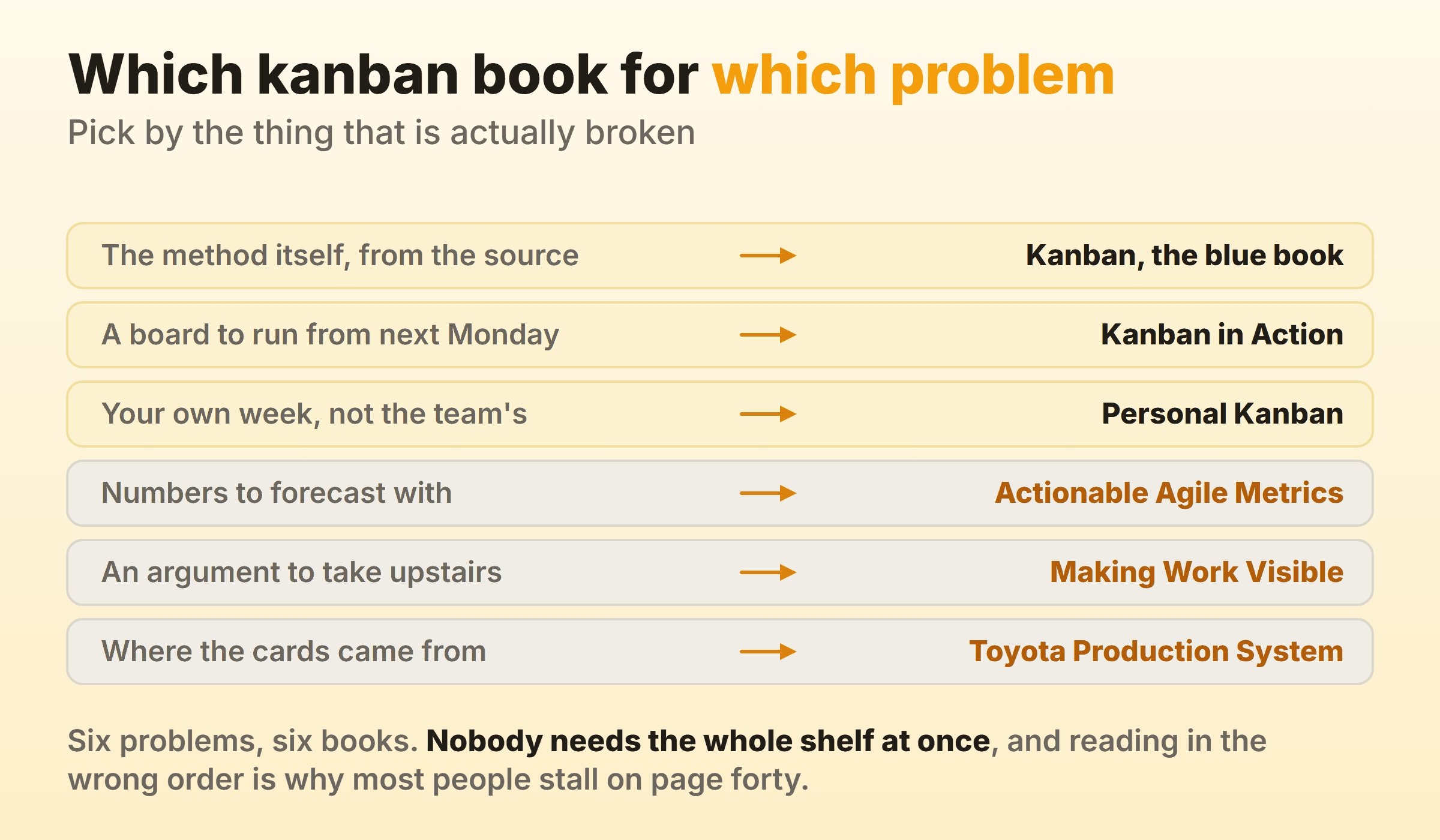
- Method or board. The method is short and free. Running one is a craft, and craft takes a working book with pictures in it.
- The team or you. Personal Kanban is a different animal from everything else here, and people buy it by accident all the time.
- Numbers. Nobody has asked you for a forecast yet? Leave the metrics books alone for now. They are excellent and they are wasted on a board that is a fortnight old.
Answer those three and the list below usually shortens to two purchases, sometimes one.
The Best Kanban Books Compared
| Book | Author, year | What it gives you | Free from the publisher |
|---|---|---|---|
| Kanban: Successful Evolutionary Change | David J. Anderson, 2010 | The source text and the case for the method | No |
| Kanban in Action | Hammarberg and Sunden, 2014 | A board built step by step across 360 pages | Excerpt only |
| Essential Kanban Condensed | Anderson and Carmichael, 2016 | Values, principles and practices, condensed | Yes |
| Personal Kanban | Benson and DeMaria Barry, 2011 | Two rules applied to one person’s week | No |
| Kanban from the Inside | Mike Burrows, 2014 | The nine values sitting under the practices | No |
| Agile Project Management with Kanban | Eric Brechner, 2015 | One Microsoft group’s transition, briskly told | No |
| Kanban and Scrum | Kniberg and Skarin, 2009 | The comparison, plus a real adoption case study | Yes |
| Actionable Agile Metrics for Predictability | Daniel S. Vacanti, 2015 | Flow metrics and forecasts you can defend | No |
| Making Work Visible | Dominica DeGrandis, 2017 | Five thieves of time, and how to expose them | No |
| Toyota Production System | Taiichi Ohno, 1988 English edition | Where the cards came from, from the man himself | No |
The free column means the publisher gives the book away. Copies sitting on file-sharing sites do not count, and that distinction gets a section of its own further down.
Kanban: Successful Evolutionary Change for Your Technology Business
The David J. Anderson kanban book from 2010 gave the method its name, its practices and most of its vocabulary. Blue Hole Press published it. Everyone calls it the blue book, and every other title here is writing downstream of it. Anderson had been running the approach at Microsoft and later at Corbis, and the case studies come out of that work.
It is an argument aimed at managers. Start from what you do now, respect current roles and titles, change by agreement, let the system evolve from there. The five core properties Anderson named in 2010 are in here with the reasoning behind each one, and the reasoning is what every summary drops. The six practices everyone quotes now are a later revision of that list.
It will disappoint anybody who wants to know what goes on a card next Tuesday. This is a book about persuading an organisation, and a reader hoping for board mechanics gets forty pages in before the penny drops.
Kanban in Action
Kanban in Action by Marcus Hammarberg and Joakim Sunden is the practical one. Manning published it in February 2014 at 360 pages, and it is what I hand to anyone about to set a board up for real. No prior kanban experience assumed. Manning pitches it at the whole team, lead included, which I think is right, because the person who benefits most from reading about queues is usually the one sitting in one.
The length is earned. The opening section builds a board from nothing and keeps going until it resembles something a real team would use. The rest works as a reference. Visualising work, capping it, measuring it, running the meetings around it.
Its age shows in the tooling chapters and nowhere else. Queue theory has not moved. It is also the title that sends people looking for a free PDF, which gets its own section below.
Essential Kanban Condensed
Essential Kanban Condensed by David J. Anderson and Andy Carmichael compresses the whole method into something you can read in an evening. Lean Kanban University Press published it in 2016, and it is a free download from the publisher in English, German, Spanish, French, Portuguese, Russian and Polish.
Use it as the reference card. Values, principles, practices, and definitions of the terms your team will otherwise use three different ways in one meeting. When somebody joins a board mid-flight and asks what a commitment point is, this is what you send them.
Sceptics stay sceptical, though. Condensed material states conclusions and skips the arguments that produced them, so a doubtful manager reads the whole thing as assertion. Send them the blue book, or better, a fortnight of your own cycle time data.
Personal Kanban: Mapping Work, Navigating Life
Personal Kanban by Jim Benson and Tonianne DeMaria Barry, Modus Cooperandi Press, 2011, takes the method down to one person and strips it to two rules. Visualise your work. Limit your work in progress. That is the whole system, and the rest of the book is about what happens once you obey both of them honestly.
The honesty is the hard part. A personal board shows you the size of what you have already agreed to in a way a task list never does, and the first week of running one is uncomfortable.
Buy it for yourself. It carries no team policies, no service classes and no flow metrics, and it was never trying to. People still reach for it expecting a team book, which is how it lands on lists like this one with a mismatched recommendation beside it.
Kanban from the Inside
Kanban from the Inside by Mike Burrows, Blue Hole Press, 2014, comes at the method through nine values sitting one layer under the practices. Transparency, balance, collaboration, customer focus, flow, leadership, understanding, agreement and respect, each mapped onto the practice it explains.
The values framing sounds soft and is the sharpest thing in the book. It answers a question the practice-first titles leave open, which is why an identical change lands in one team and gets quietly abandoned in the next.
Read it second or third. Somebody who has never run a board has nothing to attach the values to. Twelve months in, wondering why the standup improved and the replenishment meeting never did, you will find the explanation here.
Agile Project Management with Kanban
Agile Project Management with Kanban by Eric Brechner, Microsoft Press, 2015, is the shortest of the paid books here at 160 pages and the most opinionated. Brechner brought kanban into Xbox engineering at Microsoft and writes like somebody who ran the transition himself.
It is aimed at teams switching off Scrum or off waterfall, and it is specific about the trade. Where the deadlines go, what happens to estimation, which meetings survive and which ones stop earning their hour. James Waletzky contributed a chapter on sustained engineering. The narrow frame is deliberate and it is also the limit, because this is software delivery inside a large company and a two-person agency will recognise about half of it.
Kanban and Scrum: Making the Most of Both
Kanban and Scrum by Henrik Kniberg and Mattias Skarin is the comparison written before the comparison became a shouting match. It came out as an InfoQ minibook in December 2009 and it is still free. Part one puts the two methods side by side. Part two is a case study of a Scrum organisation adopting kanban in its operations and support teams, and that half carries the weight.
Its age is genuine and mostly harmless, in that the tools have changed completely while the arguments have barely moved at all. Read it when somebody in your organisation has decided the two approaches are rivals. It was written by people with no interest in that fight, it costs nothing, and it settles the question faster than any blog post.
Actionable Agile Metrics for Predictability
Actionable Agile Metrics for Predictability by Daniel S. Vacanti, published in 2015 and subtitled An Introduction, is the book that turns a board into a forecast. Cycle time, work in progress, throughput, Little’s Law and the cumulative flow diagram, in an order where each one explains the next. Vacanti helped develop the kanban method for knowledge work back in 2007 and founded ActionableAgile in 2013.
The argument underneath all of it is that a delivery date is a probability, and pretending otherwise is what makes estimates worthless. Buy it once you have a few months of card history to practise on and somebody who genuinely wants a forecast. Without both, this is an excellent book about a problem you do not have yet.
Making Work Visible
Making Work Visible by Dominica DeGrandis, IT Revolution, 2017, with a second edition in March 2022, carries the subtitle Exposing Time Theft to Optimize Work and Flow. It organises itself around five thieves of time: too much work in progress, unknown dependencies, unplanned work, conflicting priorities, and neglected work.
Naming them does real work in a status meeting. An engineer who says the sprint went badly gets nowhere. The same engineer pointing at unplanned work and unknown dependencies as two separate, countable things gets a decision out of the room.
This is the one to lend upward. It is written for the conversation between a team and the people who keep adding to its queue, and it is the least jargon-heavy book here by a distance.
Toyota Production System: Beyond Large-Scale Production
Toyota Production System by Taiichi Ohno, in the English edition Productivity Press published in 1988, is where the cards came from. Ohno built the system at Toyota, and the kanban he describes is a physical card authorising a real replenishment. The sticky note standing in for a feature came much later.
Read it for the reasoning. Overproduction as the worst waste. Pull instead of push, and stopping the line the moment something goes wrong. Those ideas travelled into knowledge work intact, and the history of kanban makes far more sense once you have heard the original argument in the original voice. It first appeared in Japan in 1978 and it reads like a translated management book of that vintage, slow going in places, and nobody has written a better version of it since.
What Order Should You Read Them In?
Read the free shelf first, buy exactly one working book, and leave the deep shelf until the board has stopped being the interesting problem. That order costs nothing to begin, and it fails cheaply if kanban is wrong for your team.
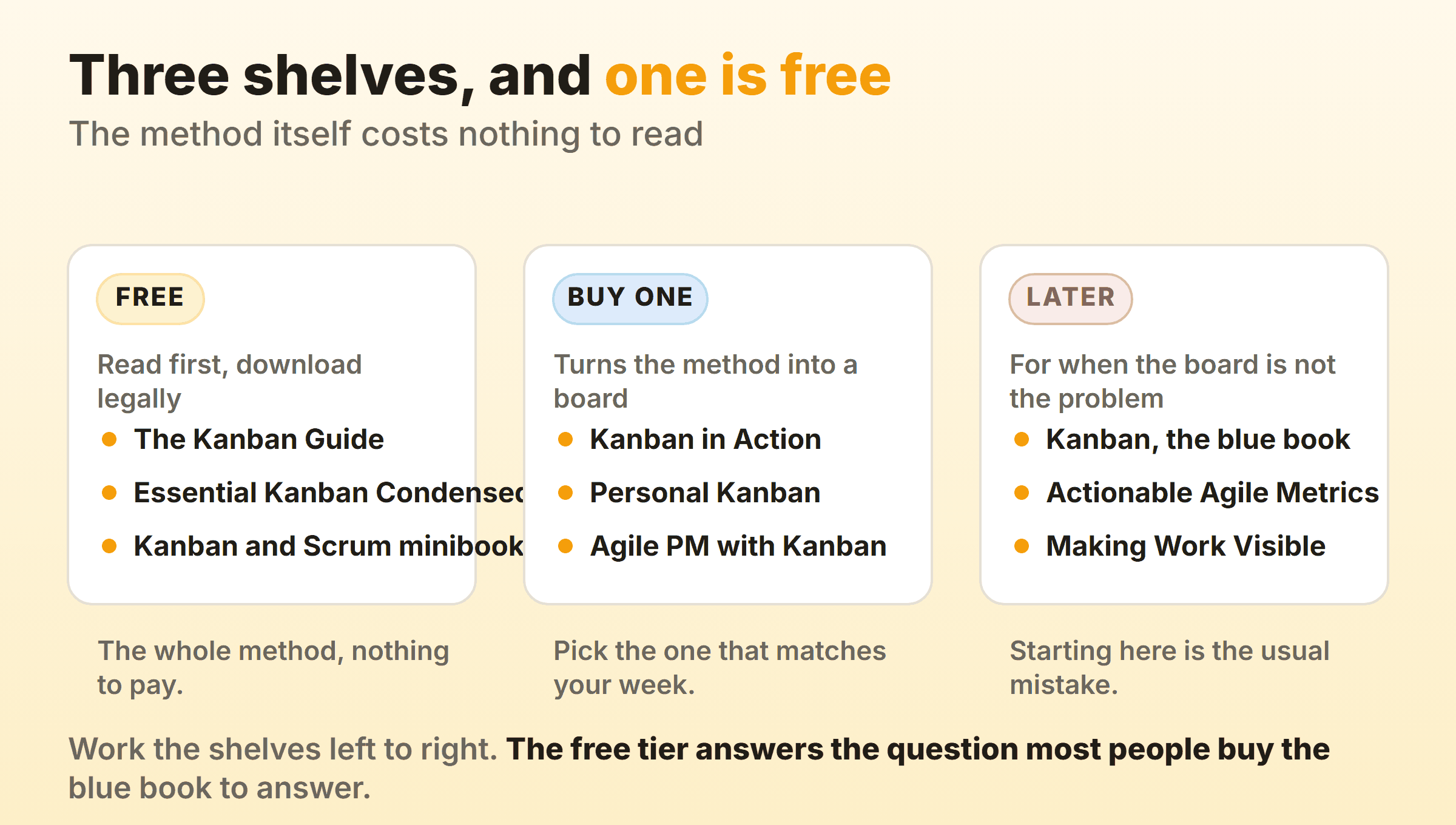
The mistake I see most often starts with the blue book, because it is the famous one, and ends around chapter six with somebody deciding kanban is a management theory. Inside that book it is one. The board mechanics are in Kanban in Action, and hitting those two in the wrong sequence is what makes people give up on the method entirely.
Reading about a cap and living with one are different experiences anyway. I cap the doing column on Kanbanee’s own product board at three, and bouncing off that work in progress limit on a Thursday afternoon taught me what the chapter on queues could only describe. Read a little, run a board, then come back to the next book with something real to argue against.
Which Kanban Books Are Free and Legal to Download?
Three titles here are given away by the people who publish them, and between them they cover the method end to end for nothing.
- The Kanban Guide at kanbanguides.org, free, and short enough to read before a meeting starts.
- Essential Kanban Condensed, free from kanbanbooks.com in seven languages. The same page gives away Essential Upstream Kanban by Patrick Steyaert and Lessons in Agile Management by David J. Anderson.
- Kanban and Scrum: Making the Most of Both, free from InfoQ.
Then there is the Kanban in Action PDF question. Manning sells the ebook and gives away chapter briefs plus a liveBook excerpt on the book’s page. The unofficial PDFs on file-sharing sites are pirated copies of a book two working practitioners wrote, and the diagrams are half the value in that particular title.
Two legitimate routes remain if the budget is genuinely zero. Public library systems often carry these titles through their ebook apps, and a corporate O’Reilly subscription includes both Making Work Visible and Agile Project Management with Kanban. Ask your employer before assuming the answer is no. A learning budget that will not stretch to a conference ticket usually stretches to four books.
Which Kanban Books Would I Skip?
Skip the self-published beginner guides that fill the search results, the ones promising kanban step by step or the ultimate beginner’s guide. They recycle the same summary of the six practices that Essential Kanban Condensed gives away free, and several are visibly padded.
Skip the Kanban Maturity Model by Anderson and Bozheva unless you are rolling out across many teams and somebody senior has asked for a maturity conversation. It is a serious reference aimed at consultants and change leads, and a strange first purchase for a team of six.
Corey Ladas’s Scrumban and Donald Reinertsen’s The Principles of Product Development Flow both get recommended out of habit. Ladas is worth reading for the history of how kanban and Scrum got fused together. Reinertsen is a hard economics book, excellent, and most teams will never open it twice.
And if you are weighing a book against a kanban certification, the book wins on cost per hour of learning and it always will. A certificate is useful when a job advert names it. Neither one substitutes for having run a board through a bad quarter.
FAQ
Which kanban book should a beginner read first?
Start with the free Kanban Guide, then buy Kanban in Action. That pairing gives you the method in an hour and the practice over a weekend. The blue book is the more famous first choice and the wrong one for most beginners, because it was written to convince a manager, and a beginner needs equipping instead.
Is the David J. Anderson kanban book from 2010 still worth reading?
Yes, as long as you read it for the argument. The 2010 book is where the method was defined, and the reasoning behind evolutionary change and respecting current roles has not been improved on since. The tooling references are dated and the case studies come from a different era of software. Neither touches the core.
Is there a free PDF of Kanban in Action?
No official free PDF of Kanban in Action exists. Manning gives away chapter briefs and a liveBook excerpt, and sells the ebook. Copies advertised as free full PDFs are pirated. If cost is the blocker, Essential Kanban Condensed and the Kanban and Scrum minibook are both given away legally by their publishers and cover much of the same ground.
What is the best kanban book for manufacturing rather than software?
Ohno’s Toyota Production System, without much competition. Almost every other title here assumes knowledge work, where a card stands for a request instead of a physical part. On a factory floor, the original argument about pull, overproduction and stopping the line maps straight onto what you are already doing.
Do you need to read a kanban book at all?
No. The method is small enough to learn from a free guide and a real board, and plenty of good teams have never opened one of these. Books earn their keep at the second stage, when the board is running, something is not working, and you want to know whether the problem is your policies, your limits or the way work arrives.