
Kanban Retrospectives, Ceremonies and Cadences
Updated at
The Answer
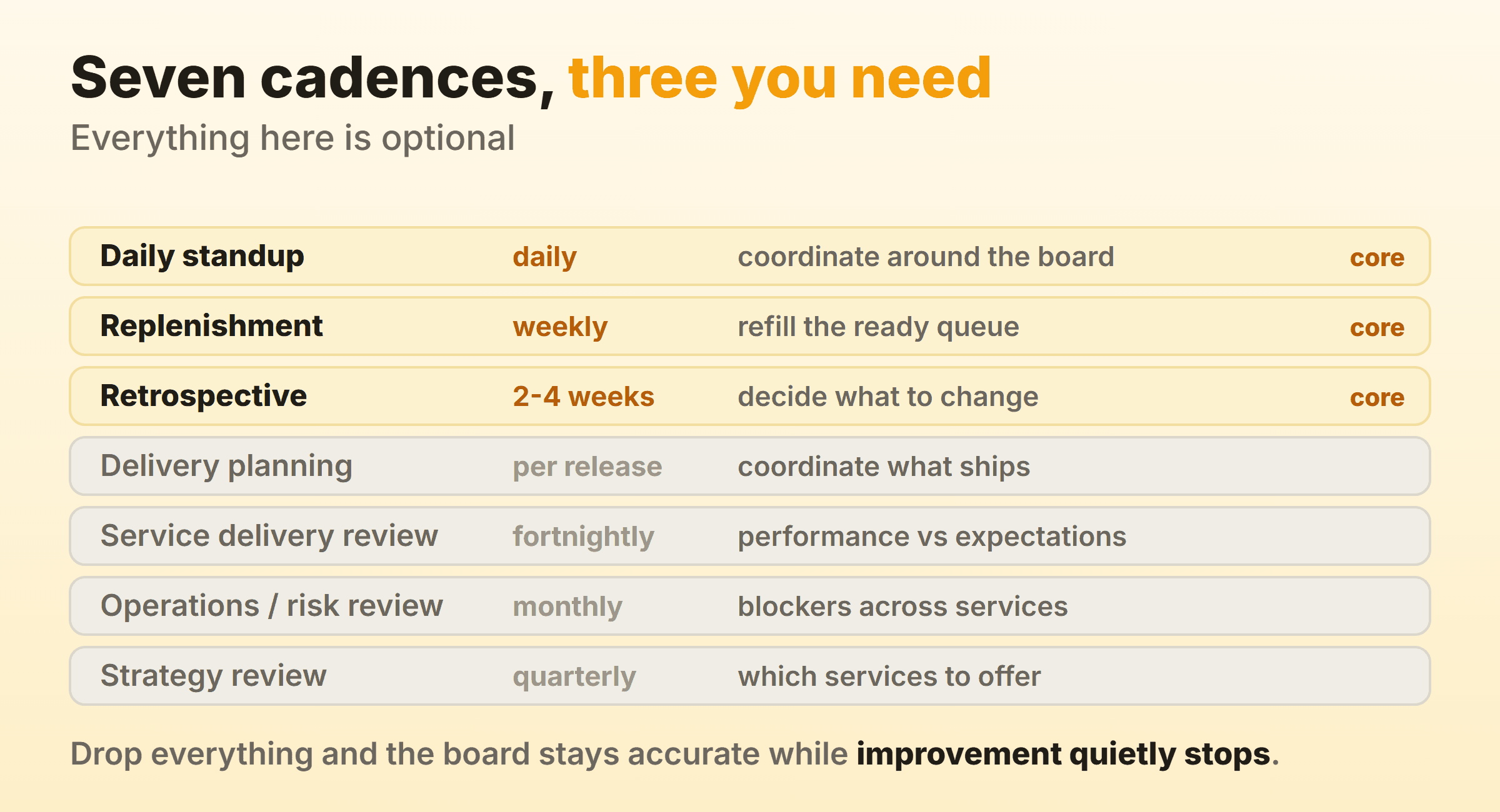
Kanban requires no meetings at all, which is why it has cadences rather than ceremonies. The method describes seven of them, running from a daily standup up to a quarterly strategy review, and every one is optional. Most small teams need three: a daily standup walked right to left across the board, a weekly replenishment meeting to refill the queue, and a regular retrospective. Kanban retrospectives differ from the scrum version mainly by being data-led, since they open with the flow numbers and the cumulative flow diagram rather than with how the fortnight felt.
Does Kanban Have Ceremonies?
Kanban ceremonies do not exist as a required set, and this is a real difference from scrum rather than a technicality. Scrum names four events and expects all of them. Kanban names cadences it considers useful and leaves adoption to the team, on the principle that you should start with what you already do and change it incrementally.
The practical consequence is that a team adopting kanban does not automatically inherit a calendar. If you already hold a useful standup, keep it. If you have a weekly planning meeting that works, keep that too and possibly rename it. Adding meetings because a framework listed them is how organisations end up with four recurring events that nobody can justify.
That said, “no required meetings” gets misread as “no meetings”, and teams that drop everything usually discover within two months that nobody is looking at the board together and improvements have stopped happening.
The Seven Kanban Cadences
| Cadence | Frequency | Purpose |
|---|---|---|
| Daily standup | Daily | Coordinate around the board, unblock what is closest to done |
| Replenishment meeting | Weekly | Refill the ready queue with the next most valuable work |
| Delivery planning meeting | Per release cadence | Coordinate what ships and when |
| Service delivery review | Fortnightly | Review performance against customer expectations |
| Operations review | Monthly | Look across services and how they interact |
| Risk review | Monthly | Examine blocked items, escalations and recurring impediments |
| Strategy review | Quarterly | Decide which services to offer at all |
The bottom four assume an organisation running several kanban systems, and a single team of six will not need them. Reading the full list is still worth it, because it shows a deliberate separation between coordinating work (top three) and improving the system (bottom four), which most teams collapse into one meeting and then wonder why the improvement conversation always loses to the status conversation.
Which Meetings Small Teams Actually Need
Three, and one of them takes fifteen minutes.
Daily standup. Fifteen minutes at the board. Covered in detail below.
Weekly replenishment. Twenty to thirty minutes to refill the ready queue with the next most valuable items. This replaces sprint planning and is usually far shorter, since the team is choosing a handful of items rather than committing to a fortnight. Kanban planning covers how the queue and the meeting fit together.
Retrospective, every two to four weeks. An hour. The single highest-value meeting on a kanban calendar and the one most likely to get skipped when things are busy, which is exactly when it is most needed.
Anything beyond those three should have to justify itself. A demo when there is something worth showing. A monthly look at the metrics if that does not already happen in the retrospective. That is usually enough for a team under ten people.
How Kanban Retrospectives Differ
A kanban retrospective is data-led. Where a scrum retrospective typically opens with how the sprint felt, a kanban one opens with what the board did, and the feelings conversation follows the numbers rather than replacing them.
A format that works:
- Start with the cumulative flow diagram. Which band widened. Where did work accumulate.
- Look at cycle time. Did the spread tighten or stretch. Which items were the outliers, and what did they have in common.
- Review the blocked and aged items. What stopped, for how long, and why.
- Then ask the human questions. What felt hard, what should change.
- Pick one change. Not five. One, with a way to tell next time whether it worked.
The reason for that order is that it makes the conversation specific. Opening with “how did the last two weeks go” produces impressions. Opening with a chart showing the review column widening for three weeks produces a discussion about review capacity. Kanban metrics covers reading a CFD and which numbers repay a monthly look.
The kanban literature has a formal relative of this called the service delivery review, which examines performance against customer expectations rather than internal process. Small teams generally fold the two together, and that is fine.
Running the Standup on a Kanban Board
Walk the board from the right, not around the room. This one change does more for a standup than any other.
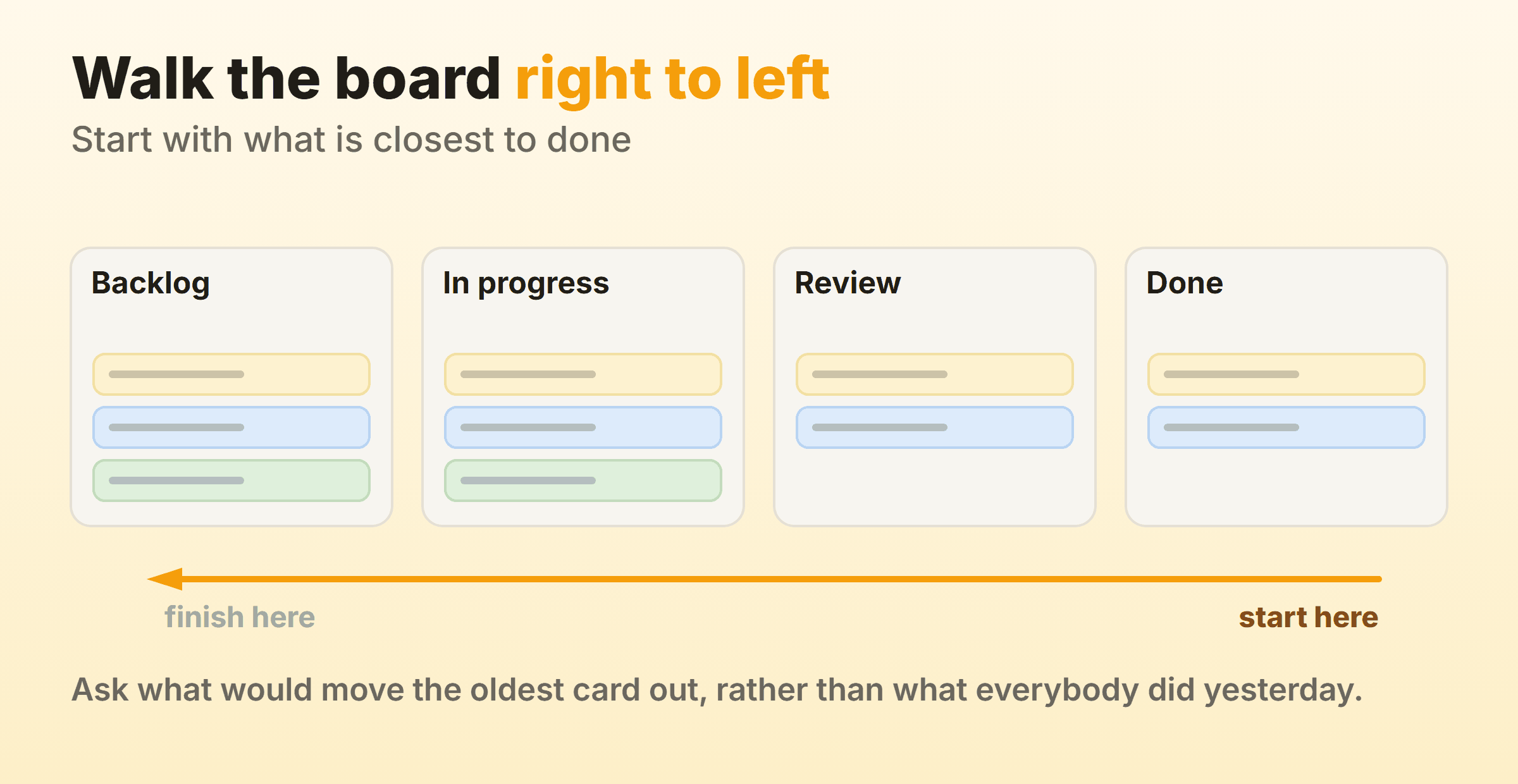
The round-robin format (“what I did yesterday, what I am doing today, blockers”) reports on people. Walking the board reports on work, starting with the items closest to done and asking what would move each one forward. Cards nobody mentions are the ones to worry about, and they surface immediately rather than never.
Three questions that cover most standups:
- What is blocking the items closest to done?
- Is anything aging? Any card noticeably older than your usual cycle time gets discussed today.
- Are any columns at their limit? If so, the answer is to help finish something there rather than to start anything new.
Fifteen minutes, standing, in front of the actual board. If the meeting regularly runs long, the overspill is usually a conversation between two people that the rest of the team is sitting through.
When Meetings Are the Problem
Two failure modes worth naming, since both are common in teams arriving from scrum.
Ceremony inertia. The team drops the sprint but keeps all four scrum events, so it now holds planning, review, retrospective and standup on a system that no longer has the boundary those events were built around. Sprint review in particular tends to survive as a meeting with no natural content. Kanban vs scrum covers what each event was doing and which ones still earn their place.
Meeting collapse. The opposite. Kanban requires nothing, so the team drops everything, and two months later nobody has looked at the board together and no improvement has happened since the switch. The retrospective is the one to protect, because it is the only meeting whose absence takes months to notice.
The honest test for any recurring meeting is whether it changed a decision in the last month. If the standup has not altered what anyone did next, it has become a status report delivered standing up.
FAQ
Do kanban teams have a scrum master?
Kanban requires no roles, so no. Teams arriving from scrum often keep the person in an adjacent job such as delivery lead or flow manager, since facilitating meetings and clearing impediments still needs doing.
How often should a kanban team hold retrospectives?
Every two to four weeks for most teams. More often than fortnightly and there is rarely enough new data, and much less often than monthly and problems compound before anyone examines them.
What is a replenishment meeting?
A short recurring meeting where the team refills the ready queue with the next most valuable items. It replaces sprint planning without the commitment, so it is usually much shorter, and it is triggered by the queue dropping below its cap.
Can you run kanban with no meetings at all?
Technically yes, and it works for solo boards. For a team it tends to fail slowly, since the board stays accurate while shared understanding and improvement quietly stop.