
Kanban vs Scrum: Differences and How to Choose
Updated at
The Answer
Kanban and scrum are both agile frameworks, and one thing separates them: whether the team commits to a fixed time box. Scrum works in sprints of a month or less, assigns three accountabilities (product owner, scrum master, developers), and holds sprint scope steady once planning ends. Kanban drops all of that. Work flows across a board with no iterations, the team caps how many items sit in progress at once, and priorities can shift on a Tuesday. Choose scrum if your priorities survive two weeks of contact with reality and the team works better to a beat. Choose kanban if requests land unpredictably, or if your real problem is that everything gets started and nothing finishes.
What Is Kanban?
Kanban manages work as a continuous flow. A board makes every item visible, and a cap on work in progress stops the team starting more than it can finish. Toyota got there first. Taiichi Ohno used physical cards on the production line in the late 1940s to signal when the next batch of parts should be pulled, and knowledge work borrowed the idea decades later.
The board has columns for the stages work moves through and cards for the items themselves. The cap goes on whichever column collects stuck work. Most teams skip that cap, which is a shame, because it does most of the useful work. A board without limits is a to-do list turned sideways. Add them and a full column forces you to finish something before starting the next thing. WIP limits have their own guide if you want the mechanics.
Kanban prescribes nothing else. No roles, no required ceremonies. It wants your work visible and your in-flight count capped, plus enough attention to your own numbers to notice what is slowing you down. Scrum asks for considerably more.
What Is Scrum?
Scrum packages work into fixed-length sprints with defined accountabilities and a fixed set of events. The Scrum Guide puts a sprint at one month or less, with the next one starting the moment the last ends, and names three accountabilities: the product owner owns the product backlog, the scrum master holds the team to the framework, and the developers build.
Four events shape a sprint. Planning picks what the team commits to, the daily scrum is a fifteen-minute progress check, the review puts the increment in front of stakeholders, and the retrospective is where the team decides what to change. Scope holds steady inside the sprint, which is the whole reason the commitment carries any weight.
That structure is scrum’s value and its price. A team gets a predictable heartbeat and a fixed moment to inspect and adapt. In exchange it needs priorities that survive contact with a two-week plan.
What Is the Difference Between Kanban and Scrum?
Five dimensions carry the difference between kanban and scrum: cadence, roles, planning, how change gets handled, and what the team measures. Every other scrum vs kanban distinction people list follows from these.
| Scrum | Kanban | |
|---|---|---|
| Origin | Software development | Lean manufacturing at Toyota |
| Cadence | Fixed sprints, one month or less | Continuous flow, no iterations |
| Roles | Product owner, scrum master, developers | None required |
| Planning | Sprint planning selects a fixed batch | Pull the next item when capacity frees up |
| Handling change | Discouraged mid-sprint | Expected, reprioritise any day |
| Limiting work | Implicit, via sprint scope | Explicit, via WIP limits per column |
| Core metrics | Velocity, sprint burndown | Cycle time, throughput, WIP, work item age |
| Release | At the end of a sprint, or later | Whenever an item is done |
| Board resets | Cleared each sprint | Persistent |
| Best fit | Stable priorities, plannable work | Unpredictable arrival, varied sizes |
Cadence
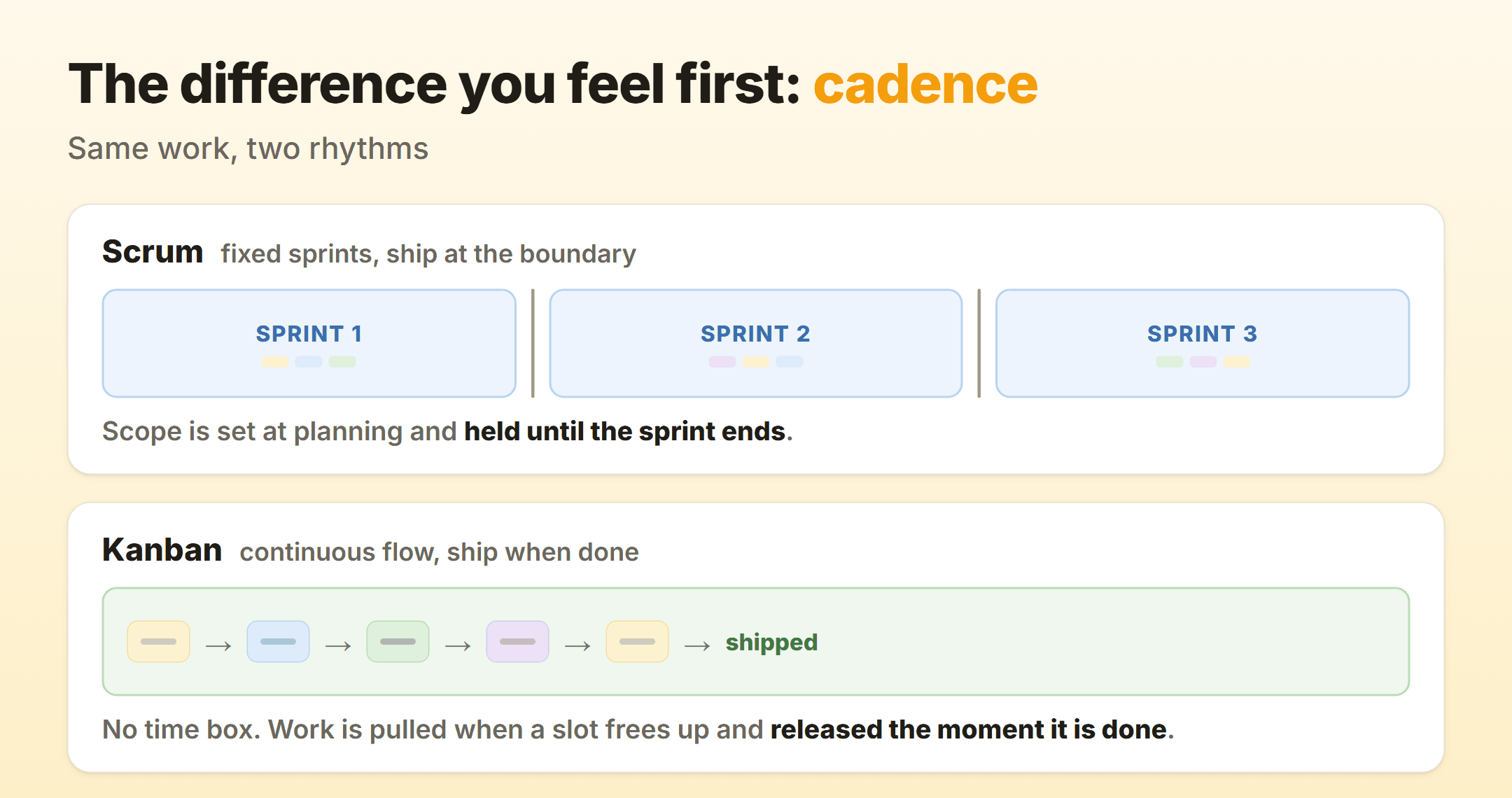
A scrum team knows the sprint ends on Monday the twenty-fifth, the review happens, and a new plan gets made. Kanban has no such boundary. An item finishes when it finishes, and someone pulls the next one when they have the capacity for it.
Teams feel this before any other difference. Sprints create a drumbeat that some teams need and others quietly resent. Continuous flow takes the artificial deadline away, which helps when the work refuses to divide into two-week chunks and hurts when a team only finishes things with a date bearing down on it.
Roles
Scrum names three accountabilities and kanban requires none, which is where most of the adoption pain lives. Kanban teams still have product owners and managers, of course. Kanban just does not ask you to invent roles you do not already have, so it lands on an existing team with far less disruption. Scrum asks you to restructure who decides what, and on a team without a real product owner, that restructuring is where adoption tends to die.
Planning
Sprint planning pulls a batch of items the team commits to for the whole sprint. On a kanban board the same decision happens one item at a time, whenever a slot opens, which means it gets made far more often and with fresher information.
Prioritisation does not disappear either way. Scrum concentrates it into an event, while a board spreads the same decisions in small doses right across the week.
Handling change
An urgent request arriving on day three of a sprint is a problem. The honest options are to park it until the next sprint or break the commitment, and a team interrupted weekly ends up breaking it every time. The same request on a kanban board is just Tuesday. Someone moves it to the top of the queue and it gets pulled next.
Interruptions have sunk a couple of scrum adoptions I was close to. The commitment stops meaning anything. A few months on, the retrospective has become a standing conversation about why the plan broke again, and the ceremony outlives whatever point it once had.
Metrics
Velocity is scrum’s number: how much the team completes per sprint, which is what makes the next forecast possible. Kanban tracks flow metrics instead. Cycle time is how long an item takes from start to finish, throughput is how many items finish per week, and work item age tells you how long the thing sitting in your Doing column has been sitting there.
The gap shows up when something goes wrong. Velocity says the team delivered less this sprint. Cycle time and work item age point at the specific item that is stuck and how long it has been stuck, which you can act on today.
Does Kanban Have Sprints?
No. There is no time box in kanban and no commitment to a fixed batch of work, so nothing plays the part a sprint plays. Items get pulled one at a time and released whenever they are done, which might mean several times a day or once a month depending on what you build.
Kanban teams do keep rhythms, just not time boxes. Plenty hold a weekly replenishment meeting to refill the queue, a daily standup walked right to left across the board, and a monthly look at the flow numbers. Those are habits a team chooses, and kanban meetings covers the full set of cadences. A sprint is a container that scopes the work, which is a different animal. Kanban vs sprint goes deeper on the time box itself.
Confusion usually starts when someone says “we do two-week kanban sprints”. That normally describes scrum running on a kanban board, or kanban with a recurring planning meeting bolted on. Both are perfectly workable setups. The label is what causes trouble later, when somebody expects sprint behaviour from a board that has none.
Scrum Board vs Kanban Board
A scrum board and a kanban board look nearly identical on screen. Columns, cards, somebody dragging work to the right. The difference between scrum and kanban shows up in the rules each board runs under, and the layout gives you almost no clue.
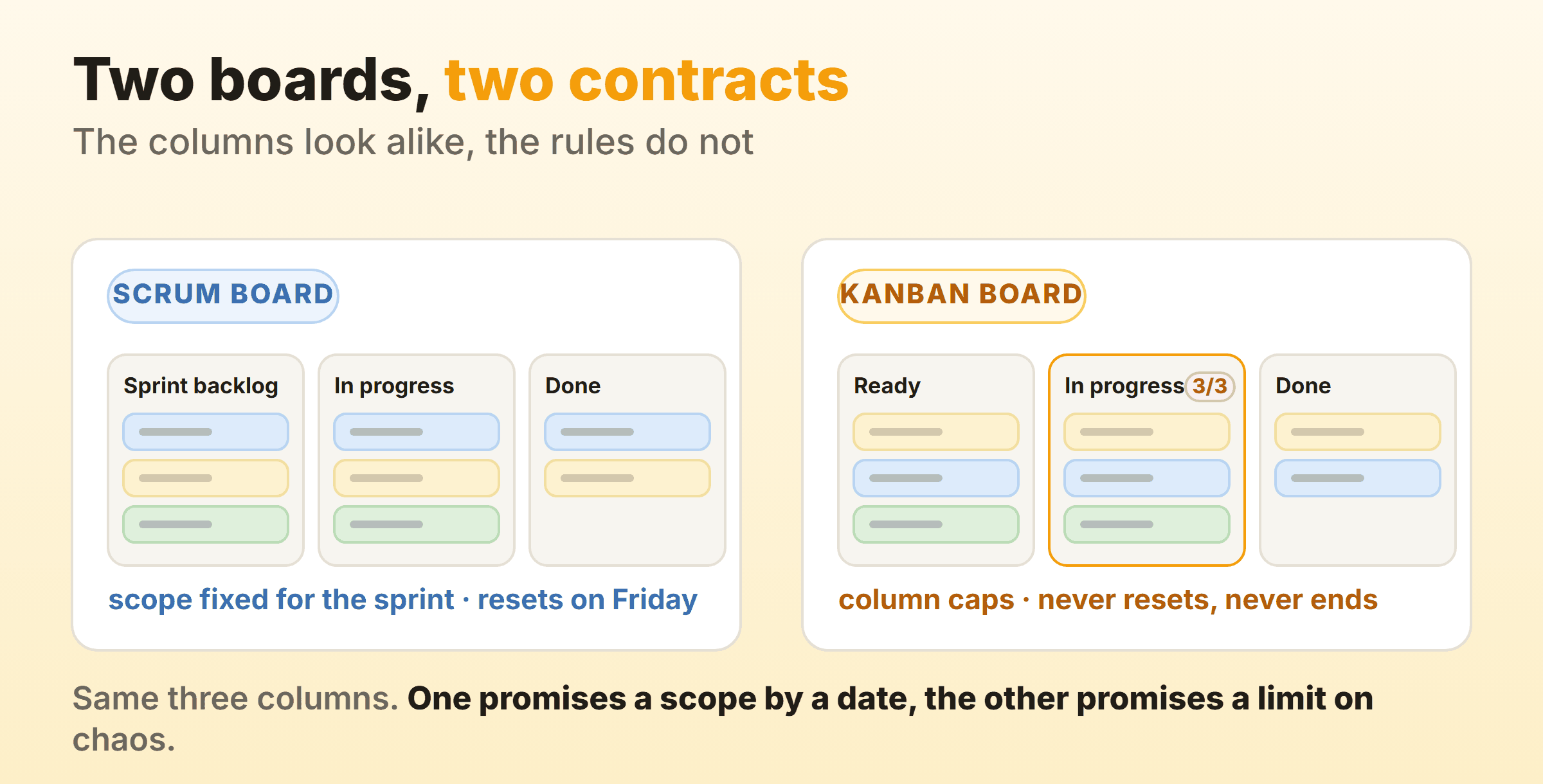
A scrum board is scoped to one sprint. Planning fills it, it holds only the items the team committed to, and it gets cleared when the sprint ends, with anything unfinished going back to the product backlog. What you are looking at is a single sprint’s worth of work.
A kanban board persists. Nothing resets it, items carry across weeks, and the columns usually carry explicit WIP limits. A scrum board can live without those limits because sprint scope already caps the batch, which is why kanban board vs scrum board comparisons so often come down to whether anyone has capped the middle column.
Faced with an unfamiliar board, ask whether it gets wiped at the end of an iteration. That will tell you which one you are dealing with.
What Are the Pros and Cons of Kanban vs Scrum?
Adaptability is kanban’s main return on the effort. With scrum you get predictability instead, and both come with a bill that lands somewhere specific.
Kanban is good at: soaking up unplanned work without wrecking a plan, making bottlenecks obvious through WIP limits, landing on an existing team without reorganising it, and releasing the moment something is ready.
Kanban is bad at: giving anyone a date. It also hands you very little structure to hide behind, so a team with weak prioritisation ends up with a board that quietly becomes a backlog nobody prunes. Skip the WIP limits and it degrades into a visual to-do list inside a month.
Scrum is good at: producing a forecast people can plan around, carving out a fixed moment for feedback, and handing a new team a clear operating manual.
Scrum is bad at: interruption. The overhead is real too, roughly four events plus refinement every sprint, and the shorter the sprint the heavier that feels. Where there is no genuine product owner, the roles become job titles and the decisions stay wherever they already sat.
Scrum fails loudly. A broken sprint is obvious by the review and someone always says so. Kanban’s failure mode is quieter and worse: a board carrying thirty in-progress items with no limits can run for the better part of a year while everyone wonders why nothing ships.
When Should You Use Kanban Instead of Scrum?
Use kanban when work arrives unpredictably, and scrum when priorities hold still long enough to plan around them. In practice three signals decide it, and preference is not one of them.
Choose kanban if: requests arrive from outside the team on someone else’s schedule, item sizes vary wildly, the team maintains and supports as well as builds, or too much gets started and too little finished. Support desks, ops teams, marketing and content teams, and anyone doing bug triage land here almost every time.
Choose scrum if: the team can protect two weeks of scope from interruption, work divides into sprint-sized pieces, stakeholders need a forecast to plan around, or the team is new to structured delivery and would benefit from a prescribed set of events.
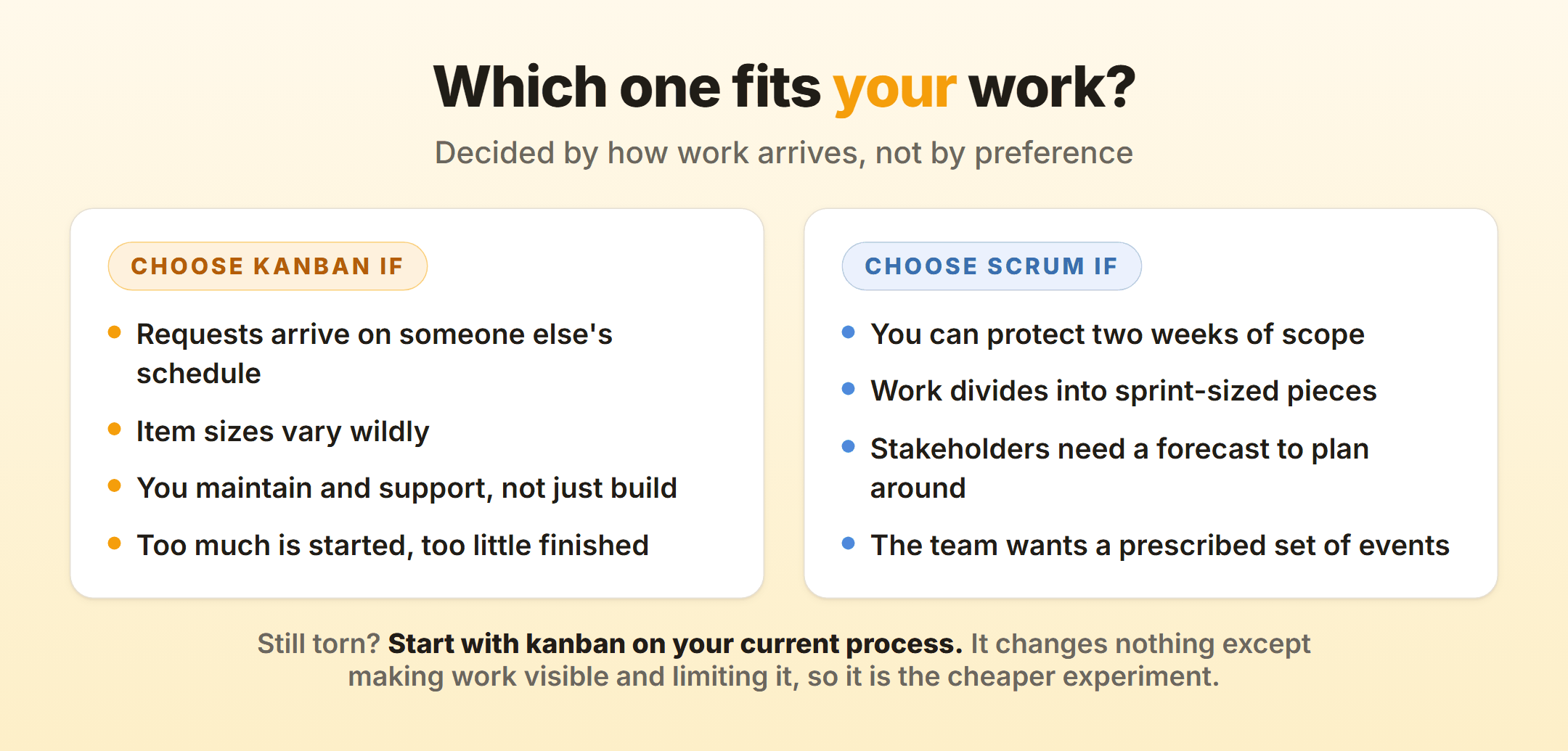
Two things I would add from running both. Teams switch from scrum to kanban far more often than the reverse, and the trigger is nearly always a run of sprint commitments that kept breaking. And if you genuinely cannot decide, start with kanban on the process you already have. It changes nothing except making the work visible and capping it, so it costs almost nothing to try, and inside a month you will know whether your problem was structure or flow. If it was structure, moving to scrum from a working board is easy.
How Do You Move From Scrum to Kanban?
Moving from scrum to kanban changes how you commit to work. The tooling stays where it is. Three steps cover most of it.
- Keep the board, drop the sprint boundary. Stop clearing the board at sprint end and let items carry across. Your existing columns usually work as they are.
- Put WIP limits on the columns where work piles up. Start with the number of people who pull from that column plus one. The first week will feel restrictive, which is the limit telling you something true about how much was in flight before.
- Swap sprint planning for replenishment. A short weekly meeting to refill the queue covers most of what planning did, minus the batch commitment.
Keep the retrospective. It is the most valuable event scrum has and kanban offers no replacement for it. Most teams keep the daily standup too, walked right to left across the board so the conversation starts with whatever is closest to done.
Stakeholders lose the velocity number, so your forecast has to come from cycle time instead. If items this size have historically taken four to nine days, that range is your forecast. Stakeholders tend to trust it once they have watched it hold for a month or two, so gather the data before you lean on it.
Can You Use Kanban and Scrum Together?
Yes, and the hybrid has a name: scrumban. In most versions it keeps scrum’s events and roles while adding kanban’s WIP limits and flow metrics. Some teams keep the sprint purely as a planning rhythm and let work flow across the boundary while the board keeps running.
Scrum does not forbid any of this. Adding WIP limits to a scrum board breaks no rule in the Scrum Guide and tends to help, because sprint scope caps the batch without capping how many items the team touches at once. A team that drags all fifteen sprint items into “in progress” on day one has followed every rule in the guide and still built a mess.
One combination does not work: calling continuous flow “scrum” because you kept the standup. Drop the sprint commitment and you have dropped the mechanic scrum runs on, and carrying the name forward mostly leaves stakeholders confused about what they can expect from you.
Where Do Agile and Waterfall Fit In?
Agile is the umbrella. Kanban and scrum are two frameworks under it, and waterfall is the sequential approach agile formed in reaction to. Worth spelling out, because people compare the four as though they sit at one level.
Waterfall runs its phases in order. Requirements, then design, then build, then test, each one finishing before the next starts. The Agile Manifesto puts working software and responding to change ahead of documentation and fixed plans, and scrum is the most prescriptive of the popular frameworks built on that idea. Kanban is the least prescriptive, to the point that some practitioners will tell you it is a method you lay over whatever process you already run.
So “kanban vs agile” is a category error, strictly speaking, and agile vs scrum vs kanban compares a category against two of its own members. As shorthand for “kanban vs scrum” both work fine, since scrum is what most people picture when they say agile.
FAQ
Is kanban better than scrum?
Neither wins in general. Kanban suits unpredictable, varied, interrupt-driven work, while scrum wants work that fits inside a fixed time box. In most real cases the team asking has been failing at scrum because its work was never plannable in the first place, and kanban would serve it better.
Can a scrum team use a kanban board?
Yes, and most do. A scrum board with columns and cards is already a kanban-style board, and adding WIP limits to it stays compatible with scrum. Working on a kanban board does not make a team a kanban team, because the sprint commitment is still sitting there underneath.
Does kanban have a scrum master?
Kanban requires no roles at all, so no. Teams moving across from scrum often keep the person in an adjacent job, delivery lead or flow manager, because the coaching and impediment-clearing still needs doing.
Which is easier to start with?
Kanban, by a wide margin. You visualise the process you already run and cap work in progress. Scrum wants new roles, four recurring events, and a team willing to hold sprint scope, which is a real organisational change even though the framework document itself is short.
Do you still estimate work in kanban?
Some teams do and plenty stop. Once you have a few weeks of cycle time data, the historical range answers most of the questions estimates were covering, and sizing items only helps if the sizes actually predict duration. Teams that keep estimating usually reduce it to rough small, medium and large buckets.