
Kanban Roles and Responsibilities: What the Method Prescribes
Updated at
The Answer
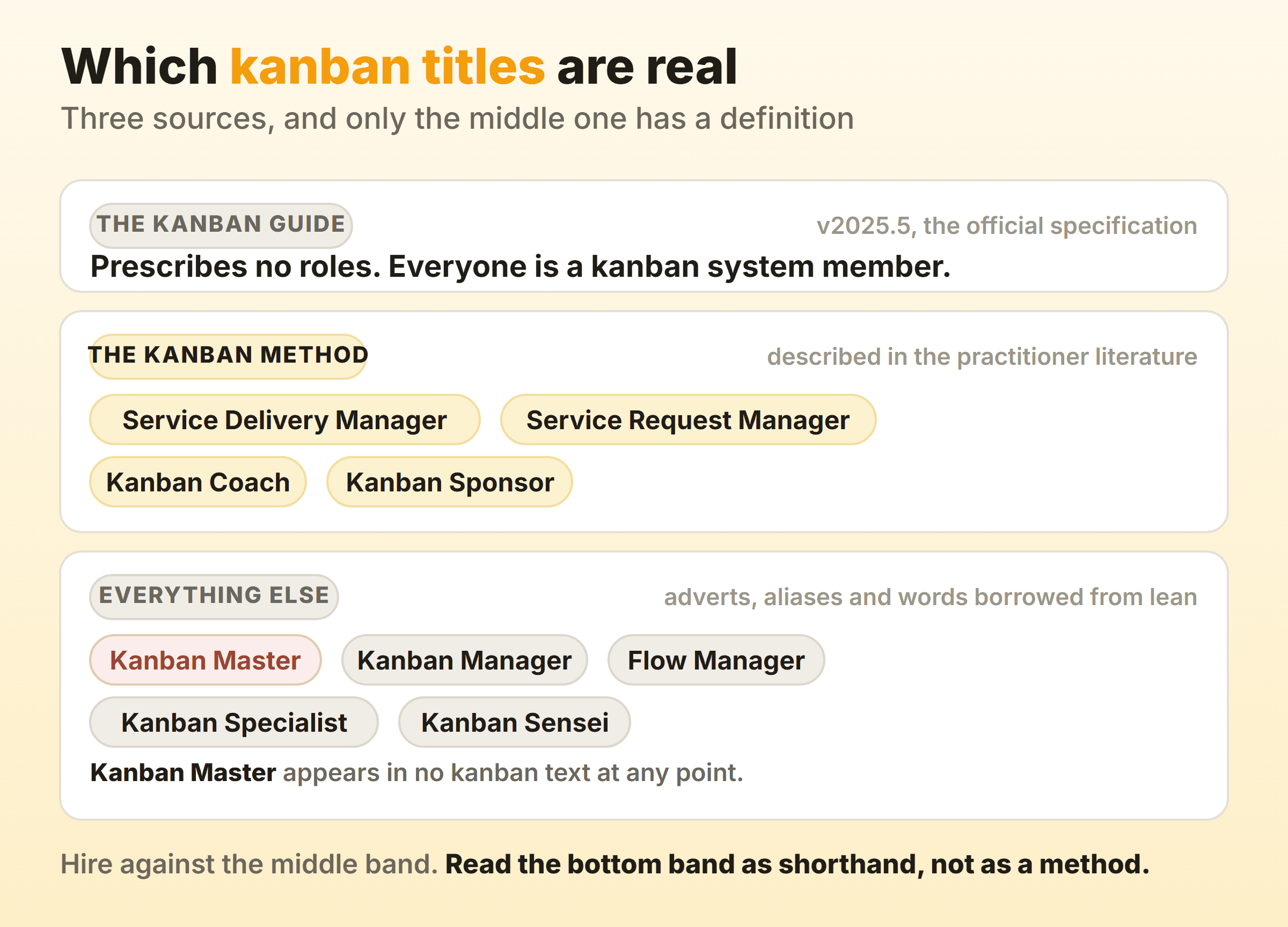
Kanban prescribes no roles. The official Kanban Guide assigns nothing to anybody beyond calling the people involved kanban system members, so a team can move to kanban on a Monday with every job title untouched. The wider Kanban Method does describe two emerging kanban roles that organisations adopt by choice, the Service Delivery Manager and the Service Request Manager, plus a kanban coach and an executive sponsor sitting outside the team. Every other title you will meet, from kanban master to kanban specialist, got invented by a team or a recruiter. No harm in that, as long as the five responsibilities underneath the titles each have somebody’s name against them.
Does Kanban Prescribe Any Roles?
Kanban prescribes no roles, and the official guide says so without hedging. The Kanban Guide, currently version 2025.5 and maintained by John Coleman, Daniel Vacanti, Colleen Johnson and a handful of other practitioners, defines the method as three practices: define and visualise a workflow, actively manage the items in it, improve it. The people doing that work are called kanban system members. No accountabilities. No minimum team shape. Not one job title in the whole document. Practitioners shorten all of this to no prescribed roles, and the official Kanban Guide is where the phrase comes from.
Scrum takes the opposite position. The 2020 Scrum Guide names three accountabilities inside a Scrum Team, the Developers, the Product Owner and the Scrum Master, and expects all three to exist. That single difference causes most of the confusion when a team switches, and kanban vs scrum goes through the rest of it. Scrum hands you a team structure and asks you to fit the work into it. With kanban you keep whatever structure you already have and get a way to see what it is doing.
The omission is deliberate. One of the founding kanban principles is to start with what you do now, and the full phrasing of that principle explicitly respects current processes, roles, responsibilities and job titles. A method built on evolutionary change cannot open by reorganising everybody. The teams I have watched try it anyway spent longer arguing about the org chart than they ever spent looking at the board, and the flow problem that triggered the whole thing was still sitting there at the end.
None of which means kanban has nothing to say about who does what. Two roles emerged from practice, and they are worth understanding even if nobody in your building ever gets appointed to one.
What Are the Two Emerging Kanban Roles?
The two emerging kanban roles are the Service Delivery Manager and the Service Request Manager. Neither was designed. Organisations kept inventing something like them until Kanban University, the body that maintains the David Anderson lineage of the method, gave the pattern a name and called it emerging. They are the only named roles in kanban the method describes at all.
Service Delivery Manager (SDM)
The Service Delivery Manager owns flow. Kanban University’s account of the emerging roles hands the SDM the replenishment meeting, the delivery planning meeting, escalation of blocked tickets and what the method now calls risk review, and notes that in more recent implementations the SDM facilitates the daily kanban meeting too.
Read that list and it is the flow half of a scrum master’s job with the coaching half taken out. The literature also calls this person a flow manager, or flowmaster. On a team of six nobody holds it formally. It survives as a habit instead, and the habit is somebody noticing that review has been at its limit since Tuesday and saying so out loud.
Service Request Manager (SRM)
The Service Request Manager owns the input. The SRM decides what is worth starting, orders the queue against business risk, and sets the policies that frame those decisions. Kanban University describes the role as a risk manager and facilitator, and gives it the replenishment meeting plus a part in the strategy review and the risk review.
A product owner is the closest familiar equivalent, though the question each one answers is different. Product owners get asked what is most valuable. For an SRM the question is what is most costly to delay, which is not the same thing and frequently produces a different order. It is also the question that catches the small compliance task everybody keeps pushing down the list.
Both roles are defined by the meetings they own, and neither comes with anybody reporting to them, so the practical way into either one runs through the kanban cadences.
Which Responsibilities Still Need an Owner?
Five responsibilities need an owner on any kanban board, whether or not the team has a single kanban role between them. This is the part of kanban roles and responsibilities that decides whether a board works.
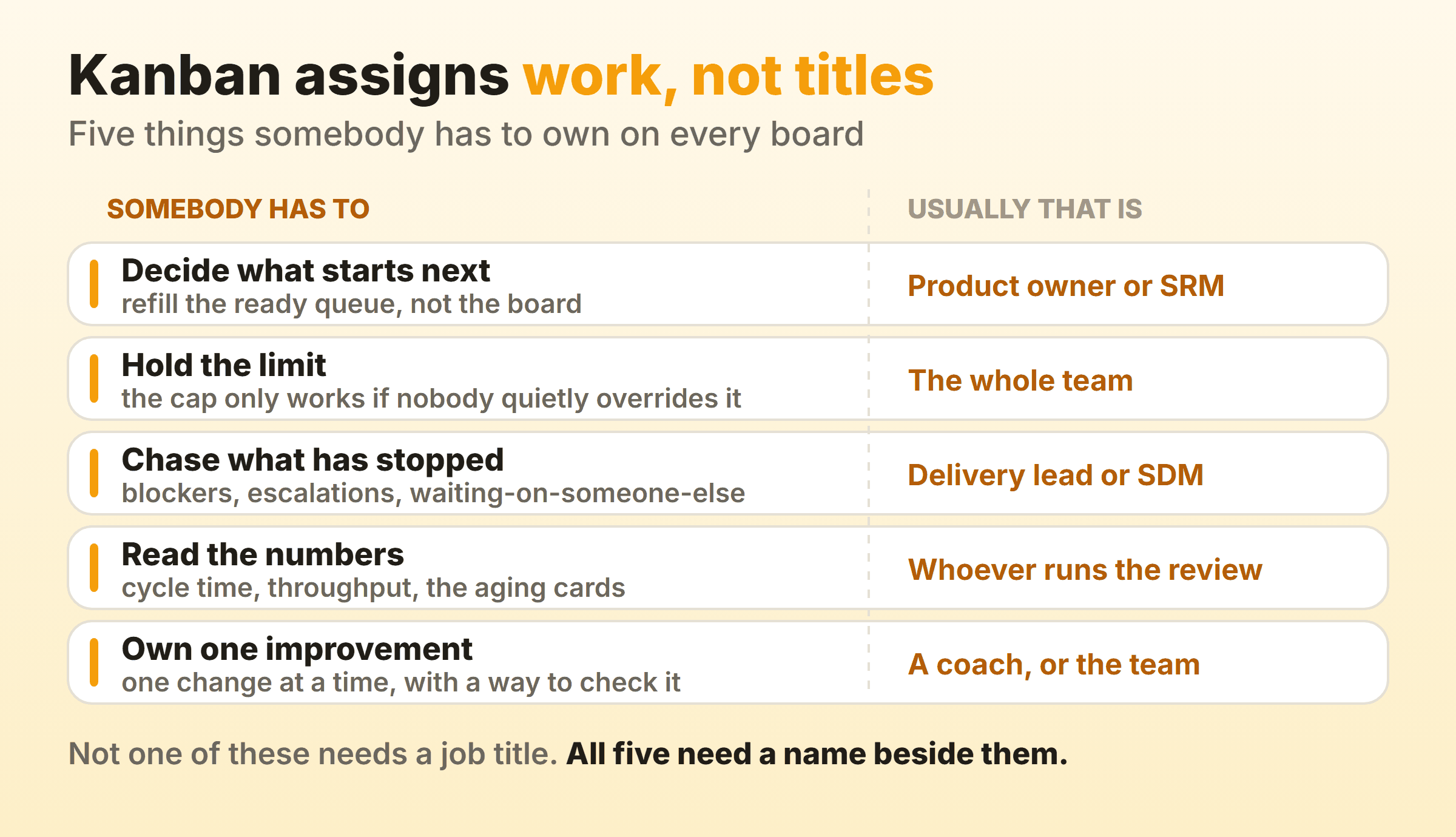
Deciding what starts next. Somebody refills the ready queue, and declining to decide is itself a decision, one that hands the choice to whoever shouts loudest. SRM work under a different name.
Holding the limit. The whole team owns this one, which is exactly why it slips. A WIP limit that any single person can quietly override has stopped being a limit. Kanbanee shows the count against the cap on each column and turns the badge red when the column goes over, and it still lets you drop the card, because a soft limit is the point. The tool makes the breach visible and then gets out of the way. Whether the breach was worth it is a conversation, not a validation error. I cap my own Doing column at two.
Chasing what has stopped. Blocked items, escalations, the ticket that has been waiting on another department since last month. SDM work, and the most common gap on a small team, because everybody can see the blocker and nobody owns the chasing.
Reading the numbers. Cycle time, throughput, and which cards are aging past your usual spread. Somebody has to look at these before the retrospective. Do it during and the hour goes on gathering data instead of deciding anything.
Owning one improvement at a time. One change, running, with an agreed way to tell whether it helped. Start five at once and you will not be able to say afterwards which one did anything.
The gaps that hurt are the ones nobody notices. A responsibility sitting between three people, each of whom assumed one of the other two had picked it up, looks from the outside exactly like a responsibility that is covered.
Are Kanban Coach, Kanban Master and Kanban Sensei Real Roles?
Kanban coach is a genuine credential, kanban master exists nowhere in the literature, and kanban sensei is borrowed from Lean. Job adverts use all three as though they were the same word.
Kanban coach and kanban consultant
A kanban coach is the one title here with certification behind it. Kanban University grants Kanban Coaching Professional (KCP) to people who already hold the KMP credential and then complete the Kanban Maturity Model and coaching courses and pass an exam. Above that sits Accredited Kanban Consultant, which needs KCP plus a change leadership masterclass.
A kanban consultant is the same skill set on a shorter contract, most of the time. The word carries no accreditation of its own, so it describes the commercial arrangement and leaves you none the wiser about the person.
Kanban specialist
Kanban specialist is not a credential anybody issues. It lives in job adverts and freelance profiles, where it means roughly “has run kanban boards before and would like you to assume that is a lot”. Nothing dishonest in that. It carries no information on its own, so treat the word as a prompt to ask which credential the person actually holds and what changed on the last board they ran.
Kanban master
There is no kanban master. The Kanban Guide does not mention it and neither does Kanban University’s credential path. The title is scrum master with one word swapped, and when it turns up on an org chart it tends to mean the team changed boards and changed nothing else. Keeping the person is sensible, since their facilitation work still has to happen. Giving the job a name that matches what they now do is a two-minute conversation that saves a lot of confusion later.
Kanban manager and flow manager
Flow manager is real, or real enough. It appears in the practitioner literature as another name for the SDM, and flowmaster turns up in the same paragraphs. Kanban manager has no such lineage. In practice the phrase describes a delivery manager who happens to use a board.
Kanban sensei
Kanban sensei comes from the Toyota Production System, where a sensei is an outside teacher who asks questions instead of handing over answers. Real lineage, and genuinely useful when you can find one. It is still not a kanban role, and no kanban body certifies it.
Which Kanban Certification Maps to Which Role?
Kanban University runs the main credential path, and the whole thing reads in about a minute.
| Credential | Stands for | Prerequisite | Points at |
|---|---|---|---|
| TKP | Team Kanban Practitioner | None | Anyone on the team |
| KSD | Kanban System Design | None, though the blue book is assumed | Designing the board |
| KSI | Kanban Systems Improvement | KSD | Improving a running system |
| KMP | Kanban Management Professional | KSD plus KSI | SDM and SRM work |
| KCP | Kanban Coaching Professional | KMP, plus the KMM and coaching courses, plus an exam | Kanban coach |
| AKT | Accredited Kanban Trainer | KMP, plus train the trainer | Teaching the curriculum |
None of it is required to run a board. TKP is the two-day entry class and the only one most team members would ever want. Kanban coaching certification training earns its cost when you are being paid to change somebody else’s system, and much less when you are running your own team’s board and can simply try things and watch what happens. In twelve years nobody has asked me for a kanban credential, which is not an argument against holding one.
It is, though, an argument about what to look for in other people.
What Should You Look For When You Hire for a Kanban Team?
When you hire for a kanban team, the question that separates candidates is what their cycle time was and what they changed to move it. Certificates come a distant second. Job adverts collapse a lot of different work into the word kanban, so it helps to know what each one is really asking for.
Hiring a kanban product owner or product manager
Adverts that say hire kanban product managers or hire kanban product owners are almost always describing SRM work. Ask how they ordered the queue, and listen for cost of delay instead of a scoring spreadsheet. Did they run a replenishment meeting, or a two-hour grooming session that produced a sorted list. The most useful question is how many items sat in ready at any one time, because anyone who ran a real queue remembers how big it was.
Hiring kanban developers
When a spec says hire kanban developers, or hire a kanban developer for one seat, kanban is describing the environment the job sits in. You are screening for whether somebody can work inside a limit. Will they leave a ticket unstarted because the column is full. Will they pair on the oldest card instead of picking up a fresh one that looks more interesting. That instinct is harder to teach than any tool.
Hiring a kanban consultant, coach or expert
Adverts that read hire kanban consultant or hire kanban expert are asking for the same person on different terms. Ask for the credential, then set it aside for a moment and ask instead for a board they changed, with the cycle time before and after. Somebody who cannot produce throughput or cycle time for a system they claim to have improved has been running workshops. That is a different job and it is worth less money.
Hiring a kanban analyst
Hire kanban analyst adverts describe a business analyst on a flow-managed team. Reading a cumulative flow diagram without having it explained is the baseline. Above that sits writing service level expectations that survive contact with a real customer. The rarest skill, and the one that does most for cycle time, is splitting a work item so it moves in days instead of weeks.
Three questions work on any of these:
- What was your cycle time, and how do you know?
- What happened the first time somebody wanted to break the WIP limit?
- Name one change you made to a board and how you checked whether it worked.
Do Small Teams Need Any of This?
No. A team of six does not need a Service Delivery Manager, and appointing one is a reliable way to make a simple board feel like a process.
Two habits cover it. Somebody notices when the board stalls and says so out loud. And when the queue runs dry, somebody decides what comes next. On a team of six that is one person, and rotating the job every few months beats fixing it in place, because the second time round a different person starts caring about the numbers.
Formal roles start paying when several teams share one input queue. They help again once work arrives from customers with a service level attached, or once nobody in the room has the authority to say no. Below that, kanban team roles are a distraction from the board.
FAQ
Does a kanban team need a scrum master?
No, since kanban requires no roles at all. Teams arriving from scrum mostly keep the person and change the title to delivery lead or flow manager, because facilitating the standup and clearing impediments still has to happen. Dropping the person and keeping all the meetings is the version that goes badly.
Who owns the kanban board?
The team owns the board, and one named person owns changes to it. Anyone can move a card. Adding a column, changing a WIP limit or rewriting a policy is a decision the team makes together, usually in the retrospective, so the board stays a shared agreement instead of one person’s design.
Is there a kanban project manager?
Kanban defines no such role, and project managers adopt kanban constantly without changing their title. The work maps most closely onto the SDM: escalation, dependencies, reporting outward. Assigning tasks is the habit to unlearn, because kanban is pull-based and cards get taken, not handed out.
Can one person hold both the SDM and SRM roles?
Yes, and on small teams one person usually does. The method separates them because the two jobs pull in opposite directions. The SRM wants more work started, while the SDM is trying to get the current work finished. When one person holds both, whichever pressure is louder that week tends to win, so it helps to run the replenishment meeting with the WIP numbers on screen.
What do kanban squad roles mean in practice?
Kanban squad roles is a phrase borrowed from the Spotify model, not from kanban, so it almost always describes an existing squad structure with a kanban board attached. The squad keeps its own titles. Kanban adds a limit, a queue and a set of numbers, none of which require the squad to be reorganised.