
Kanban Certification: Which Ones Exist and Whether You Need One
Updated at
The Answer
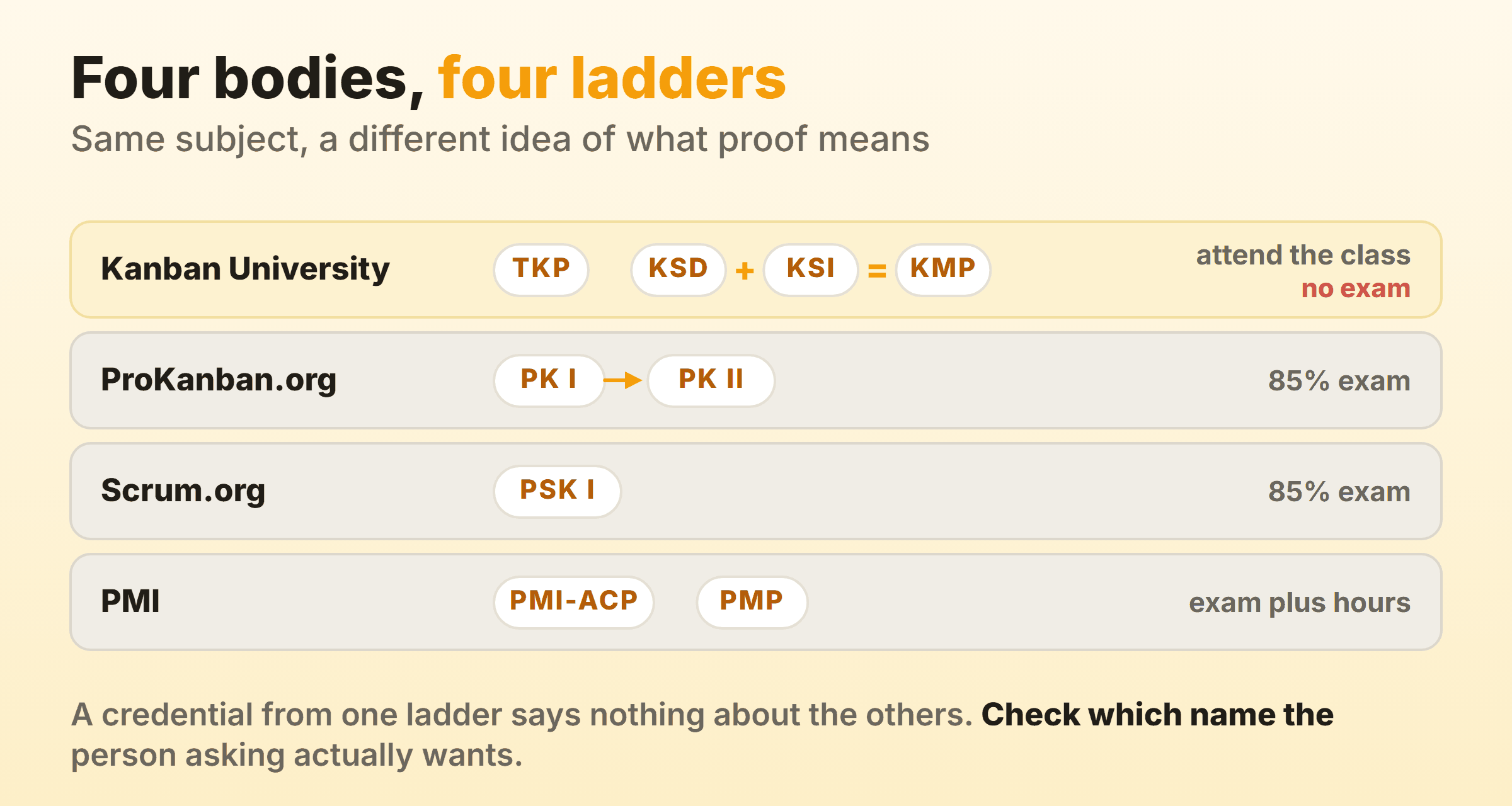
Four organisations stand behind the credentials people call a kanban certification, and they disagree about what proof means. Kanban University grants TKP, KSD, KSI and the combined Kanban Management Professional for attending a class, with no exam anywhere on that path. ProKanban.org and Scrum.org sell assessments you can sit without taking any class at all, both scored at 85 per cent to pass, both good for life. PMI folds kanban into PMI-ACP and the wider PMP syllabus instead of certifying it separately. None of the four is a licence and none is required to run a board. Take one when a job advert names it, when your employer is paying for the room and the trainer, or when you want a deadline that forces you to actually study. Otherwise the free Kanban Guide and a real board will teach you more per hour than any kanban certification course.
What Is a Kanban Certification?
A kanban certification is a credential issued by a private training organisation, not a licence issued by a regulator. Nobody can stop you calling yourself a kanban practitioner, running a board, or charging for the advice. Worth saying out loud before you spend money, because the marketing around kanban certifications borrows the vocabulary of professions where a licence genuinely is required.
Two words get used loosely and they mean different things. A kanban certificate normally records attendance, meaning you sat in the room for the whole class. A certification is meant to record assessed knowledge, which usually means an exam you can fail. Kanban University hands out its main credentials on attendance alone. ProKanban.org and Scrum.org make you pass something first. Both results get called a certification.
What any of them prove is narrow. You have been exposed to a specific vocabulary from a specific lineage, and that is not nothing. A room where everybody means the same thing by commitment point and replenishment argues faster and reaches decisions sooner. It is still a long way from proof that you can unstick a board that has been jammed for three weeks.
Who Issues Kanban Certifications?
Four bodies stand behind the credentials somebody outside your own company would accept as a kanban certification: Kanban University, ProKanban.org, Scrum.org and PMI. Only the first three issue one that is specifically about kanban, which is the distinction the marketing tends to blur. Everything else carrying a kanban certification badge is either a training company reselling one of those four, or a certificate of its own invention with no community standing behind it.
Kanban University
Kanban University is the David J. Anderson lineage, the one most people mean when they say kanban certification without qualifying it. It was called Lean Kanban University until the rename, which is why the older name still turns up in search results and on older LinkedIn profiles. Its catalogue runs from Team Kanban Practitioner through Kanban System Design and Kanban Systems Improvement, plus Enterprise Scale Kanban, the Kanban Maturity Model, Kanban Coaching, a Flow Manager course and Scrum Better with Kanban.
The ladder is worth understanding because the naming runs on two tracks at once. TKP is the one-day introduction, and Kanban University grants that credential on completion of the course. KSD and KSI are the same classes trainers still advertise as KMP I and KMP II, and the Kanban Management Professional credential is granted for completing KSD plus either KSI or Kanban for Design and Innovation. There is no exam on that route. You get the credential for attending, which is why the certificate of completion from your KSD class matters if you plan to continue to KMP later.
An exam does exist further up. The Kanban Coaching Professional pathway includes one, and since full KCP feeds the accredited consultant route, anybody heading for the trainer or consultant end of the ladder eventually sits it. For the ordinary team member taking a kanban course, the assessment is your trainer watching you do the exercises.
ProKanban.org
ProKanban.org issues Professional Kanban I and Professional Kanban II, and its assessments are open to anyone. You do not have to take the class. Applying Professional Kanban is the two-day prep course and it is where most people meet the material, but the assessment is sold separately and nothing stops you buying it cold. Every ProKanban assessment passes at 85 per cent and none of them expire.
The wider catalogue is more flow-metrics-focused than Kanban University’s: Professional Applied Metrics, Professional Flow Metrics for Scrum, Product Value Acceleration and Scaling with Portfolio Kanban all sit alongside the two core credentials. If your actual problem is that nobody in the room can read a cumulative flow diagram, this is the shelf to look at.
Scrum.org
Scrum.org issues Professional Scrum with Kanban, and the assessment is narrower than the name suggests. PSK I is 45 questions in 60 minutes, mixing multiple choice, multiple answer and true or false, passes at 85 per cent, and Scrum.org lists it as a lifetime certification with no annual renewal fee. It costs $200 per attempt to sit on its own. The two-day course includes a free password, and class participants who attempt the assessment within 14 days of receiving it and score below 85 per cent are granted a second attempt at no extra cost.
Read the name carefully. This is kanban practices applied inside Scrum, not kanban as a standalone method. If your team runs Sprints and you want flow metrics and a WIP limit on top of them, PSK I is aimed exactly at you. If your team has no Sprints and no Scrum Master, you are paying to learn half a framework you do not use.
PMI
PMI issues no kanban certification of its own. Kanban appears instead inside PMI-ACP, inside the Disciplined Agile material PMI now teaches as a Foundations course after retiring the DASM and DASSM credentials during 2025, and in the Agile Practice Guide that PMI co-published with the Agile Alliance. That guide covers lean thinking and kanban among the delivery approaches, which is where most PMP holders first meet pull systems and WIP limits in a PMI-branded document.
PMI is also the only one of the four with an ongoing cost. The others hand you a credential and go away.
How Much Does a Kanban Certification Cost?
The assessment-only prices are the only fixed numbers in kanban certification. ProKanban charges $200 for Professional Kanban I with two attempts included, and $250 for Professional Kanban II. Scrum.org charges $200 per attempt for PSK I. Both are one-off payments with nothing to renew.
Class prices are a different question, and vendor pages rarely quote them because they cannot. Kanban University classes are taught by individually accredited trainers who set their own rates, book their own venues and publish their own calendars. The same two-day kanban training course can cost meaningfully different amounts depending on who is teaching it, in which city, to a public group or in-house. Ask for the price from the trainer, not from the certifying body.
The cost that gets forgotten is the two days. Two people out of a five-person team for two days is a real hole in the month, and it is usually larger than the invoice.
Does a Kanban Certification Help With the PMP?
A kanban certification does not substitute for a PMP, but kanban training does count toward keeping one. PMI runs its credentials on professional development units, and a PMP needs 60 PDUs in every three-year cycle with a minimum of 8 in each of Ways of Working, Power Skills and Business Acumen. PMI-ACP holders need 30 PDUs across the same cycle, with a minimum of 4 in each area. One hour of qualifying learning is one PDU, and Scrum.org tells students to claim 14 PDUs for attending its two-day Professional Scrum with Kanban class, so a single course covers a real slice of a three-year Ways of Working requirement in one week.
The other half of the kanban board and PMP question is about the exam rather than renewal. PMI’s current PMP Examination Content Outline spans predictive, agile and hybrid approaches rather than predictive alone, so boards, pull, and limiting work in progress are all inside the syllabus you are expected to recognise. You will not be asked to design a kanban system from scratch. You will be asked to know what one is for, and which situations call for flow over a fixed plan.
So the honest sequence for a PMP holder is: no separate kanban credential needed, use a kanban course to feed the PDU cycle, and pick one from a body whose vocabulary matches your team rather than whichever course happens to be running next month.
What Does Kanban Training Actually Teach You?
Kanban training teaches four things across almost every provider: how to visualise a workflow you already have, how to limit work in progress, how to read flow metrics, and how to run the cadences that keep both honest. That is the shape of a Team Kanban Practitioner day, an Applying Professional Kanban class, and most agile kanban training sold under other names. The differences between them are lineage and emphasis, not subject.
The exercises are the part you cannot get from a book. Every decent kanban workshop runs a simulation where a team pulls cards through a board under changing demand, and watching a queue build in front of a bottleneck lands differently than reading about it. That simulation is the strongest argument for paying for a class over self-study, and it is also why a rushed kanban seminar with no exercise time is poor value.
What the class will not do is design your board. Trainers work with a generic system in the room because a public class is a roomful of strangers from unrelated companies and they cannot all model their own workflow at once. Bring the design work home. The kanban methodology is deliberately built to be applied to whatever process you already run, which means the mapping is yours to do afterwards.
Remote or In the Room?
Remote kanban training covers the same syllabus, and every major body now accredits online delivery. The simulations moved to shared boards and they work. Kanban training remote also removes the travel cost that used to make a two-day class an unaffordable three-day one for anybody outside a major city.
The trade is attention. A remote class competes with your inbox in a way a room does not, and the corridor conversations where people admit what is really broken on their team do not happen over video. If you can only get half your attention onto a remote course, take the certification online for the credential and accept that the learning will be thinner.
Why City Searches Like Berlin Keep Showing Up
Searches like kanban Berlin and kanban training Berlin exist because accredited classes are scheduled by individual trainers, not by the certifying body, so availability really is geographic. The German-language versions of the same searches, kanban schulung and kanban zertifizierung, sit in the same cluster, which is why German city names keep surfacing on English-language results pages. If a city name is in your search, what you actually want is a trainer calendar rather than an article. Go to the body’s class listing and filter by location and date.
Can You Get a Kanban Certification for Free?
No body issues a free kanban certification, but the material behind all of them is free. The Kanban Guide is a Creative Commons Attribution 4.0 document, currently version 2025.5 dated May 2025, credited to nine contributors including John Coleman and Daniel Vacanti, and it names no certification body at all. It is a short read. It is also the closest thing kanban has to a neutral specification, which makes it a better starting point than any vendor page.
Scrum.org publishes a free Scrum with Kanban Open assessment as practice. It gives you a score and feedback rather than a credential, which makes it a cheap way to find out whether the paid PSK I is worth $200 to you before you spend it.
Then do the thing that actually teaches you. Take a real workflow, draw the columns you already have, and turn on a WIP limit on the busiest one. In Kanbanee that is a checkbox in the column menu with the number pre-filled at 3, and the badge turns red when you go over. A fortnight of watching a column sit red teaches you more about your own bottleneck than a slide about somebody else’s.
Which Kanban Certification Should You Take?
Start with who is asking. If a job advert, a client procurement form or an internal promotion track names a specific credential, take that exact one, because the point of the certificate in that case is matching a string of text somebody else wrote. No amount of equivalent knowledge from a different lineage will satisfy it.
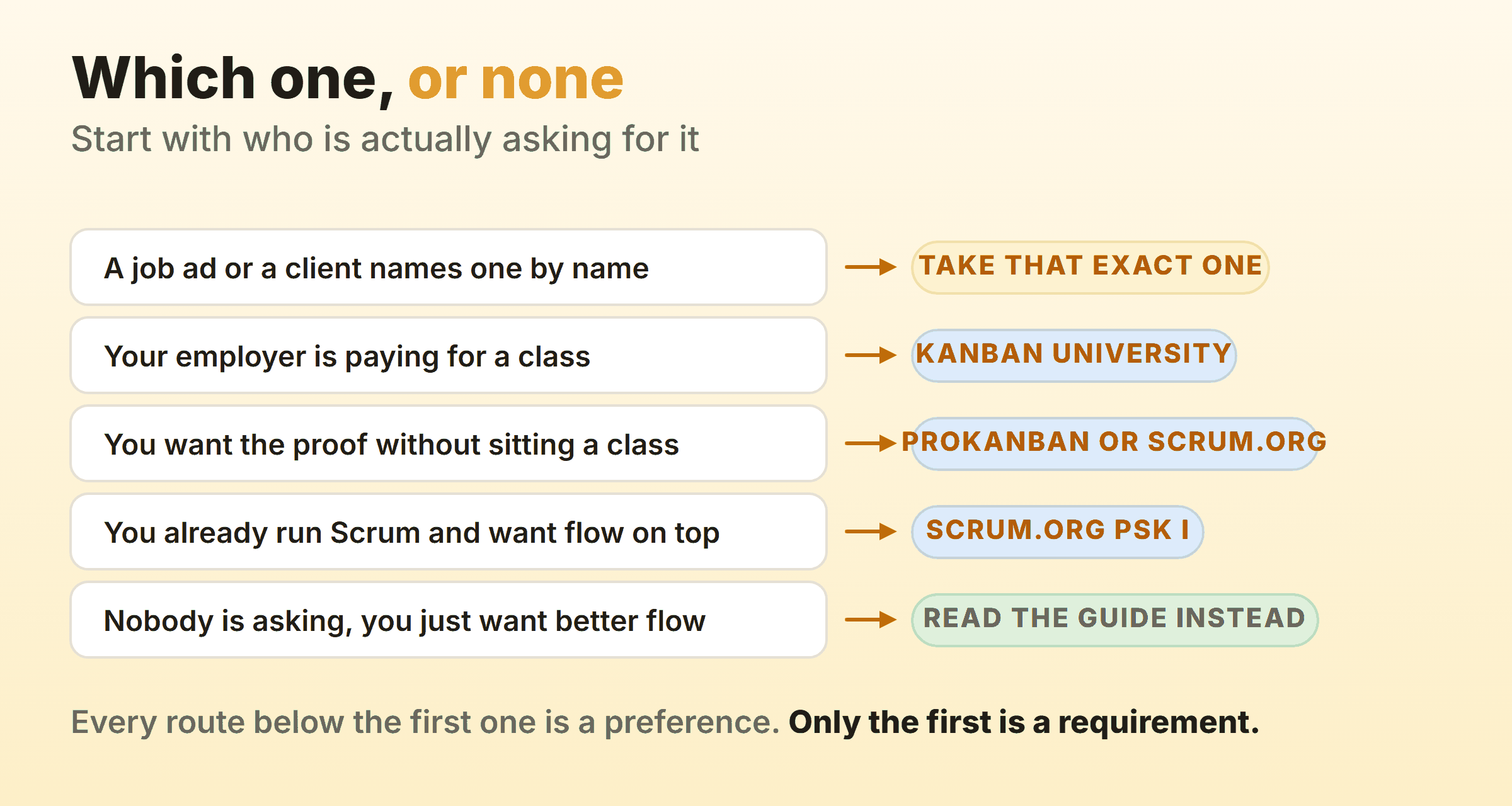
When nobody is naming anything, the choice comes down to format and lineage.
| If this is you | Take | Why |
|---|---|---|
| Employer paying, want a trainer in the room | Kanban University TKP or KSD | Deepest class catalogue, credential on attendance |
| Want the credential without a class | ProKanban PK I | Assessment is open to anyone, $200 |
| Team already runs Scrum | Scrum.org PSK I | Kanban practices inside Scrum, lifetime |
| Renewing a PMP or PMI-ACP | Any accredited class | A two-day class feeds the PDU cycle |
| Nobody is asking | None yet | Read the Kanban Guide, cap a column |
The best kanban certification argument mostly resolves to which room you want to be in for two days. Kanban University certification carries the most weight with people who came up through the Anderson lineage and use the maturity model. ProKanban and Scrum.org carry more weight in product organisations that already speak Scrum. In practice hiring managers rarely rank them against each other, because most of them cannot name the difference either.
One thing worth checking before you book anything: the trainer. Kanban classes vary far more by who is teaching them than by which logo is on the certificate, and a good trainer will happily tell you which of their own exercises are weak. Ask for two references from previous public classes. Anybody who has been teaching for a while has them.
FAQ
Is kanban difficult to learn?
Kanban is not difficult to learn. The rules fit on a few pages, there are no prescribed ceremonies to memorise, and most teams can run a usable board inside an afternoon. The difficulty is entirely in the holding. Keeping a WIP limit when somebody senior wants their item started today is a political problem, not a knowledge one, and no kanban certification course will make that conversation easier.
Is kanban lean or six sigma?
Kanban is lean. It came out of the Toyota Production System as a signalling mechanism for pull-based replenishment, and the software version inherits the same idea of limiting inventory and letting downstream demand set the pace. Six Sigma is a separate discipline focused on reducing defect variation through statistical control. They get bundled together in course catalogues because both are process improvement, and that is roughly where the overlap ends.
Is there such a thing as a kanban master certification?
No body issues a kanban master credential. The title gets invented by teams borrowing the Scrum Master pattern, and the same goes for kanban specialist, which shows up in job adverts more often than in any certification catalogue. Kanban University does run a Kanban Coaching Professional credential, and that one is real. For what the method actually says about titles, see kanban roles.
Do kanban certifications expire?
Most do not. ProKanban states that its certifications do not expire and the Credly badge is evergreen. Scrum.org’s PSK I is lifetime once passed. PMI is the exception, since PMP and PMI-ACP both run on renewal cycles that need PDUs, so a lapsed PMI credential is a real thing in a way a lapsed PK I is not.
Do you need a kanban certification to get a job?
You do not need a kanban certification to get a job, and I have never rejected anyone for lacking one. It shows up as a filter more often in consultancies and in large organisations with formal capability frameworks, where somebody has to justify a rate card or a promotion band against a documented list. For a normal delivery role, being able to explain why your last team’s cycle time dropped counts for considerably more.