
Benefits of Kanban: What You Actually Get, and What It Costs
Updated at
The Answer
The benefits of kanban split into two groups, and most teams only ever collect one of them. The board buys visibility: shared status, obvious ownership, and a sharp drop in the meetings that exist so somebody can ask where a thing got to. Everything else comes from the numbers you write on top of that board. Shorter waits. Fewer half-finished items. Bottlenecks that announce themselves days before a date slips, and forecasts built on how long the work has actually been taking. You can put a board up in an afternoon. Nobody enjoys the caps, and in most teams I have worked with they never go on at all, which is how a rollout ends up as a prettier to-do list. There is a bill attached as well. You lose deadline pressure and any rhythm that would force a team to stop and look at itself.
What Is the Purpose of a Kanban Board?
The purpose of a kanban board is to make the state of every piece of work visible, so a team manages the work itself and lets people organise around it. Ask what the purpose of kanban is at the method level and you get that same answer back, which is why the kanban board purpose barely counts as a separate question. None of it requires software. A whiteboard and a pack of sticky notes satisfies the whole kanban purpose.
The word is Japanese for signboard, and the textbook kanban definition still sits close to the original object. On a Toyota assembly line a kanban was a physical card that travelled with a bin of parts, and when the bin emptied the card went back upstream as permission to build more. No card, no production. That is the kanban model of pull, and it is the half most people leave behind when they copy the visual layout. David Anderson carried the idea into knowledge work at Microsoft in 2004, and the kanban methodology that came out of it says to map the kanban process you already run and then put a number on how much work each stage may hold. People pull the next item when they have room. You will see it called the kanban framework in places, though the method’s own literature avoids that word, because a framework prescribes roles and kanban deliberately prescribes nothing.
So a visual kanban system does two jobs at once. It reports the state of the work, and it regulates how much work is allowed to exist at any moment. Most explanations of what is kanban stop after the first one. Teams adopting kanban in project management stop there too, keeping the reporting half and leaving the other one in the box, then wonder six months later why nothing got faster.
What Are the Main Benefits of Kanban?
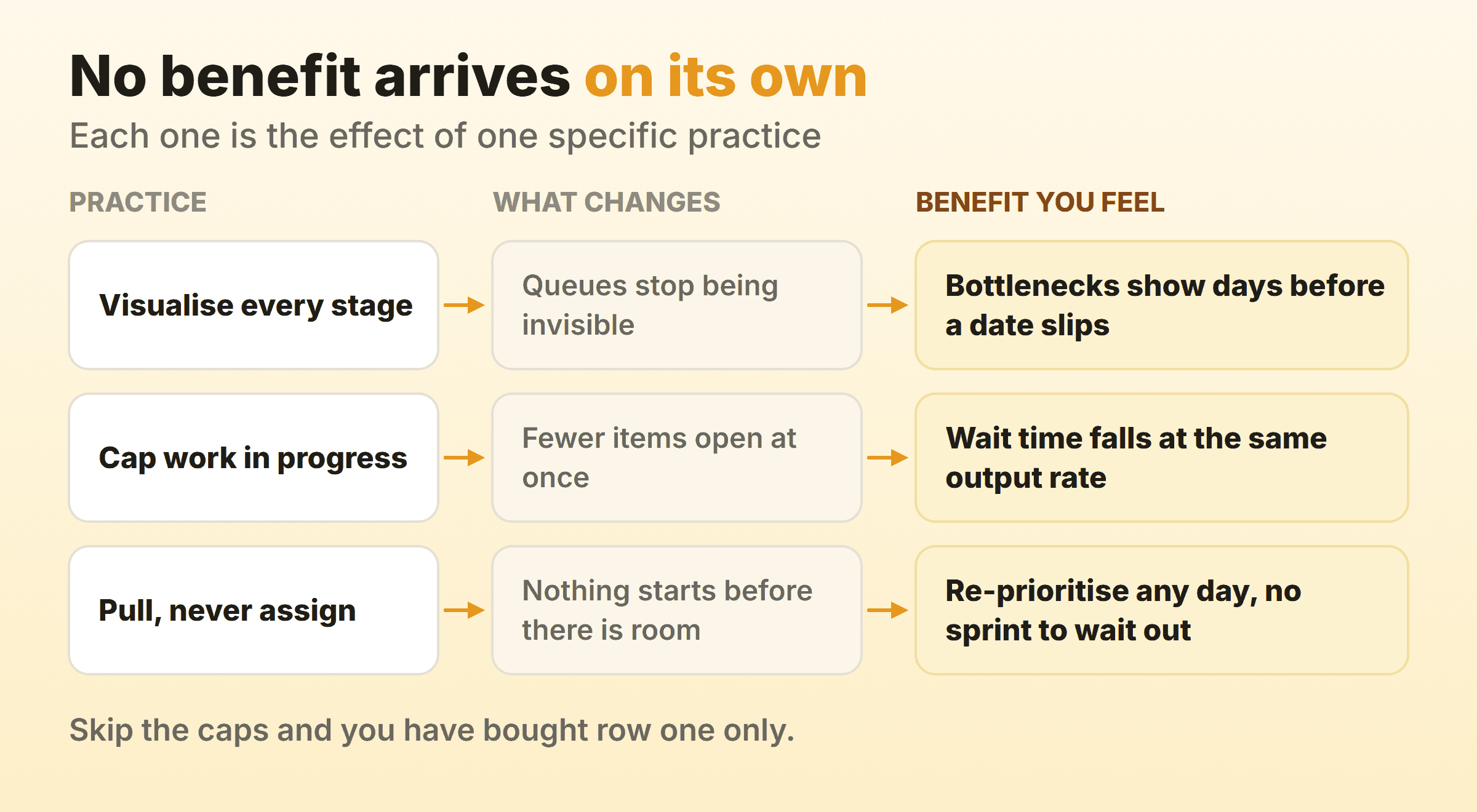
The main benefits of kanban are shorter wait times, earlier warning on bottlenecks, planning that can turn on any day of the week, less context switching, forecasts you can defend with numbers, and an adoption path that does not require reorganising anybody, and each of those six comes out of a different practice. Most kanban benefits lists leave that link out, which is how a kanban team ends up owning the board and none of the flow.
Shorter Wait Times Without Anyone Working Faster
Work finishes sooner when fewer things are open, which is the advantage of kanban that teams find hardest to swallow, because nobody has to type faster for it to happen. Average time in the system equals the work in progress divided by the number of items finished per unit of time. That relationship is Little’s Law, proved by John Little in 1961 for queues and carried into flow work more or less untouched. Twelve items open and three finished a week gives an average of four weeks per item. Cut the open items to four, keep finishing three a week, and the average lands near one and a third weeks. Same people, same output rate. Nobody worked harder for it. They stopped starting things, and getting six adults to agree to stop starting things is where this usually stalls.
Bottlenecks That Show Up Before They Cost You
A bottleneck on a board with numbers on it looks like a full column sitting next to an empty one, and you can see it on a Tuesday afternoon. Usually it is a review column that only one person is allowed to clear. Without limits the same bottleneck stays invisible for weeks, until somebody finally asks why a card that entered review in March is still sitting there. Nothing on an uncapped board ever looks wrong, because there is no number for anything to exceed, so the column keeps getting taller and by week three nobody registers it as unusual.
Planning That Can Turn on Any Day
Kanban planning has no sprint boundary, so changing priority costs one conversation and nothing else. New work goes to the top of the ready queue, the next person to free up pulls it, and nothing has to be cancelled or renegotiated first. This matters most to teams who do not control their own intake. Support, platform, anything with an on-call rota. A fortnight of committed scope is a promise those teams break most weeks, and everybody involved knows it going in.
Less Context Switching
Each extra item you have open carries a cost the board never shows, which is the price of reloading everything you knew about a task before you can move it an inch. You will see the claim that every additional concurrent task costs about 20 percent of your capacity. It comes from Gerald Weinberg’s Quality Software Management, where he presents it as an illustration. The effect is real and I would not quote the number. A cap on the Doing column settles the argument anyway, because the team stops debating how many things is too many and starts reading it off the column header.
Forecasts You Can Defend
Once a board carries a few months of history, a forecast stops being a guess dressed up as a commitment. Count how long the last thirty items took, sort them, read off the 85th percentile. “Nine days, eighty-five percent of the time” is a sentence you can put a chart behind, and it survives a stakeholder asking why. Story point velocity cannot do that. A point measures somebody’s estimate and says nothing at all about elapsed time.
Adoption Without a Reorganisation
Kanban starts with the process you already run, so nobody’s job title changes on day one and there are no new roles to appoint before you begin. You draw the real kanban workflow on a board, awkward waiting states and all, then improve it from there. A scrum adoption asks a lot more up front, and working out who becomes the product owner is often the hardest conversation of the whole rollout.
Which Benefits Come From the Board, and Which Come From the Limits?
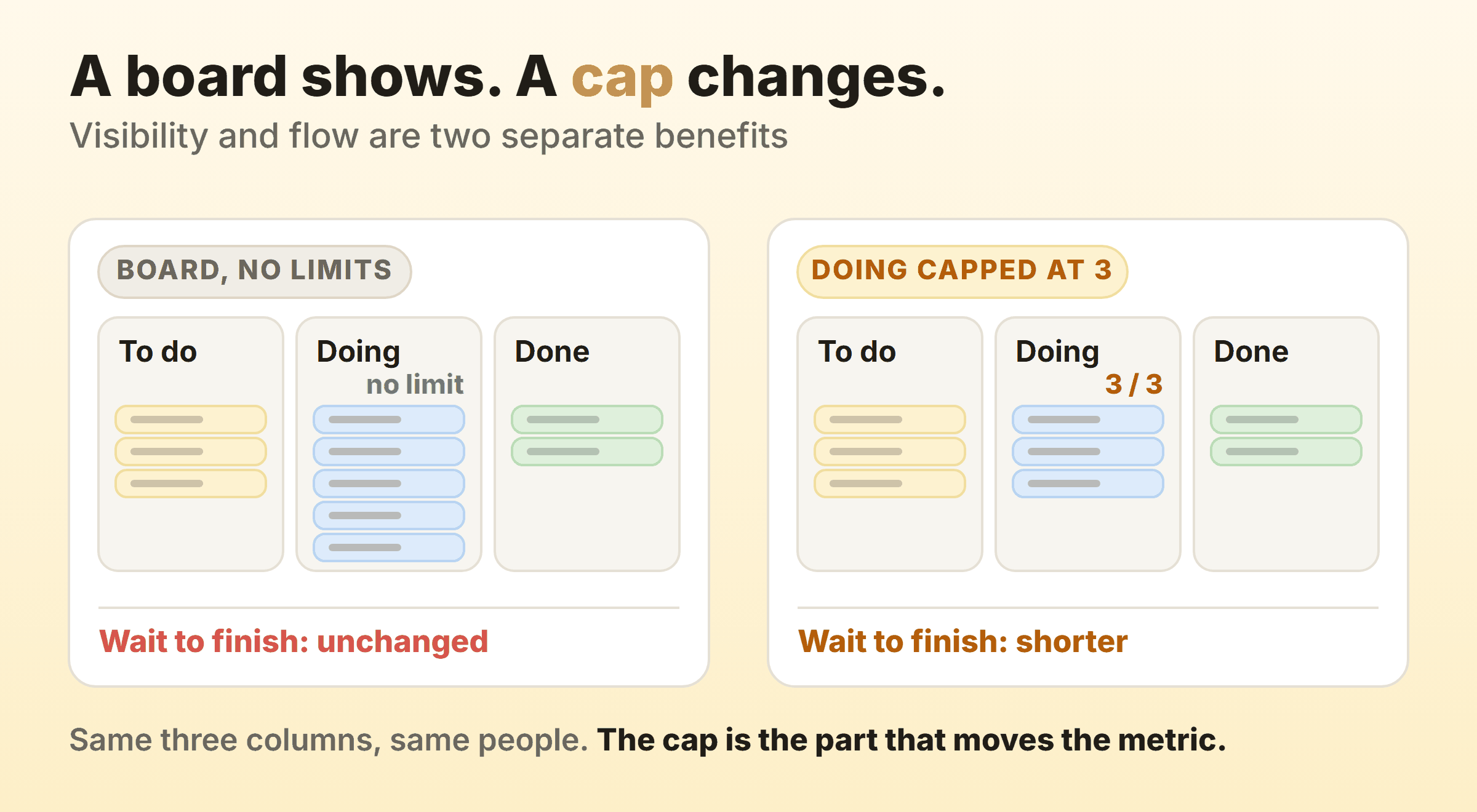
Kanban board benefits and kanban flow benefits have different causes, and separating the two explains why teams running the same tool report completely different results. The purpose of kanban board columns is to report state. Put a number on top of one and that column starts changing behaviour as well as reporting it. You can have the reporting without the number, and thousands of teams do.
| Benefit | Where it comes from |
|---|---|
| Everyone can see the status without asking | The board |
| Fewer standups that are just verbal status reports | The board |
| Handoffs stop getting lost between people | The board |
| Shorter wait from request to delivery | The limits |
| Bottlenecks visible days before they hurt | The limits |
| Less context switching per person | The limits |
| Forecasts based on real elapsed time | The limits, plus a few months of history |
The benefits of kanban board visibility are worth having on their own, and they are what most people mean when they say the board helped. Visibility fixes coordination. Cycle time stays where it was, because visibility does not remove anything from the queue.
Which is why WIP limits are the practice worth arguing for, and I do mean arguing, because somebody always wants the number set higher. In Kanbanee they are off by default and switched on per column, with a number pre-filled at three, and the badge on the column header shows a live count against the cap and goes red once you are over it. Dragging is never blocked. The limit is a signal the team agreed to, and teams who expect the software to enforce it for them tend to switch it off inside a month.
What Are the Disadvantages of Kanban?
Every freedom the method hands you takes away a constraint that was quietly doing a job somewhere else. That is the only honest way to lay out a kanban advantages and disadvantages list, because the advantages of kanban and the disadvantages of kanban are one set of properties read from either end. Most kanban disadvantages lists stop at “it needs discipline” and leave it there.
| What you gain | What it costs you |
|---|---|
| No sprint boundary, so priorities change any day | No deadline pressure, so low-urgency work drifts for months |
| No estimates required to start | Nothing to answer “when will it be done” with until you have history |
| No new roles and no new ceremonies | Nobody owns the process, so the board decays quietly |
| Continuous flow instead of batched releases | Less natural rhythm for retrospectives and stakeholder demos |
| Works with the process you already have | Works fine with a bad process too, and only makes it visible |
Nothing in a kanban system makes anybody hurry, and that row is the one that surprises people. A sprint is a crude device and it works partly because it is crude, since an arbitrary fortnightly boundary generates pressure a continuous board never will. Teams who only finish things under that pressure should go in knowing they are handing it back.
Board decay is the other one. Kanban asks for discipline and hands the job to nobody in particular. Cards go stale. Columns stop matching how the work actually moves, and the WIP limit that got raised during one crunch never comes back down. Six months on you are looking at a board that describes a team from March. Scrum’s ceremonies are annoying and they do force a reset every fortnight, which is a genuine advantage kanban answers with nothing but good habits.
Why Does Kanban Fail?
Ask why kanban fails and people usually blame the method. Every failed rollout I have been near came down to one of these five, and usually to the first.
- No limits anywhere on the board. A board with no caps is a to-do list turned sideways, and it hands you the top three rows of the table above and nothing underneath them.
- Columns that describe the org chart. Naming a column after a team or a person means the board stops working the moment somebody takes leave. Name the state the work is in. In design, in review, waiting on client.
- A definition of done that ends at the developer. If Done means the code was written, the queue in review and the queue in deployment are both invisible, and the number you report has no relationship to when the customer got anything.
- Assigning work at planning time. Assign every card to a named person on Monday and the WIP limit stops meaning anything, because everyone is now working from a private queue the board cannot see.
- Nobody looks at the numbers. A board that is never measured cannot tell you whether anything improved, so the improvement conversation runs on opinion, which is how a team ends up raising a WIP limit because one person found it annoying.
Four of those five get decided in the first week of a rollout, which is why kanban tends to work or not work early. The fix is almost always a policy somebody writes down, and I have never once watched a change of tool solve any of the five.
How Do You Prove the Benefits Landed?
Measure one number before you change anything, then measure the same number six weeks later. Cycle time is the best single choice, because the customer feels it directly and it responds to a WIP limit inside a month or so. Throughput comes second, counted as items finished per week, and it should hold steady or climb while cycle time falls. Watch for both of them falling together. That combination usually means you started less work and finished it at the same old rate, which nobody should be celebrating.
A cumulative flow diagram earns a look every fortnight. When the bands stop running parallel there is a queue growing that nobody has felt yet. Blocked time is the fourth number, tracked as the hours a card spends waiting on somebody outside the team, and it is usually the biggest single slice of a long cycle time as well as the one nobody has ever counted. Kanban metrics covers how to read all four.
Take the before number quietly, ahead of announcing anything. A team that knows it is being measured will spend that week finishing everything already nearly done, and the baseline you get out of it will flatter the next six weeks for no reason at all.
FAQ
Is kanban better than scrum?
Neither wins in general. The answer turns on how much of your intake you actually control, and kanban suits the teams who control very little of it, such as support, platform and operations. If a team can protect a fortnight and wants the pressure a fixed boundary creates, scrum earns its ceremonies. Plenty run scrum’s cadences on a kanban board and take both, which is roughly what scrumban is.
What are the disadvantages of a kanban board?
The disadvantages of a kanban board are that it will happily display a bad process without improving it, it decays when nobody is responsible for maintaining it, and it generates no deadline pressure of its own. Drawing the columns takes about an hour. Plenty of teams treat that hour as the whole job.
Is kanban good for ADHD?
Many people say it helps them, and I am not qualified to speak to the clinical half of that question. The mechanism they describe is plausible: a board holds the tracking outside your head, and a WIP limit takes away the what-do-I-start-next decision, which for a lot of people is the part that stalls. That is reported experience and nothing more. I have not seen a controlled study on it.
What are the four principles of kanban?
The four change management principles are start with what you do now, agree to pursue incremental and evolutionary change, respect current roles and responsibilities, and encourage acts of leadership at every level. Three service delivery principles were added later, which is why some sources say four and others say seven.
Does kanban work outside software development?
Yes, and its origins are on a factory floor. Kanban for software development came second, borrowed wholesale from manufacturing. Marketing teams, recruitment pipelines, legal review queues and hospital admissions all run on the same mechanics, because any process with distinct stages and a queue between them can be capped and measured the same way. Kanban project management shows up in all of them for that reason.