
Kanban for Sales: Pipeline Boards, CRM Views and Deal Lead Time
Updated at
The Answer
Kanban for sales means running the pipeline as a board, where every deal stage is a column, every deal is a card, and dragging a card between columns is the status update. That is the same thing a kanban CRM sells you under the name pipeline view. The part most sales teams skip is the measurement that makes the board worth more than a tidier spreadsheet: lead time, the calendar days between a lead arriving and the deal closing. Average lead time in a kanban system is the total lead time of everything that finished, divided by how many things finished. Chase a short lead time and the rest of the pipeline tends to fix itself, because the longer a proposal sits, the more chances the budget, the champion or the priority have to change.
What Does a Kanban Sales Board Look Like?
A kanban sales board looks like the pipeline you already describe in meetings, drawn as columns instead of rows. Each column is a deal stage. Each card is one deal. The card sits in whichever column matches the real state of the conversation, and moving it right is the only status report anybody has to file.
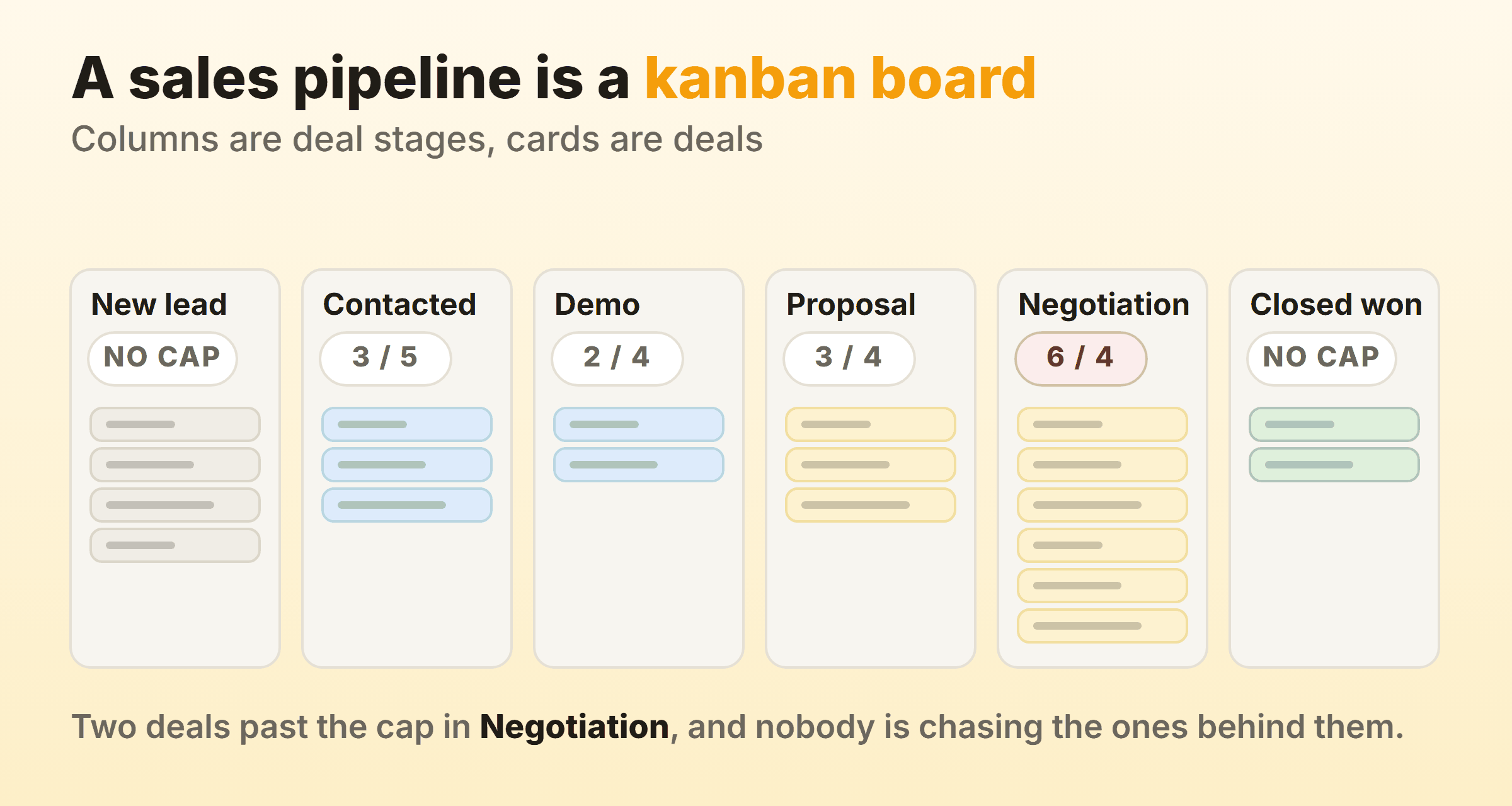
A workable starting set of columns for most B2B teams:
- New lead - arrived, nobody has touched it yet
- Contacted - a real conversation has started
- Demo - scheduled or delivered
- Proposal - numbers are with the buyer
- Negotiation - they are pushing back on terms or price
- Closed won
Lost deals get their own column or a label, not a quiet delete. You need the record to work out where deals actually die, and a card that vanishes takes its lead time with it.
The naming rule that saves the most arguments later is the same one that applies to any board. Name the state of the deal, not the person holding it. “With Dave” tells a new rep nothing in March when Dave has moved teams, while “Waiting on legal” says exactly who to chase. There is more on this in the guide to kanban columns.
What Goes on a Deal Card
A deal card needs enough to answer “what happens next” without opening the CRM. In practice that is the account name, the value, the owner, and a due date on the next action rather than on the deal itself. Deal close dates are guesses. Next-action dates are commitments, and they are the ones worth a reminder.
In board terms that is subtasks for the steps inside a stage, labels for deal size or source, a member for the owner, a due date, comments for when you need a second pair of eyes, and somewhere to attach the signed paperwork. Whatever tool you pick, check that cards carry a time log as well. That is the part that turns the board into something you can measure rather than just something you can look at.
How Is a Kanban CRM Different From a Regular CRM?
A kanban CRM shows the same deal records in a board layout instead of a table, so the difference is the view rather than the data. Most CRMs now ship both. What changes is what your eye does with the information, and a CRM with a visual pipeline answers a different set of questions than a grid of rows does.
| Table or list view | Kanban pipeline view | |
|---|---|---|
| Reading a stage | Filter, then count rows | Column height tells you instantly |
| Changing a stage | Open the record, edit a field | Drag the card |
| Spotting a pile-up | Run a report | Look at the board |
| Deal detail visible | High, one record at a time | Low, whatever fits on a card |
| Sorting by value | Trivial | Awkward |
The board wins on the questions you ask forty times a day and loses on the ones you ask monthly. That trade is why teams keep both views rather than picking one. Where a board genuinely beats a table is the pile-up: six deals stacked in Negotiation is a shape you notice without being told, and no amount of row sorting makes that shape as obvious.
Being straight about it, a kanban board on its own is not a CRM. No email sync, no call logging, no contact history, no dedupe when the same company comes in twice. If your pipeline has to talk to your inbox and your invoicing, run the board alongside a CRM rather than instead of one. Plenty of small teams do the opposite and run the board as the whole system, which works right up until the day somebody asks what was said on a call in April.
Which CRMs Have a Kanban View
Most of the CRMs people ask about already do this, they just call it something else:
- Pipedrive opens on a kanban pipeline by default, which is most of why it feels different from older CRMs
- Odoo CRM renders the sales pipeline as a kanban view with stages you can rename and reorder
- Twenty, the open-source CRM, ships a kanban view of opportunities alongside its table view
- Recruit CRM uses kanban boards for candidate and deal pipelines, which is the same pattern applied to hiring
- HubSpot and Salesforce both offer board views of deals or opportunities
If your CRM has customizable pipelines and a kanban view, use it. A separate board tool earns its place when you want kanban-style pipelines for leads the CRM does not model well, like an idea pipeline for outbound campaigns, a partner pipeline, or a renewals queue nobody wants cluttering the main forecast.
Does Kanban for Sales Need WIP Limits?
Yes, on the middle stages, and never on the first one. This is the piece of kanban that sales teams reject on instinct and regret rejecting.
The objection makes sense at first hearing. Why would you cap the number of deals you are allowed to work? More pipeline is better. But the cap is not on how many deals exist, it is on how many a rep is actively pushing at once, and the arithmetic there is unkind. A rep juggling twelve live negotiations gives each one a twelfth of their attention and a slower reply. Deals do not fail because nobody wanted them. They fail because the follow-up came too late and the buyer had moved on.
So cap Proposal and Negotiation, where attention is the scarce input. Leave New lead uncapped, because it is a buffer and refusing inbound leads to protect a number is the worst possible reading of this idea. The buffer just needs to be small enough that leads at the bottom are still warm when somebody reaches them.
Kanbanee keeps WIP limits off until you switch them on. You set one per column from the column menu, a checkbox and a number that starts at 3, and the column header then shows a count / limit badge that turns red when you go over. The limit is soft. Dragging a card into a full column is never blocked, because a hard block just teaches people to park work somewhere dishonest. The red badge is a prompt to finish something, not a wall. The full mechanics are in the guide to WIP limits.
How Do You Measure Average Lead Time in a Kanban System?
Average lead time in a kanban system is measured by adding up the lead time of every item that finished in a period and dividing by the number of items that finished. Two timestamps per card do all the work: when it entered the system, and when it left. Subtract, sum, divide.
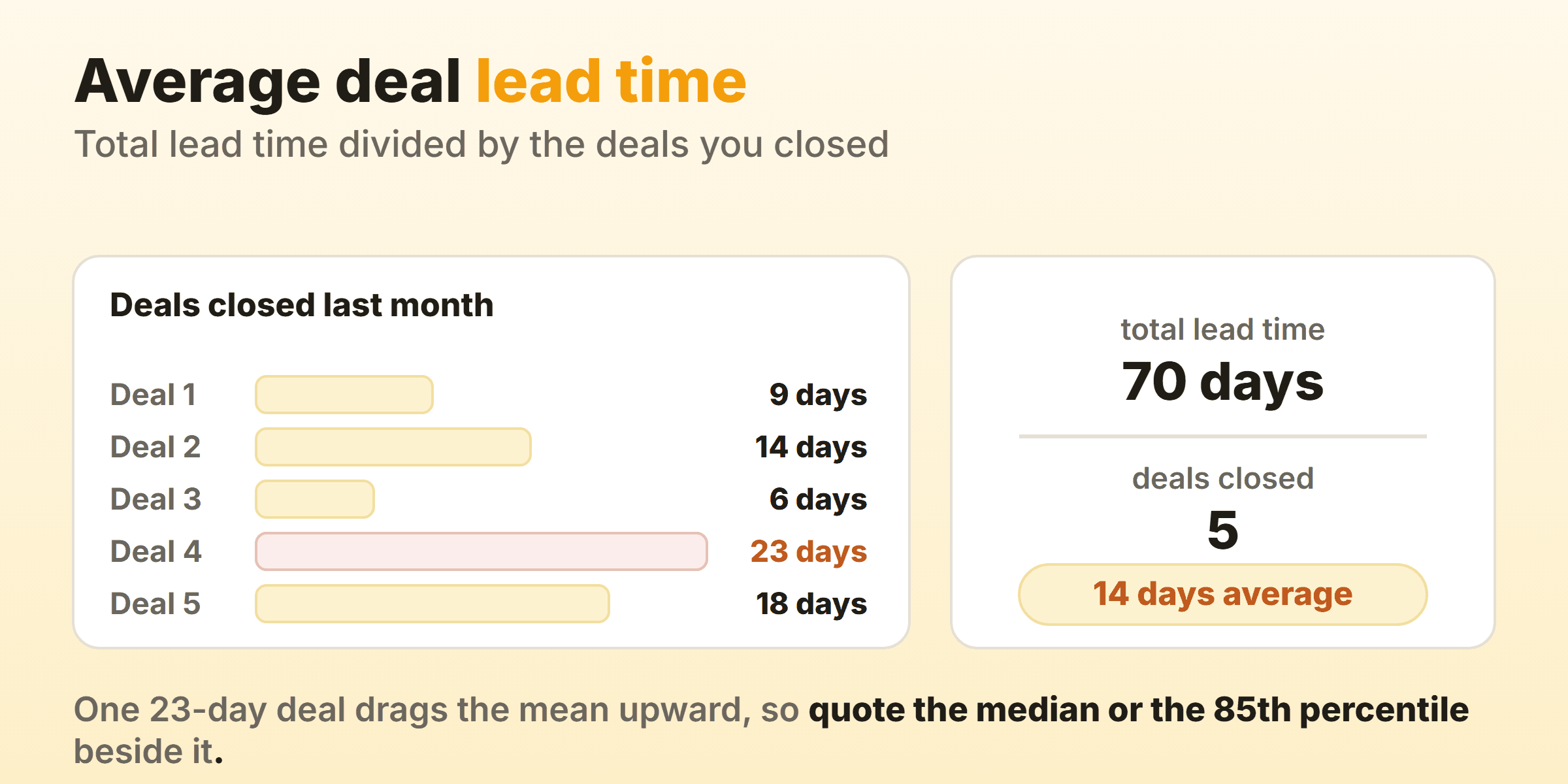
Applied to a pipeline, that is total days from lead arrival to close, across the deals you closed. Five closed deals at 9, 14, 6, 23 and 18 days give you 70 days over 5 deals, so 14 days average lead time. The number is only as honest as the moment you start the clock. Start it when the lead lands, not when a rep decides to pick it up, or you have measured your own diligence rather than the buyer’s wait.
One caution on the mean. That 23-day deal drags the average above what most deals actually take, and averages hide exactly the tail you care about. Report the median beside the mean, or better, an 85th percentile: “85% of deals close inside 21 days” is a sentence a sales director can plan around. “14 days on average” is not.
Lead Time and Cycle Time Are Not the Same
Lead time in kanban runs from the moment a request arrives to the moment it is delivered. Cycle time starts later, when the team actually begins work, and ends at the same point. The gap between them is queue time, and in sales that gap has a name everybody knows: response time.
Kanban University, which maintains the Kanban Method’s definitions of lead time and cycle time, draws this line at what it calls the commitment point, the moment the team accepts the item and agrees to finish it. Everything before that is the queue. So a lead that sits for six days and then closes in eight has a cycle time of eight days and a lead time of fourteen, and only one of those numbers reflects what the buyer experienced. Measure both. Cycle time tells you whether your sales process works. Lead time tells you whether your buyer noticed the wait. The wider kanban metrics set covers how these fit together with throughput and work item age.
Reading Lead Time Off a Cumulative Flow Diagram
On a cumulative flow diagram, average lead time is the horizontal distance between the arrival line and the departure line. Horizontal, not vertical. The vertical distance between the same two lines is your work in progress, which is the detail that trips people up on certification exams and in real analysis alike.
The chart plots cumulative items entering and leaving each stage over time. If the two lines run parallel, deals arrive and close at matching rates. If the band between them widens, deals are entering faster than they close and both your WIP and your lead time are growing, whatever the headline pipeline number says. Any board tool that draws a cumulative flow diagram for you turns that horizontal gap into something you read rather than calculate, which is most of the argument for letting software plot the chart instead of rebuilding it in a spreadsheet every month.
What Are the Advantages of a Short Lead Time?
The advantages of a short lead time in kanban come down to one thing: the shorter the gap between a buyer asking and you delivering, the less can go wrong in between. Five benefits of a short lead time show up in a sales pipeline in particular.
- Quotes decay. A proposal is most persuasive the week it is sent. Budget cycles shift, champions leave, and a competitor gets a meeting.
- Forecasts get shorter. Predicting what closes in a 14-day window is a far easier problem than predicting a 90-day one. Short lead time buys forecast accuracy without a better forecasting model.
- Cash arrives sooner. Trivially true, routinely ignored when teams optimise for pipeline volume instead.
- You learn faster. Every closed deal, won or lost, is one data point about your pitch. Halve the lead time and you double the rate at which you find out what is wrong with it.
- Less work in flight. Little’s Law says average lead time equals work in progress divided by throughput, so with a steady close rate the only lever left for a shorter lead time is fewer deals open at once.
That last point is the one that makes the WIP cap and the lead-time metric the same conversation rather than two. You cannot shorten lead time by asking reps to hurry. You shorten it by having them carry less at once.
Where the Board Stops Working
Three honest limits, so nobody sets this up and discovers them in week two.
The first is data entry. Unless the board is wired to your inbox, nothing lands on it automatically, and a lead that arrives by email becomes a card only because somebody makes it one. Boards that nobody feeds go stale fast, and a stale board is worse than no board, because people carry on trusting it. The second is concurrency. Two reps dragging cards in the same minute is ordinary in sales, and not every tool pushes changes out in realtime, so find out whether yours syncs live or polls before you run a pipeline review off it. The third is the phone. Updating one deal between meetings is fine on mobile almost everywhere, but restructuring the pipeline itself, adding stages and reordering columns, is a laptop job in most tools.
None of that is fatal for a pipeline board. It does mean this suits a team of three to fifteen better than a fifty-rep floor, where the forecasting, permissions and territory rules outgrow what a board is built to carry.
FAQ
What is lead time in kanban?
The standard kanban lead time definition is the elapsed time from when a work item enters the system to when it is delivered, measured in calendar days rather than working hours. It includes every wait, queue and handoff along the way, which is what makes it the metric that reflects the customer’s actual experience.
Is a kanban board the same as a sales pipeline?
Structurally, yes. A sales pipeline is a sequence of stages that a deal passes through in order, which is precisely what a kanban board models. The difference is that a pipeline is usually reported as a funnel of totals, while a board shows you the individual deals sitting in each stage right now.
Can you run a kanban CRM view on mobile?
Most CRMs with kanban-style deals on mobile support dragging a deal between stages on a phone, usually with a long press to pick the card up and a snap between columns. Reordering the columns themselves is generally a desktop task across tools, because precise drag targets are hard to hit on a small screen.
What is an idea pipeline kanban board?
An idea pipeline kanban board tracks proposals through stages of validation rather than deals through stages of a sale, with columns like Captured, Researched, Approved and Building. The mechanics are identical to a sales board, including the value of a cap on the middle stages, since ideas pile up in Researched exactly the way deals pile up in Negotiation.
Is single card kanban suitable for short lead time work?
Single card kanban, where one card triggers one replenishment, is a manufacturing signalling method rather than a sales technique, and it is suitable for stable, high-frequency demand where lead time is already short. The sales equivalent is a capped Ready queue: finish one deal, pull one lead. The principle carries over even though the mechanism does not.