
Open Source Kanban Board: 8 Self-Hosted Tools, Licences Checked
Updated at
The Answer
An open source kanban board is a board whose source code you can read, change and run on your own server, and the eight below differ far more in licence than in features. Wekan and Kanboard are MIT. Vikunja, Kan and Nextcloud Deck are AGPL 3.0, OpenProject is GPL 3.0, and Taiga splits its licence across two repositories. Planka, the best looking of the group, ships under a licence of its own invention that no OSI list recognises. I opened every repository on 10 September 2026 and read three things by hand: the licence file, the date of the last commit, and whether a documented install path still exists. Three widely recommended projects failed that second check. One of them is still the result most people click first.
What Makes a Kanban Board Open Source?
A kanban board is open source when its licence lets you read, modify and redistribute the source code. Downloading it for nothing is a different question. The two get conflated constantly here, and the distinction stays academic right up to the security review or the price rise you cannot walk away from. Three licence families cover almost all of it.
- Permissive. MIT and Apache 2.0. Do what you like, keep the copyright notice, publish nothing back. Wekan and Kanboard sit here.
- Copyleft. GPL 3.0 and AGPL 3.0. Your modifications inherit the licence, and AGPL extends that to code you run as a network service. Vikunja, Kan, Nextcloud Deck and OpenProject sit here. Internal use changes nothing. Read the text properly before you sell anything built on it.
- Source available. You get to read the code and host it, under restrictions no OSI-approved licence carries. Planka is the example, marketed alongside the genuinely open ones.
Most readers stop at the licence, then install something nobody has touched since 2023.
Three Checks to Run on the Repo Before You Host It
Run all three on the repository itself. Landing pages are written by the people who want you to install the thing.
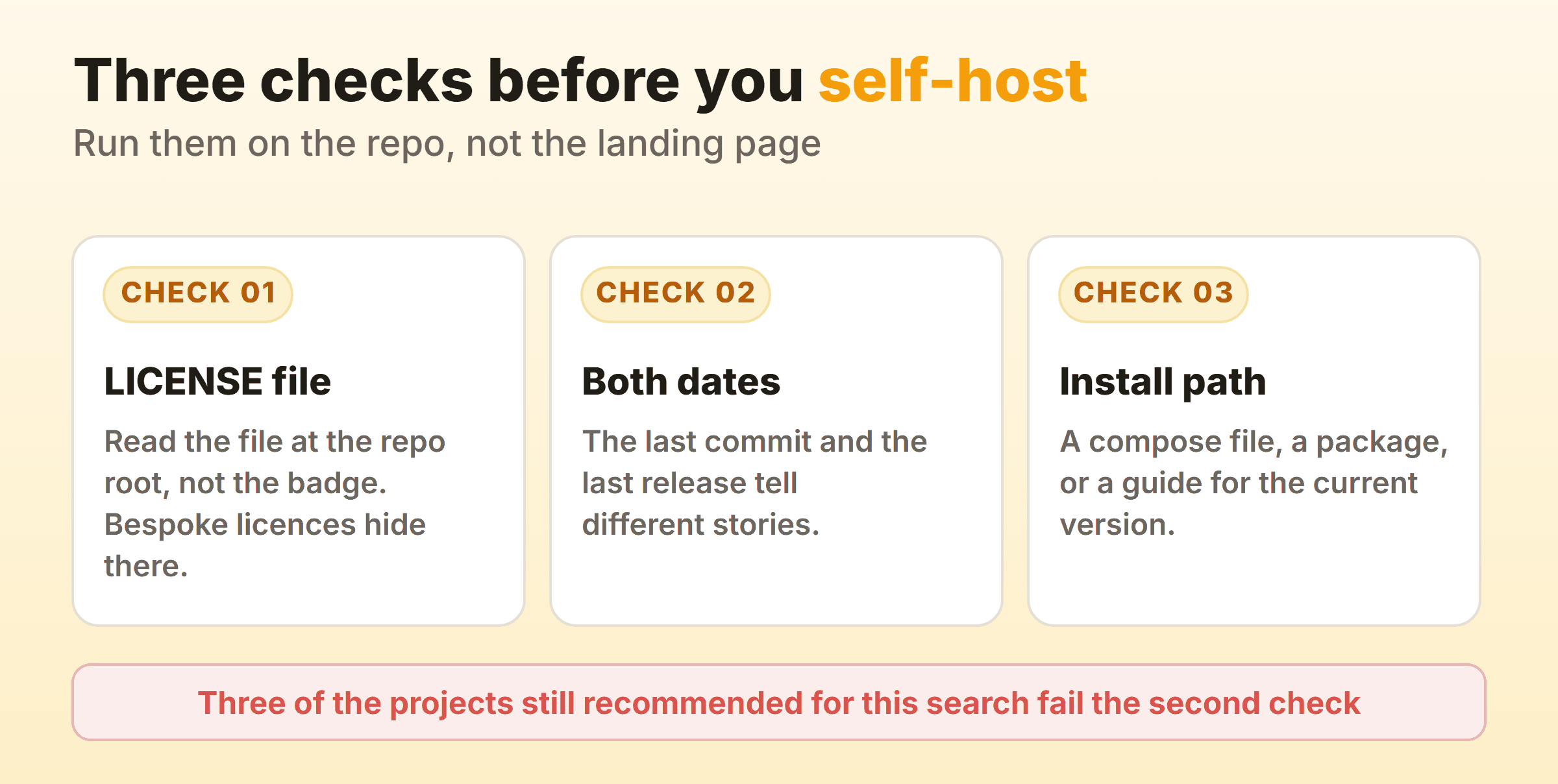
Open the LICENSE file. Badges are hand-typed strings in a README and they go stale. What sits at the repository root is what you are agreeing to, and it is where Planka gives itself away, because its LICENSE.md is bespoke.
Read both dates. The last commit and the last release tell different stories. A repository can look busy on dependency bumps while nothing has shipped in two years, and a quiet release page can hide a maintainer who commits daily and tags once a year.
Find the install path. A compose file in the repo, a distribution package, or a guide written for the current major version will do. If the newest instructions still point at a version two majors back, expect to spend an evening on it.
Open Source Kanban Boards Compared
| Project | Licence | Latest release, 10 Sep 2026 | Install path | Per-column WIP limit |
|---|---|---|---|---|
| Wekan | MIT | v11.67, same day | Docker image and compose file | Yes, with a soft option |
| Kanboard | MIT | v1.2.54, 29 Aug 2026 | PHP 8.1 plus a database | Yes, column highlights |
| Vikunja | AGPL 3.0 | v2.6.0, 31 Aug 2026 | One binary, or Docker, or a distro package | Yes, per bucket |
| Kan | AGPL 3.0 | v0.6.0, 29 Jun 2026, pre-release | Docker Compose with Postgres | Not in its feature list |
| Planka | PLANKA Community License | v2.2.1, 10 Aug 2026 | Docker Compose with Postgres | Not in its feature list |
| Taiga | MPL 2.0 and AGPL 3.0 | Rolling, no tagged release | Docker Compose via taiga-docker | Yes, per status |
| OpenProject | GPL 3.0 | v17.8.0, 2 Sep 2026 | Community Edition, self-hosted | Not in its locale file |
| Nextcloud Deck | AGPL 3.0 | v1.18.4, 27 Aug 2026 | Install Nextcloud first | Not in its feature list |
All of it checked on 10 September 2026. Every cell came from the project’s own repository, release feed, documentation or English interface strings.
Wekan: The Open Source Kanban Board With Real WIP Limits
Wekan is the open source kanban board I recommend most often, because it is MIT licensed and it takes work in progress seriously. Its English interface strings carry Set WIP Limit, Enable WIP Limit and Soft WIP Limit, plus a popup that fires when a list holds more cards than its limit allows. So you get a per-list cap, an over-limit warning and a soft mode that still lets you drag, which covers WIP limits properly and puts Wekan ahead of most tools here.
Install is straightforward. Container images go to GitHub Container Registry, Docker Hub and Quay, and a docker-compose.yml sits in the repo. The default compose file now runs FerretDB on an embedded SQLite backend instead of MongoDB, with MongoDB compose files kept alongside for anyone needing replica-set reactivity.
Wekan is a Meteor application carrying more than a decade of accumulated behaviour, and the interface shows it. Releases land often enough that pinning a tag beats tracking latest.
Kanboard: A Small PHP Board That Admits It Is Finished
Kanboard is MIT licensed and unusually honest about its own status. Its README calls the application “in maintenance mode” and explains that the author has stopped developing major features, with releases now depending on community contributions. Take that as a warning if you like, though v1.2.54 still shipped on 29 August 2026.
For a lot of teams this is a feature. Kanboard is small, fast, and runs on an ordinary Linux box with PHP 8.1 or newer. The requirements page lists SQLite, MySQL, MariaDB and PostgreSQL, recommends PostgreSQL, and warns against SQLite over NFS or inside Docker. Apache, Nginx, IIS and Caddy all work.
Kanboard’s own site says you limit work in progress per column, and that the column is highlighted once you go over. No plugin, no configuration project. For an on-premise kanban board on hardware you already run, nothing here is shorter, provided you can live with a tool that stopped growing on purpose.
Vikunja: One Go Binary You Can Run Almost Anywhere
Vikunja has the simplest install here, because the front end and back end are bundled into one deployable binary. The install documentation covers that binary, a build from source, Docker, Debian and Ubuntu packages, RPM for Fedora and RHEL, Arch, Alpine, FreeBSD, Kubernetes and Ansible. For a Linux kanban board that does not drag a container runtime along with it, this is the one.
The licence is AGPL 3.0 or later. Kanban is one view among several, and each bucket carries a limit the board displays. Tasks also show up as lists, tables and a Gantt chart, which suits a team that wants a board without committing everything to board shape.
There is a paid Vikunja Pro, and its README pitch names an admin panel, audit logs and time tracking, so confirm the feature you assumed was in the free build actually is. The project also states plainly that parts of its codebase are written with LLM-assisted tooling.
Kan: The Newest Trello-Shaped Option
Kan is the youngest project here and the most obviously aimed at people leaving Trello. It is AGPL 3.0, built on Next.js, tRPC and Drizzle with Postgres underneath, and the feature list runs to board visibility controls, workspace members, Trello import, labels and filters, comments, an activity log and board templates.
Self-hosting is a docker-compose.yml with a Postgres 15 service, or a one-click Railway template the maintainers keep. Both sit in the README.
Every tag Kan has published so far is flagged as a pre-release, so GitHub shows no stable latest release at all. The newest is v0.6.0 from 29 June 2026, while commits keep landing daily, which means the image you pull carries months of work no tag covers. Normal for a young project, and still a real operational cost. I would pick Kan for a small team that wants something modern looking, and avoid it anywhere a change-control process exists. Replacing Trello? The Trello kanban guide covers what you actually lose in the move.
Planka: Polished, Popular, and Not Actually Open Source
Planka is the best-looking board in this roundup and it is not open source, which is the single most repeated error in articles about open source kanban boards. Its LICENSE.md is the PLANKA Community License, version 1.1, last updated 20 May 2025. Source files marked for Pro and Enterprise sit outside community use and need a commercial licence, while the rest falls under what the document calls a Fair Use License. Bespoke, in other words, and no OSI list carries it.
None of that makes Planka a bad tool. Version 2.2.1 shipped on 10 August 2026, the install guide is a clean Docker Compose walkthrough with Postgres and a generated secret key, and the interface is genuinely pleasant. It publishes no per-column WIP limit, so cards pile up wherever you drag them.
Pick it if you want the nicest self-hosted kanban board on this list and the licence is nobody’s business but yours. Where a compliance reviewer signs off on installs, that file surfaces and the argument ends there.
Taiga: Kanban and Scrum Under Two Different Licences
Taiga suits teams that need kanban and scrum in the same tool, and it carries a split licence that catches people out. The back end repository is Mozilla Public License 2.0 while the front end is AGPL 3.0, which trips up anyone who checks one and assumes the other. Both were still receiving commits in the week I looked, on 9 and 4 September 2026.
Its interface strings confirm real kanban controls: swimlanes, a WIP limit input per status, and a message explaining that the limit caps how many user stories a status can hold. That puts Taiga ahead of most of this list on method support.
Deployment runs through a separate taiga-docker repository. A launch script and docker compose bring up the stack, and a manage script creates the superuser. The application repositories move weekly while that deployment repository last changed in October 2025, so the install tooling is older than the thing it installs.
OpenProject Community Edition: The Heavyweight
OpenProject is a full project management suite that happens to include boards. It is GPL 3.0, the self-hosted Community Edition is free of charge, version 17.8.0 was released on 2 September 2026, and the repository had commits the day I looked.
This is a Ruby application with work packages, Gantt charts, time and cost tracking, wikis and meetings. Anyone who just wants a board is installing enormously more software than they need. It earns its size when the goal is replacing a commercial PM platform outright, and teams heading that way should read the enterprise kanban guide first.
I searched OpenProject’s English locale file for a WIP limit string and found none. Do not assume its boards will cap a column for you. Verify on your own install.
Nextcloud Deck: Free If You Already Run Nextcloud
Nextcloud Deck is an AGPL 3.0 kanban app that lives inside Nextcloud, which makes the install question circular. Already running Nextcloud? Deck is a checkbox in the app store, and v1.18.4 arrived on 27 August 2026. Otherwise the honest install path starts with deploying and maintaining a Nextcloud server, a much larger commitment than anything else here.
Deck gives you cards with markdown notes, labels, assignments, attachments and sharing with groups or Circles, and it is excellent for organising work beside files you already store. No per-column WIP limit though, so the column mechanics that turn a board into a system are missing.
The Projects That Look Alive and Are Not
Four projects that still rank and still get recommended have either stopped or announced they are stopping. This is where roundups on the topic go wrong most often.
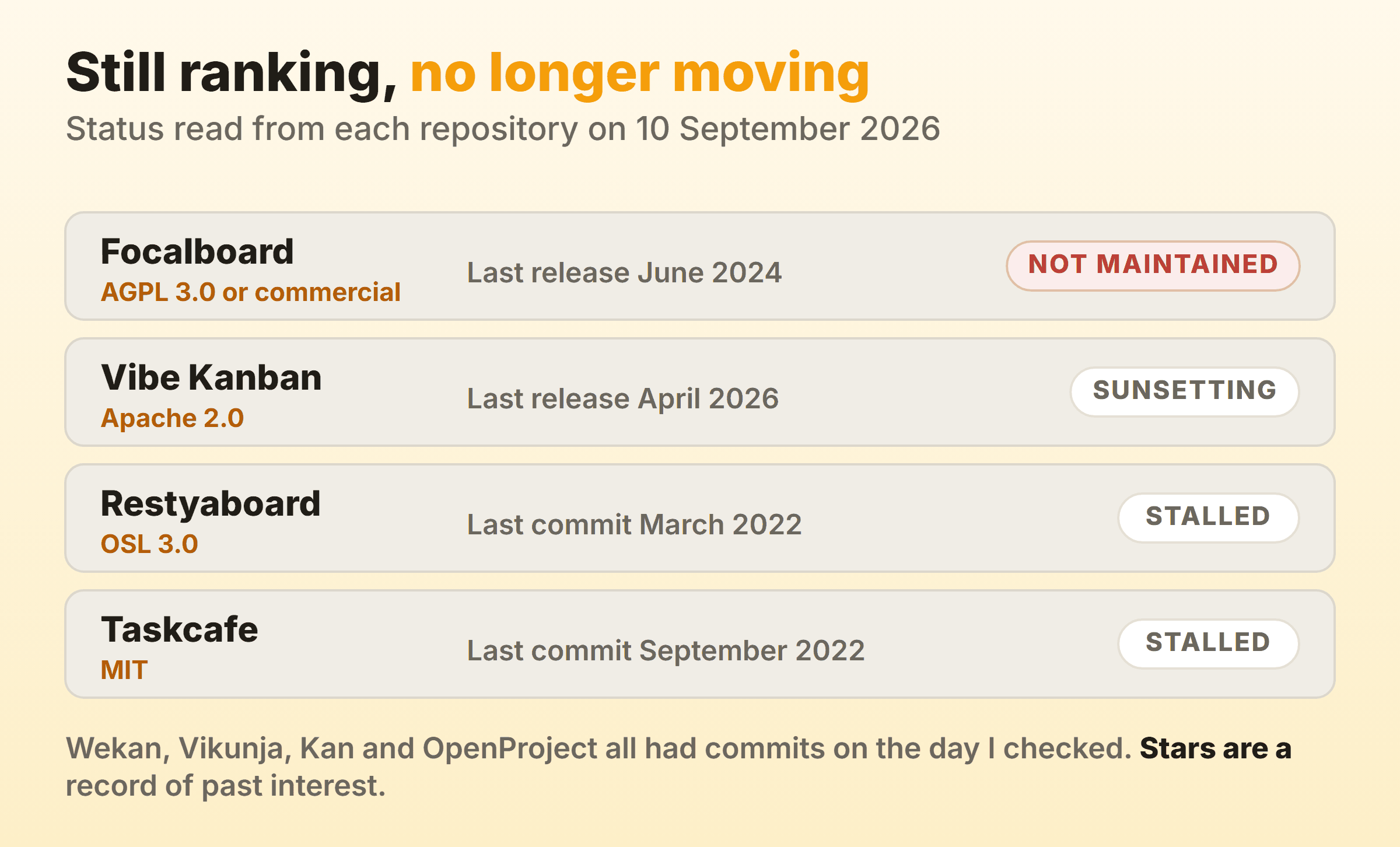
Focalboard is the big one. The repository moved to the mattermost-community organisation, and its README now opens with a warning that the repository is not currently maintained, alongside a request for someone to take it over. The last tagged release, v8.0.0, dates from June 2024. Its licensing was always odd too, with compiled versions under MIT and source under AGPL 3.0 or a commercial licence from Mattermost.
Vibe Kanban is worth naming for a different reason. It is Apache 2.0, it was extremely visible during 2026, and its README now announces that the project is sunsetting. It was never a team board anyway, more an orchestration layer for coding agents, and the Vibe Kanban write-up covers what it actually did.
Restyaboard carries the Open Software License 3.0, and its default branch has not taken a commit since March 2022, the same month as its last release. Taskcafe is MIT licensed with more than five thousand stars, and its master branch stopped in September 2022. Both repositories do show later dates, but only on abandoned dependency-bot branches nobody merged, which is exactly what a badge or a directory listing reads as activity.
Four years is a long time for a web application with a database, an auth layer and a dependency tree. Unpatched dependencies pile up whether anyone is watching or not. You are the one exposing that box to your network. Wekan, Vikunja, Kan and OpenProject all had commits on the day I read those four READMEs.
What Self-Hosting Actually Costs
Self-hosting a kanban board costs nothing in licence fees and a real amount in attention, which is the part these roundups leave out.
The recurring work is dull and predictable. A database that needs backing up, and restoring at least once so you know the restore works. TLS certificates that renew. An SMTP relay so board invitations and notifications arrive, and somebody who notices when the box fills its disk on a Saturday. On-premise deployment adds network policy and patching to the pile.
For a team of five, a hosted board at a few dollars a seat costs less than the hours. Self-hosting earns its keep when hosting is a hard requirement: data residency rules, an air-gapped network, a client contract, or a settled conviction that your work items should not sit on someone else’s infrastructure. Saving money is rarely the real driver, and where it is, the free kanban tools comparison is the more useful page.
When a Hosted Board Is the Better Answer
A hosted board is the better answer when nobody on the team wants to own a server, which describes most teams. That is the category Kanbanee sits in, and if you must hold the source code, stop reading here, because it is closed source with no self-hosting on offer. The free plan covers two boards you own with unlimited members. Pro is $6 per month or $48 per year. WIP limits are off by default and stay soft once you switch them on, and the gaps are real: no realtime sync, no public API, and column dragging that works on desktop only. Weigh that against Wekan, which gives the same WIP limit behaviour for the price of running a server.
Still deciding between hosted tools? The best kanban apps roundup covers that side of the choice.
FAQ
Is Planka Open Source?
No, not in the standard sense. Planka ships under the PLANKA Community License version 1.1, a bespoke document that carves Pro and Enterprise source files out and places the rest under what it calls a Fair Use License. You can read and self-host the code. It is not an OSI-approved open source licence, and any list filing it beside MIT and AGPL projects has not opened the file.
Which Open Source Kanban Boards Run on Linux?
All of them, since every project here is a server application. Vikunja is friendliest for a plain Linux install, shipping Debian, RPM, Arch and Alpine packages plus a single binary. Kanboard needs only PHP 8.1 and a web server. Any existing LAMP box will do. Wekan, Kan and Planka assume Docker, which is fine on Linux and one more layer to keep patched.
Can Redmine Give Me a Kanban Board?
Not out of the box. Redmine is GPL v2 and very much alive, with three releases listed in August 2026 alone, and its published feature list covers issue tracking, Gantt charts, a calendar, wikis and forums instead of a drag-and-drop board. Kanban comes from third-party plugins, which means trusting a second maintainer on a second release schedule. Run the same three checks on the plugin.
What Is the Easiest Open Source Kanban Board to Self-Host?
Vikunja. One binary gets you a working board without a container runtime or a separate database server. Planka is the smoothest Docker route if you follow its production compose guide. PHP shops will get Kanboard up quicker than either. Nextcloud Deck only makes sense where the Nextcloud server is already running, in which case installing it takes one click.