
Kanban Use Cases: Where a Board Works and Where It Does Not
Updated at
The Answer
Kanban use cases fall into three families. Team workflows inside a company, covering software, IT operations, marketing, sales, accounting, recruitment and support desks. Physical replenishment wherever stock moves, covering hospitals, kitchens, construction sites and spare parts stores. And personal boards, run by one freelancer at a desk or a household on the fridge door. Underneath the labels each of them is the same three pieces: a queue of work nobody has started, one place where the work is actually happening with a limit on how much may sit there, and a finished pile. Swap the nouns and a hiring pipeline, a hospital supply cupboard and a chore board are structurally identical. What decides whether a kanban use case sticks is never the industry. It is whether the work repeats, keeps arriving, and passes through states somebody can name.
What Do All Kanban Use Cases Have in Common?
Every kanban use case shares the same three parts: a queue, one capped place where the work happens, and a finished pile. Industries that look nothing alike keep drawing the same board because they have the same problem, which is too much started and not enough finished.
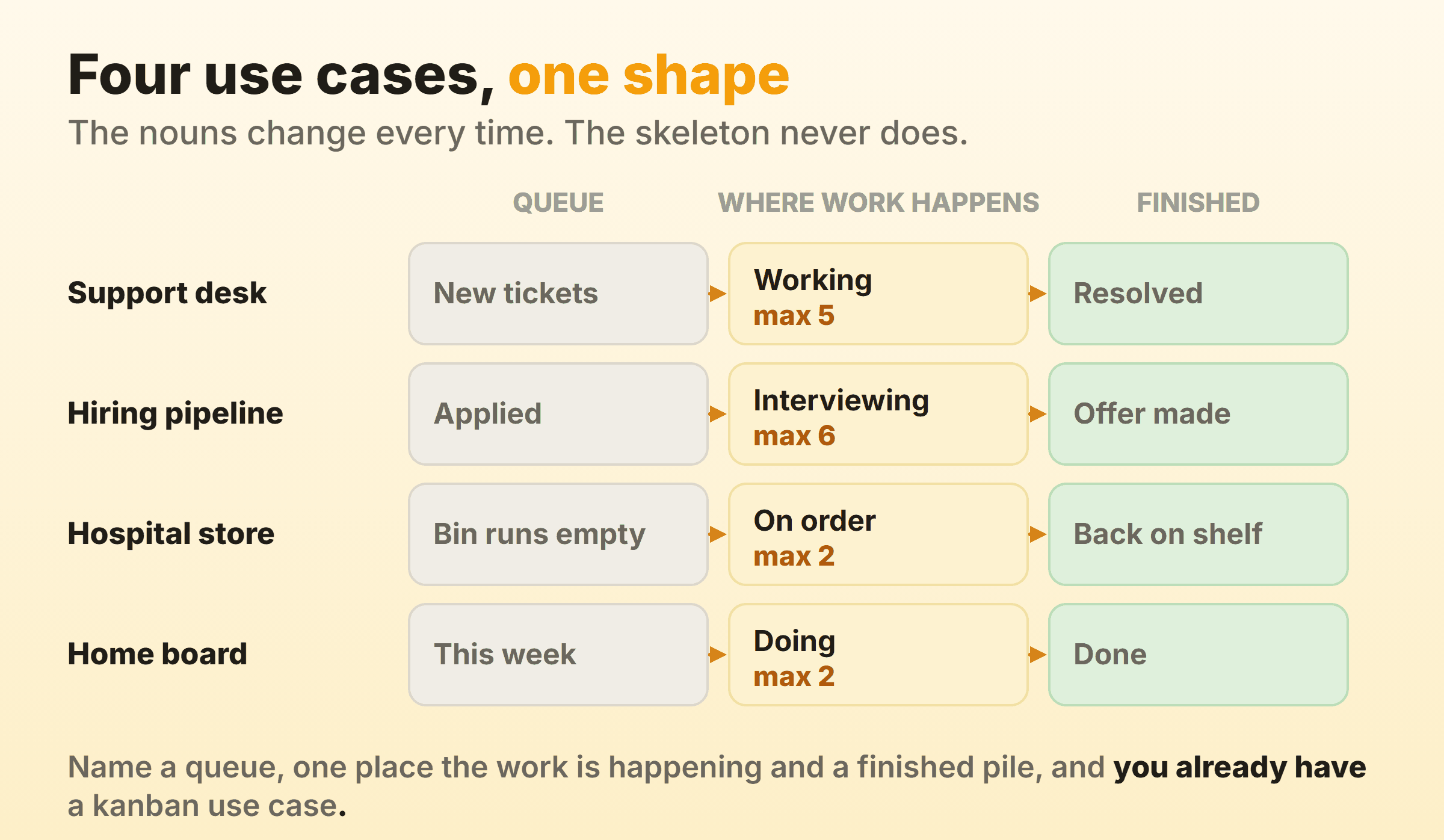
The middle box is where the method lives. Everything else is a list. A queue is a list, a done column is a list, and neither one changes how anybody behaves. The number on the middle column does, because it makes finishing the only legal way to start.
That gives you a rough test for whether a group is running kanban or just owns a board. Ask what happens when the capped column is full. If the answer is that somebody goes and finishes something, the system works. If the answer is that somebody adds another card, the board is wallpaper.
The card lifecycle is identical everywhere too. A card gets created, it waits, someone pulls it, it moves through states, sometimes it goes backwards, and it lands in done. Whether the card stands for a bug, a job applicant, a box of surgical gloves or a load of laundry changes nothing about the mechanics.
Where Is Kanban Used Inside a Company?
Kanban is used inside a company anywhere work arrives from outside the team and has to queue: software delivery, IT operations, marketing, sales, recruitment, accounting and support. These are the highest-volume kanban use cases in business, and they share the trait that makes the upkeep worth it, which is that requests keep coming whether or not anyone is ready for them.
IT and Software Teams
IT kanban covers two different jobs that teams run on one board and should not. Project work has a beginning and an end. Operations work does not.
A software team board tracks features and bugs through states like ready, in progress, in review and released. Kanban for IT operations tracks maintenance windows, live incidents, access requests and monitoring alerts, so its columns look more like triage, investigating, fixing and verified. Push both kinds of work through one column set and you get a board where a two-minute password reset sits beside a six-week migration and neither one is legible.
The usual fix is a swimlane per work type, each with its own share of the cap, so an incident never gets to eat the whole team’s capacity by default. Kanban in IT departments tends to live or die on that split.
Support and Helpdesk Queues
Kanban for helpdesk support ticket queues works because a ticket queue is already a kanban system with the board missing. Tickets arrive, wait, get picked up, wait again on the customer, and close.
The column that earns its place on a support board is the one for waiting on the requester. Most helpdesks count a ticket as open work while it sits with the customer, which quietly inflates every workload figure in the room. Split that state into its own column and the number of tickets the team is genuinely working on stops being a fiction.
Marketing Teams
A marketing kanban board tracks campaigns, content and events through production stages rather than through calendar dates. Typical columns run ideas, briefed, in production, in review, scheduled and live.
Kanban for marketing has a wrinkle other functions do not. Marketing work arrives as clusters of small parallel pieces, a landing page and four emails and a set of ads, all belonging to one campaign. So you choose: one card per campaign with subtasks inside it, or one card per deliverable tied together with a shared label. Cards per deliverable measure better, because you can see which stage the individual pieces jam in. Cards per campaign read better in a status meeting. Pick by whichever conversation you have more often.
Kanban email production is the same shape as content. A queue of drafts, a capped writing column, a review column, a scheduled column. Nothing exotic.
Sales and Client Onboarding
A sales board turns pipeline stages into columns and every deal into a card, so dragging a card is the status update. Kanban for client onboarding is that same board pointed at the weeks after the contract is signed: kickoff booked, access granted, data migrated, training done, live.
Onboarding is a better first use case than sales, for a slightly unfair reason. Onboarding steps belong to you. You control every column, so a stalled card is a real problem you can fix. Sales columns depend on a buyer replying, and no cap on earth makes somebody answer an email.
Recruitment and Hiring
A kanban board for recruitment maps the hiring pipeline to columns: applied, screening, interviewing, offer, hired. The cap goes on interviewing, and it is the most useful number on the board, because interview capacity is a genuinely fixed thing measured in hours from busy senior people.
Hiring pipelines tend to fail at the same spot, which is candidates aging in screening while everyone reassures each other that the funnel looks healthy. A board makes the age visible. That is the entire benefit, and it is enough.
Which Industries Use Kanban Outside Software?
Outside software, kanban is used in healthcare, construction, restaurants and anywhere that holds spare parts, and in those settings the cards usually stand for physical things rather than tasks. This is closer to what the method originally was. Toyota’s version signalled that a bin had been emptied and needed refilling, and the card travelled with the material.
Healthcare and Hospitals
Kanban in healthcare is mostly a supply system rather than a task board. A hospital kanban runs two bins per item. Staff take stock from the front bin, and the moment it empties, the bin itself goes to a collection point as the reorder signal while the second bin covers the wait.
Healthcare kanban holds up there because nobody has to remember to reorder, count anything, or fill in a form. The empty bin is the paperwork. Hospital kanban shows up in a second form as well, on patient flow boards in emergency departments, where columns are stages of care and the real cap is beds.
Supply cupboards are the safe version of this. Clinical scheduling is a much harder problem and I would not claim a board solves it out of the box.
Construction
Kanban in construction gets used for site logistics and the trade sequence rather than for the master programme. A kanban board for construction typically tracks work packages through ready, in progress, inspected and signed off, with the cap set by how many work faces are actually open.
Construction has its own version of the queue problem, which is a trade turning up before the preceding trade has finished. That is a work in progress problem wearing a hard hat, and the board at least makes it arguable with something other than raised voices. Materials on site are a straight two-bin case: rebar, fixings, consumables.
Restaurants and Kitchens
A kanban restaurant setup covers two separate things. The pass, where tickets flow left to right and the cap is how many covers the line can hold at once. And the store cupboard, which runs exactly the same two-bin refill as a hospital.
Kitchens have run kanban for decades without ever calling it that. The ticket rail is a board.
Spare Parts and Slow-Moving Stock
Kanban for low turnover slow moving parts is where the standard advice breaks. Classic kanban assumes consumption is steady enough that a fixed bin size covers the reorder lead time. A part used twice a year does not behave like that at all.
The working approach is to split the catalogue. Kanban for high and low turnover parts means running bins and cards for the fast movers, which are most of the volume and almost none of the part numbers, then putting the slow movers on a min-max reorder point instead. Forcing kanban onto low turnover parts goes one of two ways. Either you tie up cash in bins that sit full for a year, or you shrink the bin until a single unexpected order causes a stockout. The kanban inventory system guide covers bin sizing and the reorder maths properly.
How Do People Use Kanban Outside Work?
Outside work, kanban turns up as a personal board on a wall and a family kanban board on the fridge. Same three columns, much smaller cap.
A home kanban board is usually four: this week, doing, waiting on, done. The waiting column matters more at home than at the office, because domestic work stalls on other people constantly, on a delivery or a reply or a form somebody else has to sign. A kanban board for home works best capped at two per person, and it fails for a predictable reason. Nobody wants to file status updates about their own house.
Physical beats digital here far more often than it does at work. Kanban post it notes on a fridge door, a whiteboard in the hallway, index cards in a magnetic tray, all of them get looked at, because they are physically in the way. An app you have to open is not in the way. Jim Benson and Tonianne DeMaria Barry’s book Personal Kanban made the two-rule version of this popular: visualise your work, limit your work in progress. For one person that is the whole method.
Freelancers land in between the two. A freelance board carries a column employed people never need, which is invoiced but unpaid, and it is usually the column that changes behaviour fastest.
What Changes When the Team Is Remote?
Remote kanban changes one thing, and it is not the columns. The board stops being a shared object in a room and becomes the only place the work is visible at all, which makes a wrong card much more expensive than it used to be.
Three things reliably go wrong on a shared kanban board when nobody sits together:
- Cards get updated at the end of the day rather than when the state actually changed, so the board is a daily report pretending to be a live picture
- Blocked work goes quiet, because in an office somebody would have grumbled about it out loud by lunchtime
- The team kanban board fills up, since starting one more thing costs nothing when no one watches you do it
The fixes are dull. Make the card, not the chat thread, the place a blocker gets written down. Walk the board in the standup instead of going person by person. Cap the columns tighter than you would in a room, because remote teams overcommit more easily than co-located ones.
Kanbanee handles the sharing side with per-board invites by email or link, Editor and Viewer roles, and a per-column cap that shows a count / limit badge which turns red once the column goes over. The limit stays soft and the drag is never blocked, because a hard block only teaches people to park work somewhere dishonest. Two things worth knowing before you lean on it: there is no realtime sync, so the board polls rather than updating live, and dragging columns is desktop only. Picking the numbers is covered in the WIP limits guide.
Which Use Cases Does Kanban Handle Badly?
Kanban handles four kinds of work badly, and not one of them is an industry. They are shapes.
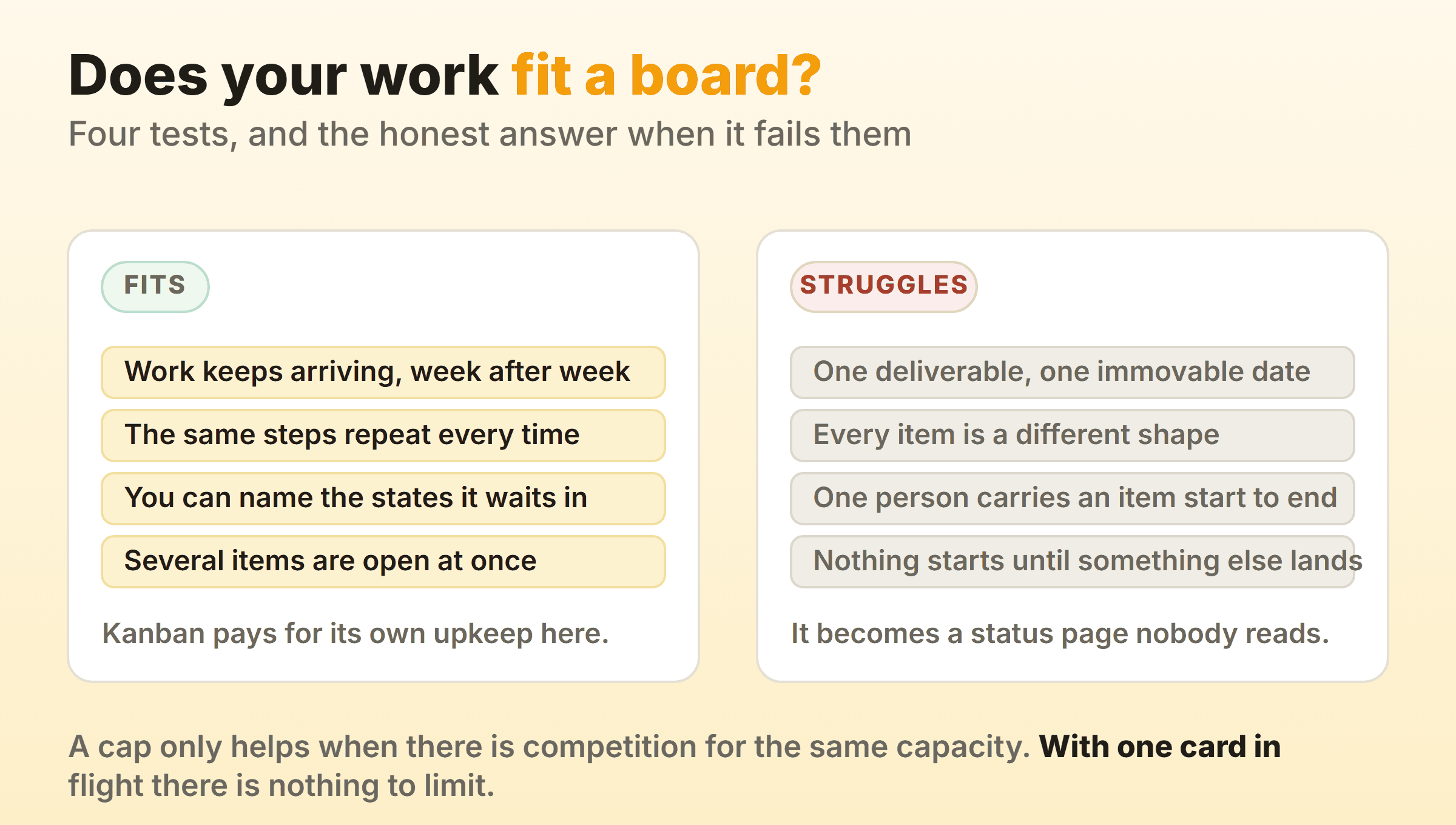
One deliverable with one immovable date. A conference, a building handover, a regulatory filing. Work with a single fixed endpoint and heavy dependencies between tasks is what critical path methods and Gantt charts were built for, and a board will not tell you whether the path is slipping.
Steps that run once and never repeat. Kanban improves a process by letting you watch the same steps happen many times and then fix the one that keeps jamming. Run the steps once and there is nothing to learn from.
Work where one person carries an item start to finish. No handoffs means no queues between stages, and queues between stages are the thing a board exposes. A solo consultant running discovery, analysis and write-up on a single project ends up with a to-do list plus ceremony.
Everything stuck behind one gate. If nothing can start until a legal review, a client approval or a hardware delivery lands, the constraint sits outside your board entirely. Capping your own columns will not shift it.
The honest boundary is this. Kanban needs competition for the same capacity. Cap a column when three people want it and you have forced a useful argument into the open. Cap it when one item is in flight and you have added an admin step to a single task.
How Do You Know a Kanban Use Case Is Working?
You know a kanban use case is working when items finish faster, not when the board looks tidy. Two measurements answer that, and both are simple enough to keep in a spreadsheet.
Little’s law in kanban gives you the first. Average cycle time equals average work in progress divided by average throughput. Nine items in progress and three finished a week means items take about three weeks each. Nothing in that equation lets you go faster by starting more, which is why kanban little’s law gets quoted so often. Halve what is in flight and the wait halves too, at exactly the same output rate. Arithmetic, not technique.
Aging work in kanban gives you the second, and it is the one to check first. Age is how long a card has been on the board since work on it started. Sort every in-progress card by age and read the top of the list. The oldest card is nearly always the one nobody has mentioned in a week, and it is the reason the average looks the way it does. Cycle time reports what already happened. Age reports what is going wrong right now, while there is still time to act on it. Throughput, cumulative flow and cycle time are covered end to end in the kanban metrics guide.
FAQ
Why is it called kanban?
Kanban is a Japanese word normally translated as signboard or billboard, built from characters for looking and for a board. Toyota chose it because the original artefact was a physical card that travelled with a bin of parts and signalled that more were needed. The name points at the signal, not at the columns, which is why a kanban board is called a kanban board even when it holds no cards at all. The board is just where the signals live.
Is there a certification for running kanban in a team?
Yes. Kanban University runs Team Kanban Practitioner, which it publishes as a one-day class in person or eight hours online, aimed at people working inside a team rather than designing a system, covering boards, work in progress limits and flow. It is the entry point to their certification ladder. Said plainly: nobody needs it to run a board. Team kanban practitioner training earns its keep when you are the person who has to win the argument in a room of sceptics.
Can you use kanban for one-off events?
Partly. An event has a fixed date and a checklist that runs once, which is the wrong shape for a board. What does suit a board is the repeating production around the event, meaning assets, emails, speaker logistics and follow-up, all of which have real stages and real queues. Teams running kanban events usually keep a board for production and a plain dated checklist for the day itself.
Does kanban work for innovation and research?
Kanban for innovation works if you accept the columns will be wrong at first. Research does not have known states in advance, so the board starts as three columns and earns extra ones only when a queue genuinely appears. What transfers cleanly is the cap. Limiting how many experiments run at once is useful whether or not anybody can name the stages yet.
Can you run your inbox as a kanban board?
Yes, and it is one of the more common personal setups. Columns are usually needs a reply, waiting on them, and done, with the cap on needs a reply. It works because inbox stress is rarely about volume. It is about holding an untracked list of open threads in your head. It stops working the moment you have to hand-copy messages into cards, so pick a setup where the message and the card are the same object.
Kanban Use Cases in More Depth
Four of these have guides of their own:
- Kanban for software teams covers columns that match a real dev workflow, WIP limits that expose the code review queue, and where the board hands off to CI/CD.
- Kanban for sales covers pipeline stages as columns, deals as cards, and how to measure average deal lead time.
- Enterprise and portfolio kanban covers what changes when the cards are whole initiatives, the six SAFe states, and where the caps go above team level.
- Kanban for students covers coursework on a board, why the cap belongs in study hours rather than cards, and group projects.